
A rigorous architectural pattern establishes strict responsibility boundaries between transport, application logic, domain modeling, and persistence to combat entropy in long-lived backend systems.
Backend systems often start clean but degrade into unmaintainable complexity as responsibilities bleed across layers. Controllers accumulate business logic, repositories enforce domain rules, and DTOs morph into universal data carriers. This architectural entropy makes systems brittle and difficult to modify. The solution isn't more layers—it's clearer ownership boundaries.
Why Naïve Layering Collapses
Traditional layered architectures fail because they prioritize technical separation over semantic responsibility. Business logic becomes distributed across controllers, services, and repositories, creating hidden couplings. Changes require understanding how data flows through multiple tiers, making simple modifications risk-prone. The core failure mode: Responsibility diffusion, where no component owns complete decision-making authority.
The Four-Pillar Model Taxonomy
This architecture enforces strict model segregation based on lifecycle and purpose:
HTTP DTOs (Transport Envelopes)
- Only concern: API contract stability
- Contain transport-specific metadata and formatting
- Never reused outside controllers
Application Entities (Service Contracts)
- Define inputs/outputs for business use cases
- Transport-agnostic and persistence-agnostic
- Enable service reuse across delivery mechanisms
Domain Models (Behavioral Truth)
- Own business invariants and state transitions
- Exist only in valid states
- Never serialized directly or exposed externally
Persistence Entities (Storage Adaptations)
- Pure database schema representations
- Zero business logic
- Optimized for storage efficiency
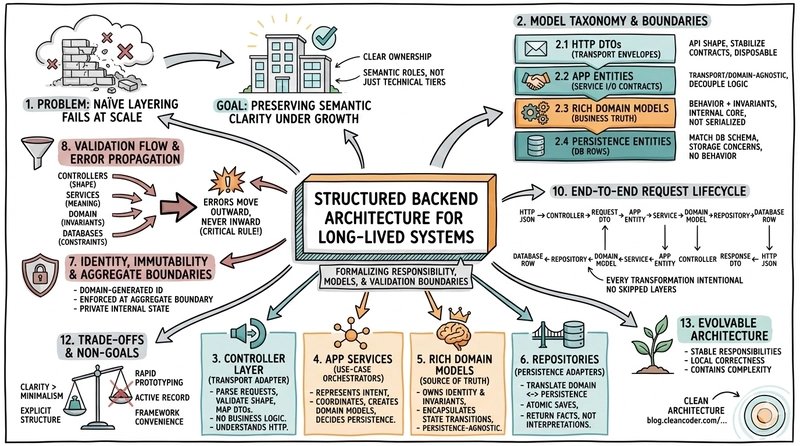
Enforcing Layer Autonomy
Controllers: The Protocol Adapters
Controllers strictly convert HTTP requests into application entities and vice versa. They handle:
- Request validation (syntax/structure)
- DTO ↔ Entity translation
- Error translation to HTTP codes
No business logic resides here. This isolation allows API evolution without service-layer contamination.
Application Services: Use-Case Embodiment
Services orchestrate business workflows:
- Accept application entities
- Load domain aggregates
- Enforce cross-aggregate rules
- Execute state transitions
- Return domain models or projections
Crucially, services never handle persistence directly—they delegate to repositories after ensuring domain validity.
Domain Models: The Invariant Fortress
Domain objects are the system's truth source:
- Identity generation
- State transition validation
- Local invariant enforcement
- Encapsulated mutation
They expose state only through controlled methods or defensive copies (toData() pattern), preventing external corruption.
Repositories: Persistence Translators
Repositories strictly convert between domain snapshots and database rows:
- No business rule enforcement
- No domain logic interpretation
- Pure CRUD with atomic guarantees
If removing a repository constraint changes business behavior, that rule belongs elsewhere.
Validation Flow: The Fault Cascade
Validation follows a strict directional flow:
- Controllers: Validate request structure
- Services: Validate use-case preconditions
- Domain: Enforce invariants during state changes
- Database: Enforce data integrity constraints
Errors propagate outward—never caught and reinterpreted by inner layers. This ensures:
- Fail-fast behavior
- No partial persistence
- Clean error semantics
Trade-Offs and Conscious Limitations
This architecture prioritizes longevity over convenience:
| Gain | Cost |
|---|---|
| Clear change boundaries | Increased mapping boilerplate |
| Independent evolution | Steeper initial learning curve |
| Localized reasoning | Not optimized for rapid prototyping |
| Protected domain invariants | Rejects Active Record convenience |
Optimistic concurrency is the default stance. Transactions ensure atomicity—not semantic correctness—with stricter consistency introduced only when business requirements demand it.
Why This Scales Evolutionarily
The architecture's longevity comes from stable interfaces:
- API changes affect only controllers
- Database migrations touch only repositories
- Business rule updates modify domains/services
Engineers modify systems by understanding one bounded context rather than deciphering global interactions. As MongoDB Atlas demonstrates with its document model flexibility, clear data ownership boundaries enable adaptation—whether scaling AI workloads or evolving transactional systems. This pattern doesn't eliminate complexity; it corrals it into properly fenced pastures.
The Cardinal Rule: Errors flow outward, never inward. Controllers alone decide HTTP error representation.
Comments
Please log in or register to join the discussion