Organizations implementing personalization face systemic challenges that extend beyond technology. A structured prepersonalization workshop framework addresses organizational alignment, technical readiness, and ethical design principles before implementation begins.
The promise of personalization—digital experiences that adapt to individual needs—often collides with the reality of organizational complexity. When Spotify's DJ feature debuted, it represented not just technical achievement but years of groundwork in metadata architecture and user understanding. This gap between aspiration and execution is where personalization initiatives stumble, manifesting in 'persofails' like algorithmic recommendations gone absurdly wrong. The solution lies not in better algorithms alone, but in what precedes them: structured organizational preparation through what we term 'prepersonalization.'
The Personalization Paradox
Personalization fails when treated as a feature rather than a practice. It requires continuous refinement across three evolutionary stages: basic experimentation (A/B testing), rules-based automations, and finally mature product features. Yet most organizations leap directly to solutions without establishing shared understanding across stakeholders. The consequences range from technical debt accumulation to eroded user trust when personalization feels intrusive or irrelevant.

Why does this happen? Marketing teams prioritize customer experience metrics while engineering focuses on system capabilities. Legal concerns over privacy compliance remain siloed from design teams crafting interfaces. Without alignment, organizations build on fractured foundations. This is where the prepersonalization workshop intervenes—not as a planning exercise but as an organizational therapy session.
Mapping the Territory
At its core, the workshop framework creates a shared language for cross-functional teams. Through card-based exercises derived from interaction pattern libraries, participants map 'connected experiences'—UX scenarios requiring orchestration of backend systems like CMS platforms combined with customer data platforms. This visualization accomplishes three critical tasks:
- Complexity Assessment: Teams score implementations across five levels (functions → features → experiences → products → portfolios) to gauge effort required
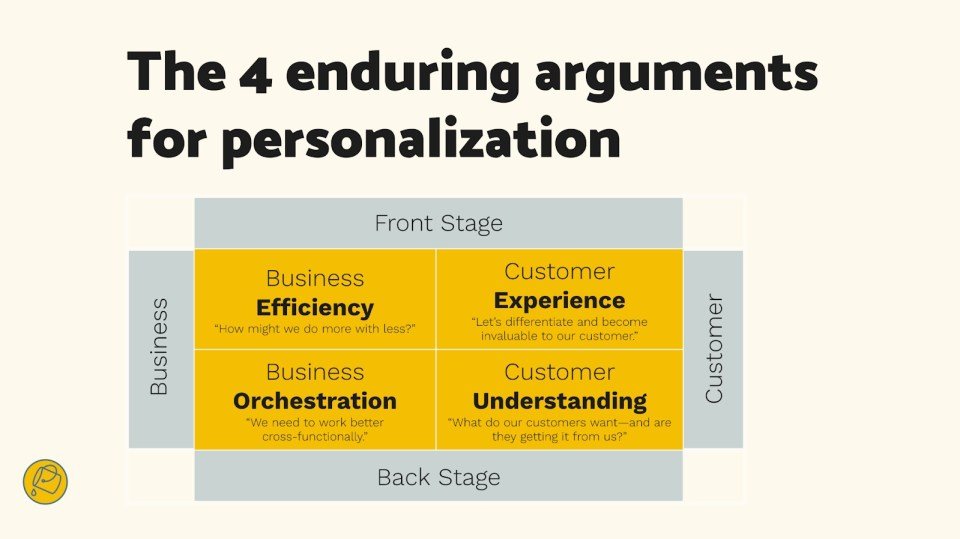
- Outcome Alignment: Using a 2×2 grid, stakeholders articulate whether personalization should prioritize business efficiency, customer experience, business orchestration, or customer understanding
- Gap Analysis: Documentation of metadata deficiencies, privacy hurdles, and journey mapping gaps that become technical debt if unaddressed
The Ingredient Imperative
Personalization's building blocks—audience segments, content elements, contextual triggers—function like culinary ingredients. Just as a recipe fails without quality components, personalized experiences crumble without:
- Audience Integrity: Precisely defined segments avoiding problematic profiling
- Content Readiness: Structured content with consistent metadata schemas
- Contextual Awareness: Ethical triggers based on legitimate user signals
- Measurement Cohesion: Unified success metrics across departments
Documenting these as 'if-then' statements creates organizational muscle memory. For a reading app, this might materialize as:
When a new user registers (WHO), deliver an onboarding email (WHAT) highlighting genre diversity (CONTENT) triggered post-registration (WHEN) to increase engagement (WHY).
Beyond the Workshop
Implementation challenges persist—especially regarding metadata debt. Spotify's success traces directly to its acquisition of The Echo Nest, which solved fundamental information architecture problems. Similarly, effective personalization demands confronting uncomfortable truths about content structure and data hygiene long before algorithm tuning.
The workshop's true value emerges in its aftermath: prioritized backlogs where 'nurture automations' and 'winback campaigns' compete through structured pitching sessions. Teams exit not with solutions but with shared understanding of constraints and possibilities—the essential foundation for personalization that feels less like surveillance and more like service.
The Human Algorithm
In the rush toward AI-driven experiences, we forget that effective personalization is fundamentally human-centered. It requires acknowledging that:
- Organizational readiness trumps technical capability
- Metadata quality determines output relevance
- Ethical boundaries must precede feature development
The prepersonalization workshop formalizes these truths. By making implicit assumptions explicit and undocumented gaps visible, it transforms personalization from technological fantasy into disciplined practice—one where the distance between toilet seat recommendations and genuinely useful experiences shrinks through deliberate preparation rather than algorithmic alchemy.
Comments
Please log in or register to join the discussion