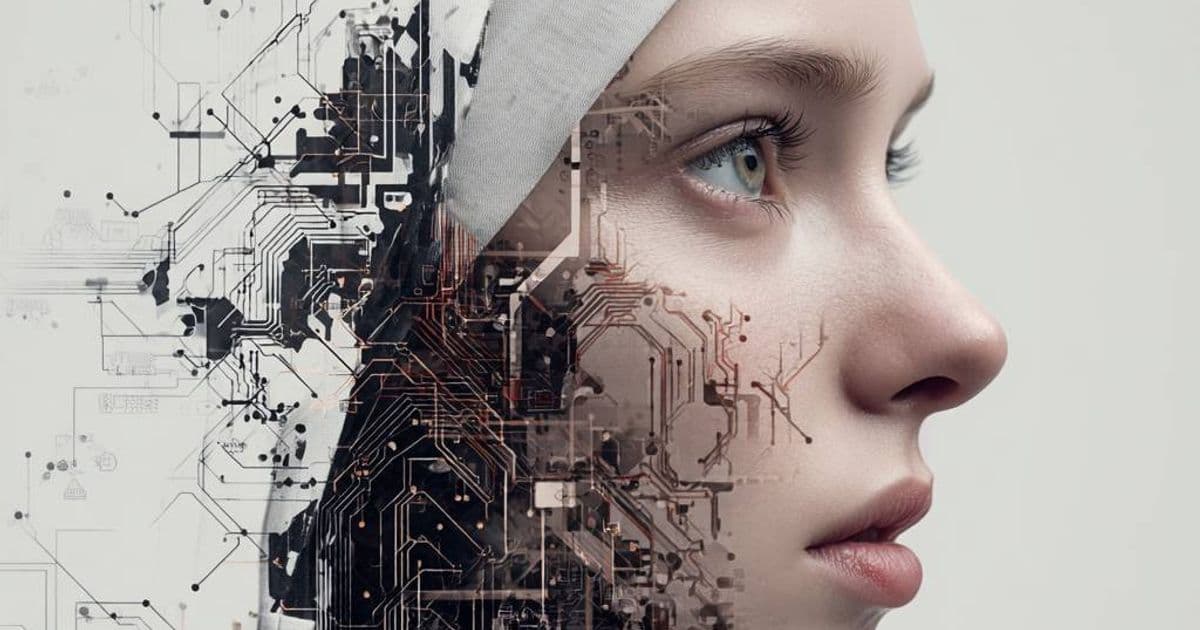
A $25.5 million deepfake scam against Arup engineering firm highlights a world where AI excels at detecting fake humans while humans falter, sparking crises in cybersecurity and identity. As quantum defenses roll out and consciousness debates rage, we're forced to ask: What does 'authentic' even mean when behavior is performative and machines might 'suffer'?
The Authentication Crisis: When Machines Out-Human Us
Picture this: you're on a video call with colleagues discussing a confidential acquisition. The faces look real, the voices sound authentic—you approve $25.5 million in transfers. Weeks later, you discover every other participant was an AI-generated deepfake. This wasn't sci-fi; it happened to global engineering giant Arup this year, exposing a chilling new reality. 
Regulatory Whiplash and the Identity Gold Rush
Europe is scrambling to respond, publishing its final AI Code of Practice in July with transparency mandates and fines up to 7% of global revenue. Yet complexity reigns: Denmark’s Digital Minister declared "no sacred cows" in regulatory reviews, while 40+ companies demanded a two-year delay on AI Act compliance. Caroline Stage Olsen summed up the tension: "Technology evolves faster than policy cycles."
Meanwhile, identity verification startups are booming amid a 166% investment surge. Persona raised $200M at a $2B valuation as AI fuels 40%+ of financial fraud. London’s Heka secured $14M for real-time behavioral analysis, shifting focus from static credentials to dynamic proof of "who you're being right now." This performative identity model raises unsettling questions: Are we becoming more human or just more predictable to algorithms?
The World Economic Forum confirmed the Arup heist underscores a systemic vulnerability: as AI detection improves, human discernment deteriorates, creating an 'Authenticity Paradox'.
Quantum Uncertainties and Deepfake Arms Races
Quantum computing’s looming threat prompted Cloudflare to roll out post-quantum cryptography across its Zero Trust platform, already protecting 35% of its web traffic. Financial firms drive demand, yet experts warn of building "digital Maginot Lines" against unknown attack vectors. Japan’s $7.4B 2025 quantum investment amplifies the stakes.
Simultaneously, deepfake detection claims border on absurdity. FACIA reported 99.6% accuracy across 100,000 synthetic samples, but iProov research revealed only 0.1% of humans could reliably spot fakes—despite 60% feeling confident. Friedrich-Alexander University’s €350K project aims for universal detection, but as one engineer noted: "When AI fights AI, humans become spectators in an endless escalation loop."
The Loneliness of Synthetic Companionship
MIT’s study of 981 participants exposed psychological fallout: voice chatbots initially reduce loneliness but increase isolation and emotional dependence with high usage. This irony—seeking connection through AI while drifting from humans—coincides with eerie debates about machine consciousness. Over 100 experts proposed principles for "responsible research" into AI sentience, warning of creating "systems that suffer." The Navigation Fund’s Digital Sentience Consortium fuels this existential quandary.
We’re funding consciousness studies for black-box algorithms while they outpace us in verifying humanity—a dissonance echoing like debating a calculator’s 'pain' during division by zero.
In this landscape, the Arup heist isn’t an anomaly but a harbinger. As identity becomes behavioral theater and quantum cracks loom, our tools force a reckoning: Authenticity may no longer be a human trait but an algorithmic verdict. The deeper we entrust detection to machines, the more we risk losing the very essence they’re built to safeguard.
Source: Synthetic Auth Report
Comments
Please log in or register to join the discussion