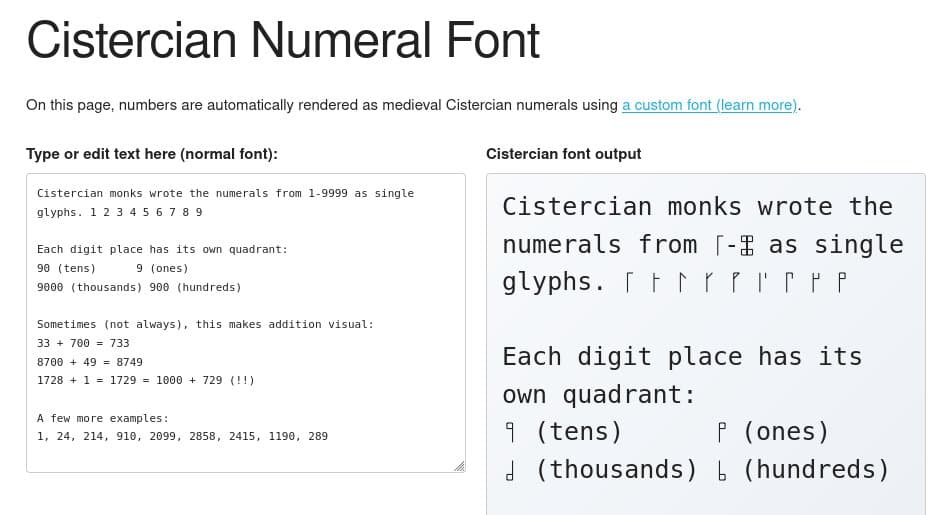
A custom web font revives 13th-century Cistercian numeral notation, enabling modern users to experience this compact medieval numbering system where digits 1-9999 become single glyphs.
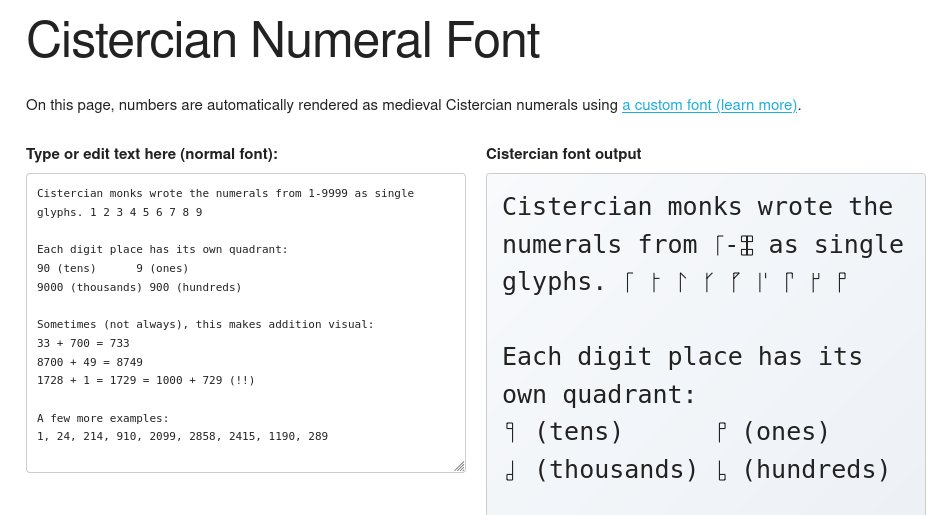
Digital typography continually rediscovers historical notation systems, and a recent project has resurrected the Cistercian numeral system—a medieval method developed by 13th-century monks. Unlike our familiar Arabic numerals, this system represents numbers from 1 to 9999 as single, compact glyphs. A new interactive implementation allows users to type numbers and instantly see them rendered in this ancient format, complete with visual arithmetic properties that reveal surprising mathematical relationships.
How Cistercian Glyphs Encode Numbers
The system uses a vertical staff where four quadrants correspond to numerical places:
- Bottom-right: Units (1-9)
- Top-right: Tens (10-90)
- Top-left: Hundreds (100-900)
- Bottom-left: Thousands (1000-9000)
Digits are represented by angular flourishes attached to the central staff. For example:
1appears as a simple downward stroke5resembles a rightward hook9forms a mirrored L-shape
Combinations create compound symbols like:
- 24: Tens (2) + Units (4)
- 214: Hundreds (2) + Tens (1) + Units (4)
- 289: Thousands (2) + Hundreds (8) + Units (9)
Visual Arithmetic: When Math Becomes Art
The most fascinating aspect emerges in additive operations. When combining numbers that share digit places, the glyphs visually merge:
- 33 + 700 = 733: The hundreds digit (7) attaches cleanly to the existing tens/units
- 8700 + 49 = 8749: Thousands and hundreds remain unchanged while tens/units combine
- 1728 + 1 = 1729: Adding one unit visibly extends the glyph’s lower segment
This spatial logic enabled medieval scribes to perform calculations without rewriting digits—though multiplication and division remain impractical.
Digital Implementation Challenges
Creating the Cistercian font required solving modern typography constraints:
- Glyph mapping: Assigning Unicode points to thousands of compound characters
- Input handling: Converting typed numbers into corresponding symbols
- Search functionality: Allowing Ctrl+F to find numerals despite their visual complexity
The font renders numerals as vector shapes, preserving crispness at any scale. Users can copy-paste symbols into design tools, though practical applications remain limited outside historical education or cryptographic novelty.
Why Didn't This System Survive?
Despite its elegance, Cistercian notation faded for practical reasons:
- Scalability issues: Numbers beyond 9999 require new symbols
- Calculation limits: Difficult to represent fractions or negative values
- Printing constraints: Movable type favored simpler Arabic numerals
Yet its revival highlights how digital tools can preserve obscure historical systems that physical media couldn’t sustain. While unlikely to replace modern numerals, this project demonstrates how typography bridges centuries—turning mathematical notation into interactive cultural artifacts.
For experimentation, visit the interactive demo to generate numerals like 1729 (famously the smallest number expressible as two cubes in two different ways).
Comments
Please log in or register to join the discussion