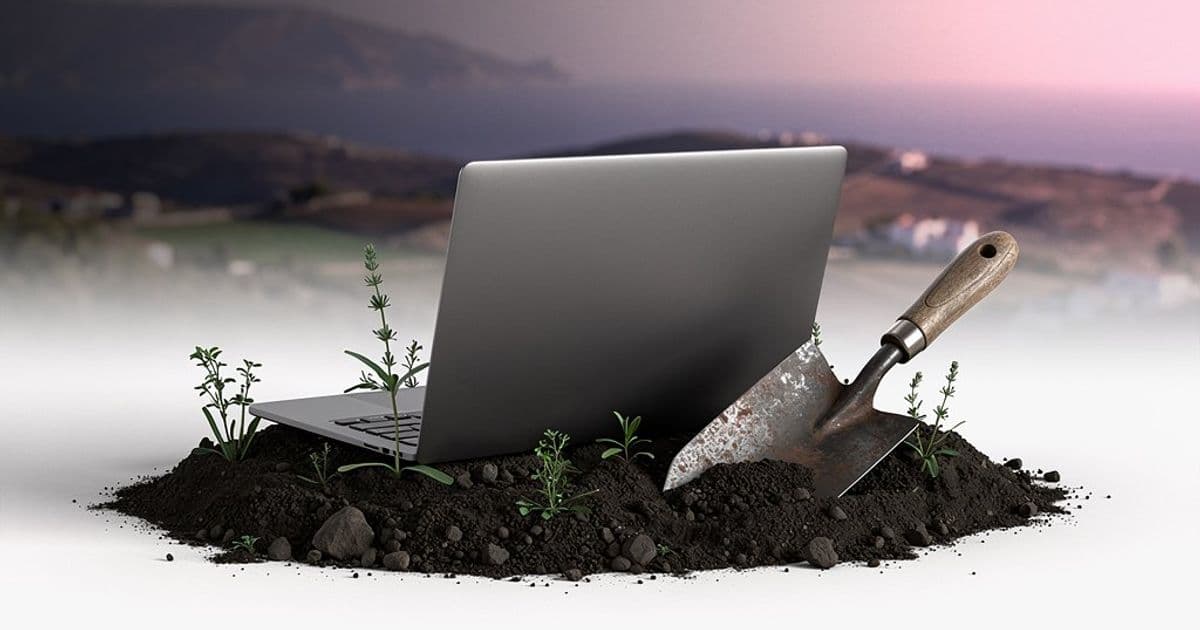
Dylan Araps, known for creating Neofetch and other popular open-source tools, shares his journey from a sedentary software engineer to a natural farmer in Greece, detailing the burnout that led to his disappearance and the spiritual and physical transformation that followed.
The tech community has a fascination with disappearances and comebacks. When Dylan Araps, the creator of Neofetch, Pywal, and the KISS Linux distribution, vanished from the internet in 2021, it sparked speculation. His return in 2024 with a cryptic message about having "taken up farming" only deepened the mystery. Today, he breaks his silence to tell his story and announce WILD.gr, a small-scale natural farming project on the Greek island of Euboea. This isn't a tale of a disillusioned programmer romanticizing agrarian life from a cabin; it's a raw account of burnout, spiritual crisis, and a deliberate, methodical reinvention.
For years, Araps was a fixture in the open-source world, celebrated for his prolific output and the utility of his projects. His work ethic was legendary, characterized by 16-hour days and rapid responses to messages. He was the "wizard" behind the screen, crafting tools that made other developers' lives easier. This persona, however, came at a severe personal cost. The constant demand to maintain complex projects and uphold the wizard image led to a gradual decline. His physical health deteriorated: hunched posture, muscle weakness, chronic cough from smoking, and a diet of meat, potatoes, and junk food. He was dependent on substances to regulate sleep and wakefulness. The very work that defined him was consuming him.
The breaking point was a severe, recurring burnout cycle. He describes periods where he would be physically unable to write code, his brain "fried." This culminated in an existential crisis. Looking at his life, he asked himself a fundamental question: "What am I doing with my life?" The answer was stark. He was dedicating his existence to making pixels light up differently on a screen, all while systematically destroying his own health in the process. The realization was so profound that he stopped entirely, abandoning all effort and disappearing from the digital world he had helped shape.
With the void left by his 16-hour coding days, Araps turned to reading. He purchased a Kindle, jailbroke it, and filled it with public domain literature. A recurring theme in everything he read was the Bible, a book he had never read. He decided to read the King James Version cover to cover. This immersion led to a spiritual awakening. He describes the experience as a mirror being held up to him, revealing a life steeped in what he came to see as sin—weakness of mind, ruled by bodily desires. He felt he was on the "broad road" alongside liars, thieves, and fornicators, a realization that shocked him into a desire for change.
Over the next three years, he embarked on a rigorous personal transformation. He quit all vices cold turkey: alcohol, tobacco, marijuana, caffeine, sugar, pornography, masturbation, gaming, and processed food. He adopted a plant-based diet, inspired by his great-grandparents' eating habits—local, seasonal, whole foods. He took up calisthenics, yoga, and barefoot running to reverse years of postural damage. This holistic approach restored his vitality, resolving his chronic cough, sleep issues, and headaches.
Faced with the question of what to do with his renewed life, Araps arrived at a spiritual conclusion: from a moral perspective, the only two meaningful career paths are farmer or artisan. He chose farmer. Not an industrial farmer, but a "Natural Farmer." He sought to work outside with his hands, to reconnect with the physical world he had neglected for so long. In 2018, his family had moved from Australia to Greece. In 2024, he, his brother, mother, and grandmother acquired an abandoned estate in the village of Amphithea on Euboea. They named their venture WILD.
WILD is not a large-scale agricultural operation. It is a small, family-run project focused on producing natural food—olives, grapes, and other local produce—using methods that align with nature. There is no tractor driving across vast fields, no manifesto from a woods cabin. It is a quiet, deliberate return to the land, a stark contrast to the high-paced, screen-dominated life he left behind.
Araps's story presents a counter-narrative to the prevailing tech ethos of optimization and growth. While the industry often champions "work-life balance" within the confines of digital work, his journey suggests a more radical solution: a complete physical and spiritual reset. His disappearance and subsequent return challenge the assumption that a successful tech career is the ultimate goal. For some, the constant stimulation and abstraction of software development can lead to a profound disconnect from the self and the physical world. His turn to farming, reading, and spirituality represents a search for meaning beyond the screen, a return to tangible, fundamental activities.
His experience also highlights the severe, often overlooked consequences of chronic overwork and burnout in the developer community. The "wizard" persona, while celebrated, can be a trap, leading to unsustainable expectations and personal neglect. Araps's physical decline—postural problems, chronic illness, substance dependence—serves as a cautionary tale. His recovery required not just a break, but a complete overhaul of his lifestyle, diet, and daily practices.
The announcement of WILD.gr marks the end of his hiatus and the beginning of a new chapter. It is a project born not from a desire for fame or influence, but from a need for healing and purpose. By sharing his story, Araps provides a rare, unvarnished look at the personal cost of a life spent in front of a computer and the arduous path to recovery. His journey from creating tools that run on screens to cultivating food that grows in soil is a powerful testament to the human need for balance, connection, and a life grounded in the physical world.
Comments
Please log in or register to join the discussion