Building business systems on external SaaS tools creates fragile dependencies that break at the worst moments. Here's how autonomous, self-hosted systems provide stability and control.
Most businesses today are running on a precarious stack of SaaS tools. Zapier connects to Make, which triggers plugins, which depend on various subscriptions—all of which require constant updates and maintenance. It works fine until something breaks, and then everything grinds to a halt.
At Palks Studio, we've taken a different approach. Instead of stacking tools, we build autonomous systems that run directly on your infrastructure. No SaaS. No subscriptions. No external dependencies. Just systems that work, simply and reliably over time.
The Problem With Tool Stacking
When your business process depends on five different external services, you don't have a system—you have a fragile chain. Each link represents a potential failure point:
- Service outages
- API changes breaking integrations
- Subscription lapses
- Rate limiting
- Data transfer failures
- Authentication issues
These aren't hypothetical problems. They happen regularly, often at the worst possible moments. A payment processor outage can halt your entire invoicing workflow. An API change can break your automation overnight.
Building Autonomous Systems
The alternative is to deploy systems directly on your own hosting infrastructure. This means:
Internal Scripts: Custom code that handles your specific business logic without relying on third-party services.
Autonomous Tools: Self-contained applications that don't need constant internet connectivity or external API calls.
Direct Infrastructure: Systems running on servers or hosting you control, not someone else's platform.
For example, instead of using multiple SaaS tools for invoicing, you can have a system that handles the entire workflow: quotes → signature → invoicing → payment → revenue tracking. All running on your infrastructure, with no external dependencies.
Real-World Applications
This approach works for various business processes:
Invoicing Without SaaS: Complete billing systems that generate invoices, process payments, and track revenue without relying on external platforms.
Batch Processing: CSV uploads that get processed, structured, and delivered automatically without manual intervention or third-party services.
Internal Tools: Custom applications for your specific business needs that run reliably without constant maintenance.
The Benefits
Building autonomous systems offers several advantages:
Less Complexity: Fewer moving parts mean fewer things that can go wrong.
More Control: You own the entire system and can modify it as needed. Greater Stability: No more worrying about third-party service outages or API changes. Cost Predictability: No recurring subscription fees or usage-based pricing surprises.
The Trade-offs
This approach isn't without trade-offs. You need:
- Technical expertise to build and maintain the systems
- Initial development time investment
- Responsibility for updates and security
- Infrastructure hosting costs
But for many businesses, these trade-offs are worth it compared to the fragility and ongoing costs of tool stacking.
A Simpler Way to Build
There's another way to build business systems—one that's simpler, more stable, and fully controlled. Instead of asking "what tools can I connect together?" ask "what system do I need to run my business autonomously?"
This shift in thinking can transform how you approach business automation. Rather than creating a fragile chain of dependencies, you build robust systems that work reliably, day after day.
Less tools. Less complexity. More control.
That's the essence of building autonomous systems that actually serve your business, rather than creating new problems to solve.
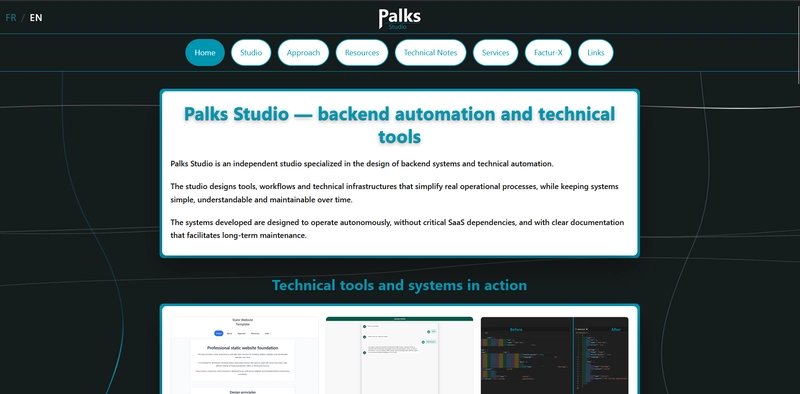
[Autonomous billing and automation system running on a self-hosted infrastructure without SaaS dependencies]
For more information about building autonomous systems, visit Palks Studio.
Comments
Please log in or register to join the discussion