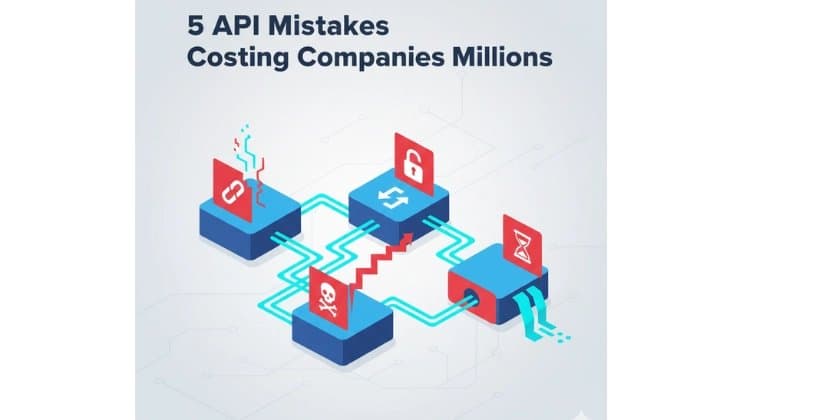
API design flaws in authentication, coupling, traffic management, observability, and governance create systemic risks that escalate into million-dollar failures through security breaches, downtime, and lost business opportunities.
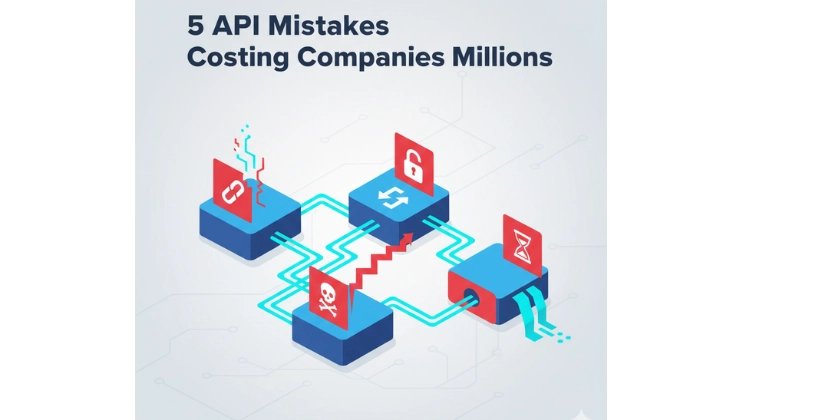
APIs form the circulatory system of modern digital organizations, yet fundamental design oversights routinely transform them into single points of failure. Unlike catastrophic infrastructure failures, API-related losses accumulate through gradual erosion of security posture, partner trust, and operational stability. Having witnessed these failures across financial systems and e-commerce platforms, I've identified five systemic anti-patterns with disproportionate business impact.
1. The Internal API Security Fallacy
Problem: The assumption that internal APIs don't require robust authentication creates porous security boundaries. When services behind the firewall communicate without mutual authentication, compromised credentials or network breaches enable lateral movement. The 2020 Codecov breach demonstrated this, where attackers pivoted from a CI tool to production environments through unauthenticated internal APIs.
Solution Approach: Implement zero-trust principles using OAuth 2.0 for delegated authorization and JWT tokens for stateless authentication. Service-to-service communication requires mutual TLS authentication, validating both client and server certificates. API gateways should enforce policy-based access controls regardless of network origin.
Trade-offs: mTLS introduces certificate management overhead and adds ~5-15ms latency per handshake. Token validation requires cryptographic operations, but hardware acceleration and token reuse strategies mitigate this. The operational burden pales against breach remediation costs averaging $4.35M according to IBM's 2022 report.
2. Tight Coupling Through Implicit Contracts
Problem: APIs that expose backend implementation details create distributed monoliths. When payment services require callers to format requests using database schema structures, any schema change cascades failures across consumers. This coupling caused a major retailer's Black Friday outage when inventory service changes broke checkout APIs, costing $100M+ in lost sales.
Solution Approach: Design APIs around business capabilities using the Bounded Context pattern. Abstract backend details behind facades that expose domain-specific operations. Version APIs semantically from day one using path (/v1/resource) or header versioning. Implement consumer-driven contracts with tools like Pact to validate compatibility.
Trade-offs: Abstraction layers add development effort upfront and may introduce translation latency (~2-5ms). However, loose coupling enables independent scaling and deployment velocity. Versioning doubles maintenance during transitions but prevents costly breaking changes.
3. Uncontrolled Traffic Propagation
Problem: APIs without rate limiting transform client errors into system-wide failures. A mobile app bug triggering recursive requests or a partner system misconfiguration can overwhelm backends. One cloud provider incurred $500K in unnecessary scaling costs when a client loop generated 800M requests in 4 hours.
Solution Approach: Implement layered defenses:
- Global rate limits per API key using token bucket algorithms
- Concurrency limits at gateway level (max open connections per service)
- Bulkhead isolation for critical backend services
- Redis-backed caching for high-cardinality request patterns
Trade-offs: Strict rate limits may throttle legitimate traffic during peaks. Solutions include:
- Dynamic scaling based on queue depth
- Priority queues for premium customers
- Circuit breakers to fail fast during downstream failures
4. Unobservable Failure Modes
Problem: APIs returning generic 500 errors without contextual payloads turn debugging into forensic investigations. When a logistics company's shipment API failed silently on address validation errors, engineers spent 72 hours correlating logs across 12 services to diagnose a 2-line code defect.
Solution Approach: Adopt structured error responses with machine-readable codes (RFC 7807) and actionable details. Implement distributed tracing with OpenTelemetry to track requests across services. Key metrics:
- Error budgets per service
- P99 latency per endpoint
- Business transaction success rates
Trade-offs: Full tracing adds ~3-8% overhead, controllable through sampling. Detailed error responses risk exposing implementation details - mitigate by masking sensitive data in production. Centralized logging requires careful PII handling to avoid compliance violations.
5. Governance Through Tribal Knowledge
Problem: Without formal deprecation policies, API changes break integrations unpredictably. A bank lost a key partner when an undocumented authentication change broke their reconciliation API, terminating a $20M/year revenue stream.
Solution Approach: Institutionalize API governance:
- Machine-readable specs (OpenAPI 3.0)
- Automated change impact analysis
- Three-phase deprecations:
- Announcement with sunset date
- Compatibility period with warnings
- Version retirement with redirects
Trade-offs: Governance slows feature delivery but prevents revenue-impacting breaks. Documentation automation requires discipline but pays dividends through reduced support load. Deprecation timelines must balance innovation velocity with integration stability.
Systemic Resilience Through Design
API failures manifest as financial losses through three vectors: direct breach costs, lost revenue during outages, and erosion of partner trust. Companies treating APIs as technical plumbing rather than business products incur preventable eight-figure losses. The solution lies in embracing distributed systems fundamentals:
- Assume breach - Authenticate all communication
- Design for failure - Isolate components using bulkheads
- Measure exhaustively - Instrument business transactions
- Govern explicitly - Version and deprecate deliberately
APIs compound both risk and opportunity. Invest in their design with the same rigor as core products - your balance sheet depends on it.
Comments
Please log in or register to join the discussion