Exploring the mathematical concept of creating triangular analogs to squircles, examining how continuous functions can transform sharp geometric shapes into smooth curves while preserving their essential characteristics.
The mathematical landscape is filled with fascinating transitions between idealized geometric forms and their more natural, rounded counterparts. Among these transitions, the squircle stands as an elegant bridge between the sharp precision of squares and the perfect symmetry of circles. Recently, a comment on my guitar pick post sparked an intriguing mathematical exploration: what would a true triangular analog of a squircle look like? This question leads us down a path of mathematical discovery that reveals how continuous functions can transform fundamental geometric shapes while preserving their essential characteristics.
Understanding the Squircle
A squircle is not merely a square with rounded corners, as one might initially assume. Instead, it represents a continuous deformation where the sides curve smoothly, with the curvature concentrated most intensely at the corners. Mathematically, a squircle can be defined using the Lp norm, where the boundary consists of points (x,y) satisfying |x|^p + |y|^p = r^p. As p approaches infinity, this shape approaches a perfect square, while for p=2, it becomes a circle. For values between 2 and infinity, we obtain various squircle forms.
The beauty of this mathematical construction lies in its ability to provide a smooth parameterization between two fundamentally different geometric forms. This continuous transition has practical applications in design, engineering, and even nature, where sharp mathematical idealizations rarely appear in their pure form.
The Challenge of Triangular Analogs
When considering a triangular analog, we face a different set of mathematical challenges. Unlike squares, which possess a natural symmetry in both x and y directions, triangles introduce asymmetry and require a more nuanced approach. The comment about a "squircle-ish analog for an isosceles triangle" suggested that existing guitar picks approximated this concept, but a more mathematically rigorous approach was needed.
Triangles are defined by three linear equations L₁(x,y) = 0, L₂(x,y) = 0, and L₃(x,y) = 0, representing their three sides. To create a smooth analog, we need a method that preserves the essential triangular nature while introducing curvature at the vertices.
Mathematical Framework: The Penalty Function Approach
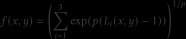
The proposed solution involves constructing a function f(x,y) that serves as a soft penalty for points not lying on any of the triangle's sides. Consider a triangle defined by the three lines Lᵢ(x,y) = 1 for i = 1, 2, 3. We can define our function as:
f(x,y) = (|L₁(x,y)|^p + |L₂(x,y)|^p + |L₃(x,y)|^p)^(1/p)
The level set f(x,y) = 1 then defines our triangular squircle. This construction mirrors the approach used for squircles but adapts it to the triangular geometry.
This function essentially measures how far a point (x,y) is from being on one of the triangle's sides, with the parameter p controlling the nature of this measurement. When p=2, we obtain a relatively smooth shape, while as p increases, the shape approaches the ideal triangle more closely.
The Role of the Parameter p
The parameter p plays a crucial role in determining the character of our triangular squircle. For smaller values of p, the resulting shape exhibits smoother curves with more pronounced rounding at what would be the vertices of a perfect triangle. As p increases, the shape becomes more angular, with the curvature concentrated increasingly at the vertices.
Mathematically, this parameter controls the relative penalty for being far from a side. Larger p values create heavier penalties, causing the level set f(x,y) = 1 to hug the ideal triangle more closely. In the limit as p approaches infinity, our triangular squircle converges to the perfect triangle defined by the original three lines.
This mathematical behavior demonstrates a beautiful continuum between the smooth, organic curves of natural forms and the sharp, precise boundaries of mathematical idealization.
Visualizing the Transformation
To better understand this transformation, imagine starting with a perfect equilateral triangle. As we decrease p from infinity toward smaller values, the vertices begin to round off, and the straight sides develop gentle curves. The resulting shape maintains a triangular essence while exhibiting the smoothness we associate with natural objects.
For different types of triangles—equilateral, isosceles, or scalene—the resulting squircle analogs will exhibit different characteristics. An equilateral triangle will produce a more symmetrical squircle, while a scalene triangle will create a more asymmetric but still smooth form.
Practical Applications and Implications
The mathematical exploration of triangular squircles extends beyond theoretical interest. In practical applications, these shapes offer advantages over both perfect triangles and circles:
Design Applications: Guitar picks, as mentioned in the original post, benefit from shapes that provide the grip and control of triangular points while avoiding the sharpness that could damage strings or be uncomfortable to hold. Architectural elements might use similar transitions to create visually interesting structural components.
Engineering Applications: In fluid dynamics, the transition between sharp and smooth boundaries affects flow characteristics. Triangular squircles could provide optimized shapes for specific flow conditions.
Computer Graphics: The ability to smoothly interpolate between geometric forms provides valuable tools for creating organic-looking shapes while maintaining mathematical tractability.
Manufacturing: Tools and molds with rounded triangular profiles might offer better material flow or stress distribution in certain manufacturing processes.
Mathematical Connections and Extensions
This approach to creating smooth geometric analogs connects to several broader mathematical concepts:
Lebesgue Norms: The use of Lp norms in defining these shapes places them within the broader context of functional analysis and measure theory.
Level Set Methods: The technique of defining shapes through level sets of functions is fundamental in partial differential equations and has applications in image processing and physics.
Morphological Mathematics: The study of how shapes can continuously transform into one another represents a fascinating area at the intersection of geometry, topology, and analysis.
Future Directions
The exploration of triangular squircles opens several avenues for further mathematical investigation:
Higher Dimensions: Extending these concepts to three-dimensional analogs of polyhedra could create fascinating smooth transitions between Platonic solids and spheres.
Optimization: Determining optimal values of p for specific applications could lead to more efficient designs.
Dynamic Transitions: Exploring how p might vary across a shape could create even more complex and interesting forms.
Physical Realizations: Investigating how these mathematical forms manifest in physical systems, from crystal growth to fluid interfaces.
The mathematical beauty of triangular squircles lies in their ability to bridge the gap between idealized geometry and natural forms. By providing a continuous parameterization that preserves the essential characteristics of triangles while introducing smoothness, these shapes demonstrate the power of mathematical functions to create elegant transitions between different geometric paradigms.
As we continue to explore these concepts, we gain not only practical tools for design and engineering but also deeper insights into the fundamental relationship between mathematics and the natural world. The humble guitar pick, in this context, becomes a gateway to a rich mathematical landscape where sharp corners meet smooth curves in a harmonious blend of precision and elegance.
Comments
Please log in or register to join the discussion