
As physicists grapple with reconciling quantum mechanics and relativity, the very concept of time is being redefined. For developers and engineers, this deep dive into the physics of time reveals profound implications for how we model reality in our most advanced systems.
From the perspective of a developer, time is a linear, predictable sequence—a clock tick in a scheduler, a timestamp in a database, or a causal chain in an algorithm. But in the deepest layers of physics, time reveals itself as something far stranger, a concept so fractured and paradoxical that it challenges our most fundamental assumptions about reality. As theoretical physics races toward a unified theory of quantum gravity, the nature of time emerges not as a single entity, but as a multi-faceted puzzle with implications that ripple into computing, cryptography, and even the architecture of artificial intelligence.
The core of this mystery lies in three irreconcilable definitions of time that coexist in modern physics. The first, coordinate time, is a mathematical abstraction—a parameter in equations describing change, whether it’s the trajectory of a satellite or the decay of a radioactive atom. Here, time is little more than a label, a variable we assign to events. The second, relativistic time, emerges from Einstein’s theories, where time becomes a dimension woven into the fabric of spacetime. In this view, past, present, and future are equally real, coexisting like points on a map, with gravity warping this dimension as it warps space. The third, thermodynamic time, is the irreversible arrow we experience: entropy increasing, ice melting, systems evolving toward disorder. Yet curiously, the fundamental equations of physics—whether Newtonian or quantum—work just as well if time flows backward. This mismatch between our experience and the math is what physicist Carlo Rovelli calls “the second problem of physical time.”
The collision between these definitions intensifies at the frontier of quantum gravity, where physicists seek to unify Einstein’s relativity with the probabilistic rules of quantum mechanics. Early attempts in the 1960s led to the Wheeler-DeWitt equation, which describes the universe as a timeless quantum state. In this framework, time vanishes entirely—a radical suggestion that time might be an emergent property rather than a fundamental feature. Modern approaches to quantum gravity, from string theory to loop quantum gravity, offer divergent paths. Some add extra dimensions to spacetime, while others propose that time and space are “quantized” at the Planck scale, composed of discrete, indivisible units. Yet all face the same hurdle: reconciling time’s role as a fluid parameter in quantum mechanics with its rigid dimensionality in relativity. This is “the first problem of physical time,” a chasm that has stumped theorists for decades.

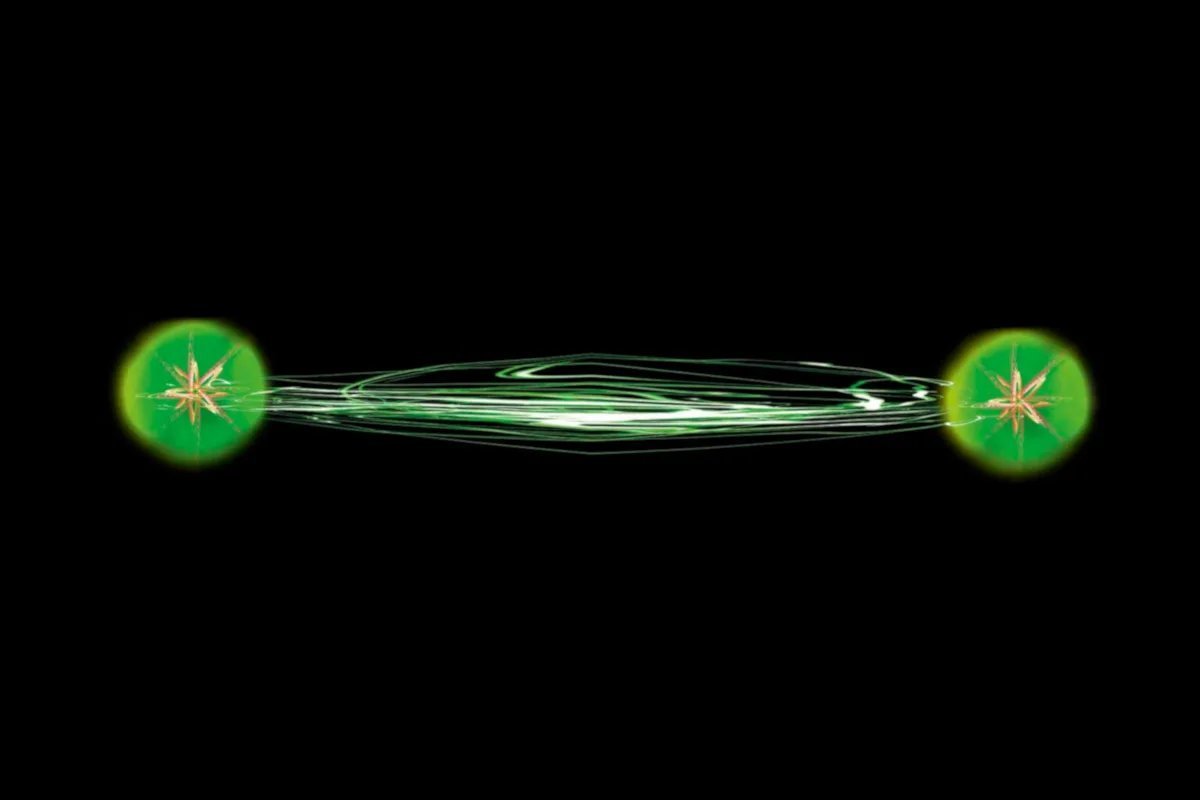
Enter quantum entanglement, the phenomenon where particles become inextricably linked, their states instantaneously correlated regardless of distance. In 1983, physicists Don Page and William Wootters proposed a revolutionary idea: time’s flow might arise from entanglement. Imagine a quantum clock entangled with its environment. Before measurement, the system exists in a superposition of all possible times. When we “read” the clock—measuring its state—the environment collapses into a corresponding moment. From our perspective embedded within the universe, this creates the illusion of time’s passage. Viewed from outside, however, all moments coexist, and time remains static. This model elegantly rescues time from the Wheeler-DeWitt equation’s timelessness, suggesting that the “arrow of time” isn’t fundamental but emerges from quantum correlations. For engineers, this hints at a deeper truth: even in classical systems, time might not be absolute but relational, dependent on the observer’s state—a concept with parallels in distributed computing, where clock synchronization across nodes remains a persistent challenge.
The implications grow stranger when quantum mechanics meets relativity. According to Einstein’s special relativity, observers moving at different velocities can disagree on the sequence of events—what one sees as cause, another might see as effect. Now, introduce quantum superposition: if two events exist in a superposition of temporal orders, cause and effect blur. Worse, general relativity ties time to gravity, meaning entangled clocks at different heights would tick at different rates. Until measured, their temporal ordering remains undefined, potentially allowing future events to influence the past—a phenomenon called retrocausality. While some physicists argue causality must be preserved at all costs, others explore retrocausality as a feature of quantum reality. For developers, this isn’t mere philosophy. In quantum computing, where algorithms exploit superposition and entanglement, the indeterminacy of temporal order could enable novel error-correction strategies or even redefine how we model causality in machine learning systems.
Time, it seems, defies simplification. It may not be a single concept but a tapestry woven from relativity, quantum mechanics, and thermodynamics—each thread valid in its domain, yet irreconcilable in totality. For technologists, this complexity is both a challenge and an opportunity. As we build systems that increasingly mirror quantum behavior—from blockchain networks to neural networks—our classical models of time may prove inadequate. The universe doesn’t run on a global clock; it runs on correlations, entanglements, and relational dynamics. To engineer the future, we may need to abandon our linear intuitions and embrace time as a quantum phenomenon: not a river flowing forward, but a web of possibilities, entangled and ever-present. In the end, the mystery of time isn’t just a problem for physicists—it’s a blueprint for the next evolution of computing.
Comments
Please log in or register to join the discussion