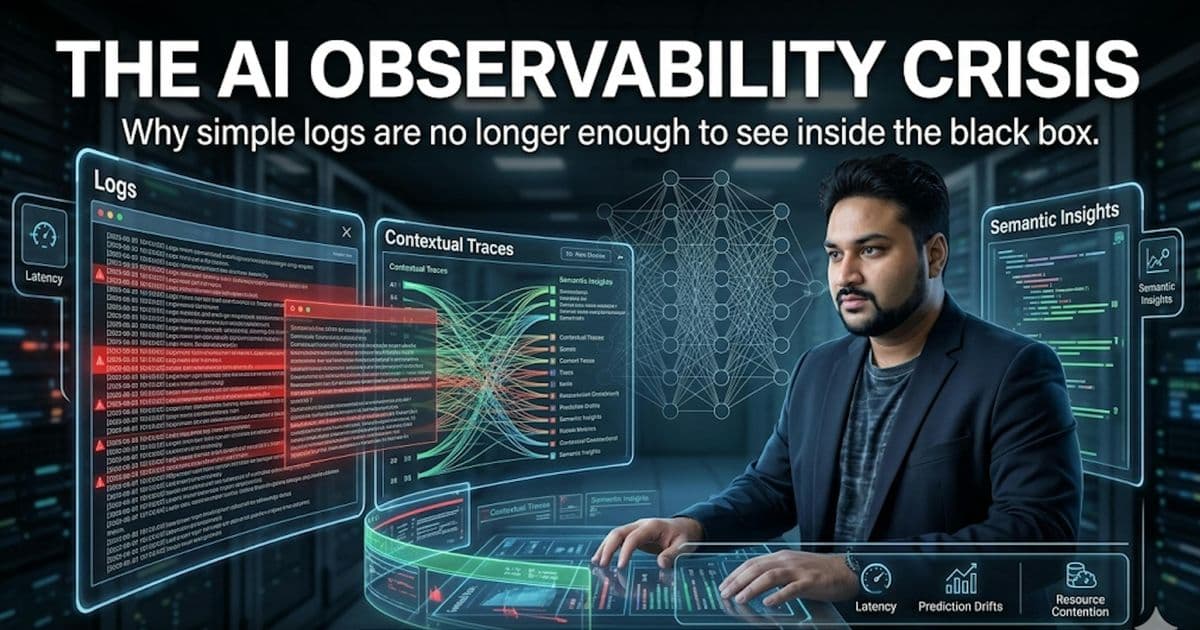
Traditional logging and metric tools assume deterministic code, but modern AI agents behave probabilistically and change their reasoning on the fly. This mismatch creates blind spots that hinder debugging, compliance, and trust. The article explains the technical roots of the problem, illustrates it with the OpenAI agentic rollout, and outlines emerging observability practices such as prompt tracing, memory state tracking, and behavioral analytics.
 )
)
The problem: legacy observability meets probabilistic AI
Traditional monitoring stacks were built around three pillars – logs, traces, and infrastructure metrics. Those pillars work well when a function call always follows the same path given the same inputs. An HTTP service that returns a 200 OK for a valid request is a classic example; the log line "request received" plus the latency metric tells you everything you need to know.
AI systems break that assumption. Large language models (LLMs) and agentic pipelines generate different token streams on each run, even with identical prompts. They maintain internal state (e.g., vector‑based memory, tool‑use histories) that mutates over time. When a model decides to call an external API, the choice depends on a stochastic policy that can shift with each inference. In short, the why behind an outcome is no longer a simple function of the code path – it is a product of learned weights, context windows, and dynamic tool interactions.
Because of this shift, the classic log line "agent performed step X" tells you what happened but not why the model selected step X over an alternative. Engineers are left with a black‑box operation that hinders root‑cause analysis, compliance reporting, and user trust.
A recent illustration: OpenAI’s 2025 agentic rollout
In early 2025 OpenAI released a suite of autonomous agents capable of planning, tool use, and multi‑turn reasoning. The agents were integrated into enterprise workflows for tasks such as automated ticket triage, data extraction, and code review. While the performance gains were measurable, customers quickly reported a new pain point: traceability.
When an agent mis‑routed a support ticket, the engineering team could see the final log entry – "ticket forwarded to tier‑2" – but the chain of reasoning that led to that decision was hidden. The agent had consulted an internal knowledge base, re‑ranked possible actions using a reinforcement‑learning‑from‑human‑feedback (RLHF) policy, and finally invoked a third‑party API. None of those intermediate steps were surfaced by the existing observability stack.
OpenAI responded by publishing a Prompt‑Trace API that records each prompt, model response, and tool call as a linked node in a directed graph. The API is open‑source on GitHub (openai/prompt‑trace) and includes a lightweight UI for visualizing decision paths. Early adopters report a 30 % reduction in mean‑time‑to‑resolution for agent failures, but the solution also highlights how much additional instrumentation is required to make AI behavior visible.
What true AI observability looks like
The community is converging on a set of layers that extend beyond raw logs:
- Prompt tracing – Capturing the exact text sent to the model, the temperature, top‑p, and any system‑level instructions. This creates a reproducible record of the input that triggered a behavior.
- Reasoning‑path recording – Logging intermediate chain‑of‑thought steps, tool selections, and confidence scores. Some frameworks, such as LangChain, already expose a
run_managerhook that can be wired to a datastore. - Memory‑state snapshots – Persisting vector embeddings or key‑value stores that the model consults during a session. Without these snapshots, the same prompt later may produce a different answer because the memory has evolved.
- Behavioral analytics – Aggregating per‑session metrics (e.g., number of tool calls, latency per reasoning step) and applying statistical anomaly detection to spot drifts.
- Tool‑interaction logs – Recording every external API call, including request payloads and responses, so that the chain of causality can be reconstructed.
These layers together form a cognitive telemetry pipeline. The data volume is higher than traditional logs, so many teams are adopting columnar storage (e.g., ClickHouse) and streaming platforms (e.g., Apache Pulsar) to keep ingestion costs manageable.
Trade‑offs and practical challenges
Implementing the above stack is not a pure win. Engineers must balance:
- Performance overhead – Instrumentation adds latency; selective sampling or asynchronous flushing can mitigate impact.
- Data privacy – Prompt content may contain PII or proprietary logic. Encryption at rest and strict access controls are essential.
- Storage cost – High‑dimensional memory snapshots can quickly consume terabytes. Compression schemes and retention policies are required.
- Signal‑to‑noise ratio – Not every reasoning step is useful for audit. Filtering based on confidence thresholds helps keep dashboards readable.
A pragmatic approach is to start with critical flows (e.g., financial decision agents) and gradually expand coverage as tooling matures.
Emerging tooling ecosystem
A handful of open‑source projects are attempting to fill the gap:
- LangChain Tracing – Provides a unified schema for prompts, LLM calls, and tool interactions.
- Arize AI – Offers a managed platform for model monitoring, including drift detection and feature attribution.
- WhyLabs – Focuses on data and model quality metrics, with integrations for LLM pipelines.
- PromptLayer – Stores every prompt/response pair and surfaces a UI for exploring reasoning graphs.
Enterprises that adopt one of these solutions early can embed observability into their CI/CD pipelines, turning the visibility problem into a testable requirement rather than an after‑the‑fact fix.
Why the observability gap matters for business
Regulated sectors (finance, healthcare, autonomous vehicles) already face strict audit mandates. When an AI‑driven credit‑scoring model denies a loan, the lender must explain the decision to the applicant. Without a reproducible reasoning trace, the organization risks non‑compliance and reputational damage.
Beyond compliance, operational risk is a tangible cost. A 2024 internal study by a major cloud provider estimated that AI‑related outages cost enterprises an average of $1.2 M per incident due to lost productivity and remediation effort. The majority of those incidents were traced back to unobservable model drift rather than infrastructure failure.
Looking ahead
The next wave of AI systems will be more autonomous, with agents that self‑organize across micro‑services and even across organizational boundaries. The only way to keep those systems trustworthy is to make their internal deliberations observable by design.
Companies that embed prompt tracing, memory snapshots, and behavioral analytics into their development lifecycle will gain a competitive edge: they can iterate faster, satisfy auditors, and reassure customers that “the AI knows what it’s doing.” Those that cling to legacy logs alone will continue to operate in the dark, facing escalating operational risk.
Harsh Verma is a Principal Software Engineer focused on AI security and observability. Follow him on Twitter.
Comments
Please log in or register to join the discussion