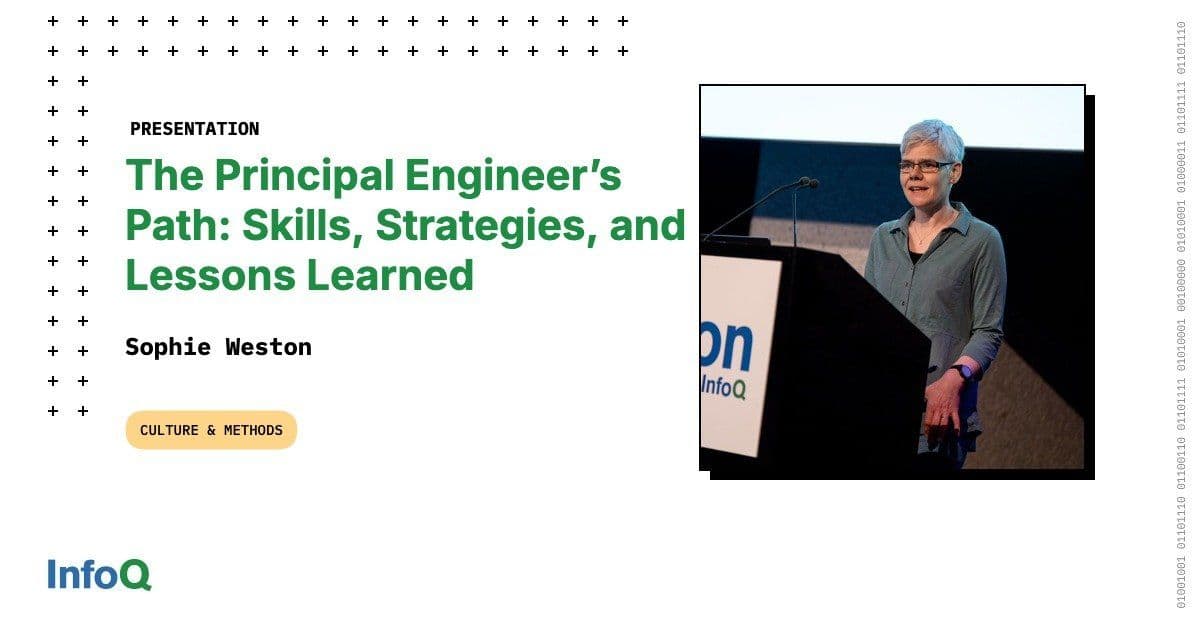
Sophie Weston shares insights from 30 years in tech on how senior ICs can grow into principal engineering roles by broadening skills, engaging with communities, and navigating organizational support.
Sophie Weston, Principal Engineer at ClearBank, delivered a compelling talk at QCon London 2025 about the realities of advancing to principal engineering roles. Drawing from her 30-year career in technology, she challenged the notion of linear career progression and offered practical guidance for engineers aspiring to leadership positions.
The Winding Journey of Engineering Careers
Weston began by dispelling the myth of career ladders, emphasizing that professional growth is rarely a straight path. "Careers don't work like that. They're not straight. They're not ordered. They're long and winding journeys, often full of unexpected twists," she explained. Her own journey from junior developer to principal engineer included multiple transitions, including a seven-year shift into coaching and consultancy roles.
What Engineering Leadership Really Means
Engineering leadership, according to Weston, encompasses three core responsibilities:
- Setting technical direction: Guiding teams toward smart architectural and technical choices
- Driving good engineering practices: Helping teams build software efficiently that delivers real value
- Shaping culture: Mentoring, coaching, and creating environments where people can thrive
She likened principal engineers to sweepers in curling, reducing friction so teams can move smoothly toward their goals. "Our role is to spot patterns, connect dots across the organization, and guide teams towards better decisions without dictating from above."
Organizational Support for Career Growth
Weston identified three critical ways organizations can support career development:
1. Flexible Working Arrangements
Flexible working isn't just a perk—it's essential for many professionals. Weston shared how part-time work enabled her career when she had young children. "Without part-time work when my kids are young, I wouldn't be in tech today. I would have had to walk away, as simple as that."
She emphasized that flexibility comes in many forms: part-time hours, compressed schedules, remote work, or simply understanding when life demands time away from work.
2. Internal Promotions
Promoting from within keeps valuable organizational knowledge, strengthens team morale, and demonstrates that career growth is achievable. Weston's 20-year tenure at one company included multiple internal promotions from developer to senior developer, team lead, technical architect, and eventually DevOps advocate.
However, she acknowledged challenges: "Navigating friendships in the selection process, avoiding perceptions of favoritism, and stepping up from colleague to leader can be tough."
3. Squiggly Career Paths
Weston advocated for supporting role changes within organizations. "A squiggly career isn't a predictably straight climb up the corporate ladder. It's a dynamic evolving journey where people take on diverse roles, sometimes even switching industry."
She particularly emphasized the importance of allowing engineers to move between individual contributor and management roles. "Having flexible career paths and allowing people to move back and forth between IC and manager roles ensures that managers are there because they want to be, not because they feel pressured into the role."
Becoming a "Broken Comb"
The most crucial advice Weston offered was to broaden one's skill set beyond deep technical expertise. Instead of being T-shaped (deep in one area, broad in others) or pie-shaped (deep in multiple areas), she advocated becoming a "broken comb" — having varying depths of knowledge across many areas.
"What makes you effective as a leader is the ability to integrate and apply that knowledge in different contexts. You can never predict exactly what scenario might arise when having a particular skill or area of knowledge will prove useful, but you have it there anyway ready to use."
Her recommended reading list covered:
- Team Topologies and fast flow methodologies
- Domain Driven Design principles
- Wardley Mapping for strategic thinking
- DORA metrics and DevOps practices
- Psychological safety in organizations
- Systems thinking approaches
- Product thinking and strategy frameworks
- Building effective teams
Bringing Your Whole Self to Work
Weston emphasized that valuable leadership skills often come from outside traditional work experiences. "Nothing prepared me for leadership quite like parenting. Some of the most valuable leadership skills I have, I learned through being a parent."
Skills like negotiation, time management, multitasking, stakeholder management, and adaptability are all honed through life experiences. "Don't leave those skills at the door. Bring your full skill set, your whole self to work."
Community Engagement and Public Speaking
Getting involved in the tech community provides multiple benefits:
- Learning opportunities: Exposure to new ideas and different perspectives
- Networking: Building professional connections and finding mentors
- Visibility: Raising your profile within the industry
- Skill development: Practicing leadership and communication skills
Weston shared how her first public speaking experience at a Women in Tech York event led to unexpected opportunities. "The very first time I spoke in public properly was at a Women in Tech York event... that chance encounter... was the first step which eventually led to my being asked to join the team as an organizer."
She encouraged starting with internal talks and gradually building confidence for external presentations.
Creating Positive Feedback Loops
The real power comes from combining all these elements. Learning leads to community engagement, which leads to speaking opportunities, which leads to organizing events, creating a virtuous cycle of growth and visibility.
"When you focus on what you love, you'll often find that opportunities come your way. It's like the '80s movie, the Field of Dreams, starring Kevin Costner. Build it and they will come."
Key Takeaways
Weston concluded with essential points for aspiring principal engineers:
- Careers are winding journeys, not predictable ladders
- Engineering leadership requires breadth beyond technical expertise
- Organizations must support flexible working, internal promotions, and role changes
- Become a "broken comb" with varied knowledge across multiple domains
- Engage with the tech community to learn, network, and grow
- Step outside your comfort zone through public speaking and new challenges
- Pay it forward by supporting those coming up behind you
As Weston emphasized, while organizational support builds the path, "how far you travel along that path and how fulfilling that journey is, is entirely down to you." The journey to principal engineering is about continuous learning, adaptation, and growth—not just reaching a destination.
Comments
Please log in or register to join the discussion