AI coding assistants boost individual productivity but can hurt team delivery when workflows aren’t adapted. The article explains the “DORA anomaly,” why faster coding creates bottlenecks downstream, and which practices let teams capture the promised gains.
The Real Reason AI Coding Assistants Fail at Scale
By Brian Zimbelman – May 18 2026
TL;DR
This is the second installment of the Beyond the Coding Assistant series. It looks at why two teams using the same AI‑driven coding tool can end up with opposite results, and what you need to change in your process to avoid the trap.
The data shows the dichotomy
The 2024 DORA Accelerate State of DevOps Report is the most credible single source on this. On the individual level, 75.9 % of respondents said they rely on AI for part of their job and 75 % reported personal productivity gains. Flow and job satisfaction improve, and engineers enjoy the tool.
At the organizational level the picture flips. DORA’s modeling linked a 25 % rise in AI adoption to a 1.5 % drop in delivery throughput and a 7.2 % reduction in delivery stability. The same survey that showed happier developers also showed slower, less reliable releases.
Why the gap appears
A recent MIT Sloan and Microsoft paper, Chaining Tasks, Redefining Work: A Theory of AI Automation, argues that AI’s value appears only after teams restructure around it. Before that “threshold” the costs of adoption outweigh the gains. Gene Kim and Steve Yegge call this the DORA anomaly in their Vibe Coding framework (FAAFO).
How faster coding can make a team slower
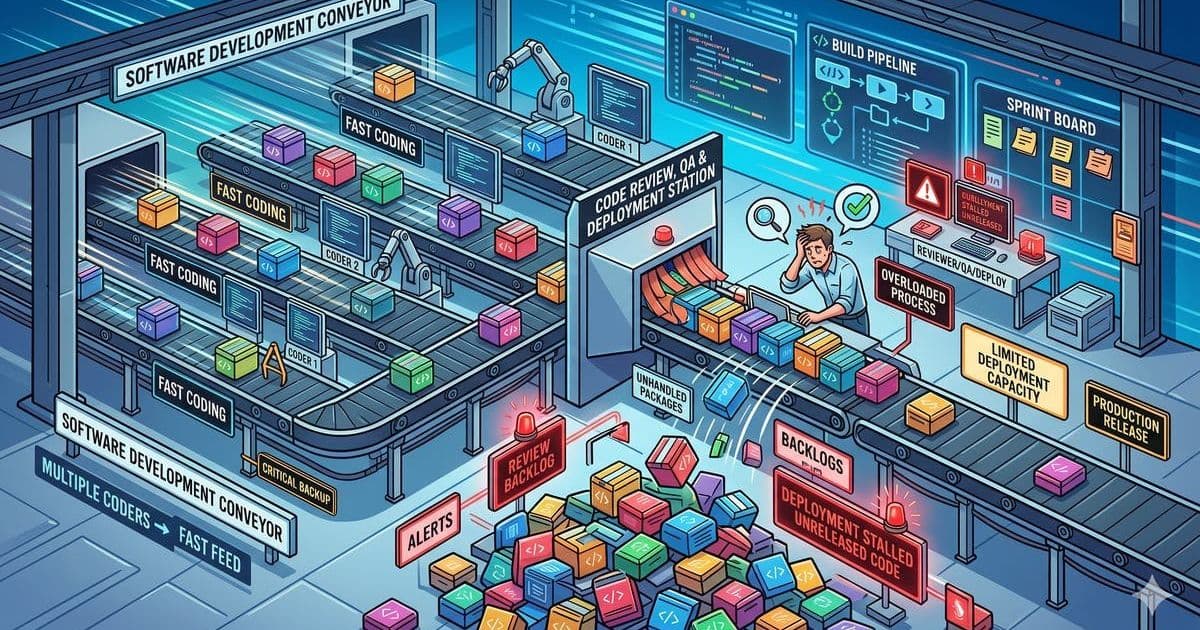
When AI speeds up the front‑end coding step, the downstream stages—code review, testing, QA—do not automatically get faster. The result is a classic bottleneck shift:
- More code → larger pull‑request queue.
- More PRs → longer review latency.
- Longer reviews → more context switches for reviewers.
- More interruptions → higher error rate (Gloria Mark’s 23‑minute recovery‑from‑interruption figure still holds).
- More errors → more incidents, on‑call alerts, and post‑mortems.
Each step adds a coordination cost, often called the handoff tax. The overall throughput can drop even though individual developers feel faster. It’s essentially Amdahl’s Law applied to software delivery: improve a non‑dominant stage and the system’s ceiling moves, but if the new bottleneck is worse than the old one the total output falls.
Practices that turn AI into a net gain
Teams that succeed share a handful of habits that align the whole delivery pipeline with the higher coding velocity:
- Architectural stewardship – a dedicated role keeps the system’s shape coherent; AI will otherwise follow whatever prompt it receives.
- Fast feedback loops – CI pipelines that finish in minutes, not hours. Kent Beck has repeatedly said that TDD becomes a “superpower” when paired with AI agents.
- Explicit agent contracts – treat AI interactions like API calls: versioned, documented, and predictable, rather than free‑form chat.
- Small, well‑bounded work items – AI excels at concise tasks; large, ambiguous tickets lead to flaky results.
- Balanced autonomy – engineers can explore, but shared conventions keep the codebase reviewable.
What the losing teams miss
- No clear ownership of architecture, so AI‑generated code diverges.
- Slow or flaky CI that cannot absorb the increased change rate.
- Ad‑hoc prompting without shared conventions, leading to inconsistent outputs.
- Work items that are too large or too coupled for any agent to handle cleanly.
- A culture that equates “use AI however you like” with autonomy, which actually fragments coordination.
The tool amplifies existing practices. If the foundation is weak, the amplification makes the weaknesses more visible, faster.
Redefining the workflow
AWS’s 2025 AI‑DLC (AI‑Driven Development Life Cycle) and similar models embed AI as a first‑class citizen. They recommend:
- Front‑loading AI – let the model generate code drafts, then immediately run automated linting and unit tests.
- Parallel validation – spin up preview environments for each PR so reviewers can test in isolation.
- Automated handoff documentation – generate a short summary of what the AI changed and why, attached to the PR.
When the entire pipeline moves in lockstep, the handoff tax shrinks and the team’s throughput rises.
The next step
The upcoming article, The End of Cheap AI, will examine how rising token costs and hardware price pressure will force teams to close the practice gaps that cheap tokens currently mask.
Sources
- DORA Accelerate State of DevOps Report 2024 – InfoQ summary
- Shahidi et al., Chaining Tasks, Redefining Work – PDF
- Kim, Yegge, Amodei, Vibe Coding – IT Revolution
- Kent Beck on TDD + AI – Pragmatic Engineer podcast
- Gloria Mark et al., The Cost of Interrupted Work – CHI 2008
Read the full series for free at https://articles.zimetic.com.
Comments
Please log in or register to join the discussion