
AI tools like Claude Code and Claude Opus 4.5 are enabling anyone to generate functional applications, but true software engineering remains essential for building robust systems that withstand real-world complexity.
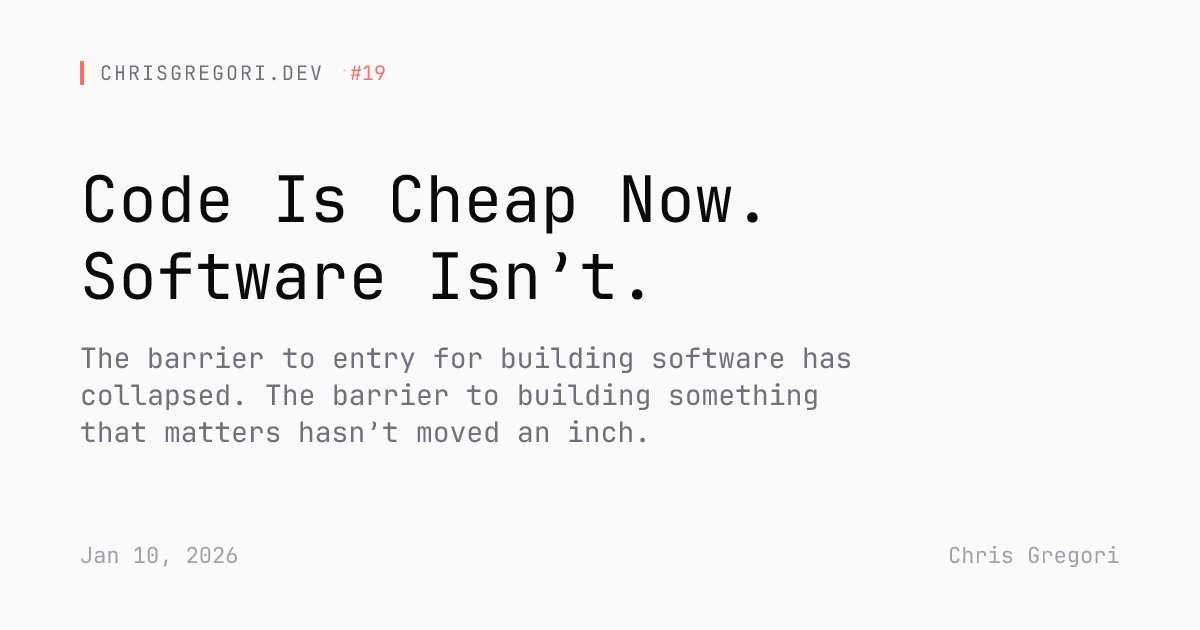
The emergence of Claude Code and Claude Opus 4.5 represents more than just incremental progress in AI-assisted development. These tools have fundamentally shifted the economics of software creation by lowering the barrier to entry to near-zero levels. Non-developers now routinely architect personalized utilities—from budget-specific subscription trackers to niche browser extensions—using natural language prompts. This democratization signals a tectonic shift from SaaS consumption to what might be called "scratchpad development": temporary solutions designed for immediate needs rather than long-term persistence.
Unlike traditional SaaS models built for customer retention and expansion, these AI-generated tools prioritize immediacy and control. They embrace CLI-first workflows where thin abstraction layers put users directly in command, echoing spreadsheets' original purpose as disposable calculation surfaces. The economics make sense: when creating a specialized tool takes minutes rather than days, longevity becomes irrelevant. This paradigm thrives on local data storage, zero onboarding friction, and the acceptance of impermanence as a feature.
Yet beneath this surface revolution lies an uncomfortable truth: while generative AI has made code production virtually free, it hasn't reduced the actual cost of quality software. The torrent of weekend projects flooding social media often crumbles upon encountering real-world complexity. Edge cases, changing API dependencies, unanticipated scaling needs, and UX debt transform seemingly simple solutions into maintenance nightmares. That subscription tracker breaks when banks alter CSV formats; the Chrome extension fails with DOM changes; the fitness app falters without offline support.
This reality exposes the core misconception in popular "end of engineering" narratives. Professional value isn't shifting from coding to non-coding—it's elevating from syntax to systems thinking. True engineering manifests in distributed cache implementations, thoughtful rate-limiting strategies, and knowing precisely where not to store credentials. AI excels at hiding complexity, but engineers must still manage it. The proliferation of brittle applications demonstrates why architectural judgment remains irreplaceable.
Compounding this is the distribution illusion permeating tech communities. Viral claims of five-figure MRR from weekend projects often prioritize engagement metrics over sustainable business models. When coding ceases to be the primary bottleneck, competitive advantage shifts toward harder-to-automate factors: audience understanding, timing, and taste. Generating functional code has become trivial; creating something people genuinely need remains profoundly difficult.
So who benefits in this new landscape? Domain experts automating repetitive tasks, internal teams building throwaway tooling, power users replacing manual workflows, and engineers prioritizing ownership over polish. Tools like Claude Code and Cursor genuinely accelerate boilerplate reduction and documentation generation—but only when paired with critical human oversight. As with any teammate's pull request, AI output demands rigorous review for logic flaws and hidden assumptions.
The future belongs to personal software: bespoke utilities generated on demand and discarded after use. Yet this accessibility doesn't eliminate the need for engineering rigor—it elevates it. Non-technical leaders dreaming of replacing development teams fundamentally misunderstand that while AI writes code competently, it cannot architect resilient systems. Until artificial general intelligence arrives, human judgment remains the essential ingredient for transforming cheap code into valuable software. The tools have changed; the responsibility hasn't.
Comments
Please log in or register to join the discussion