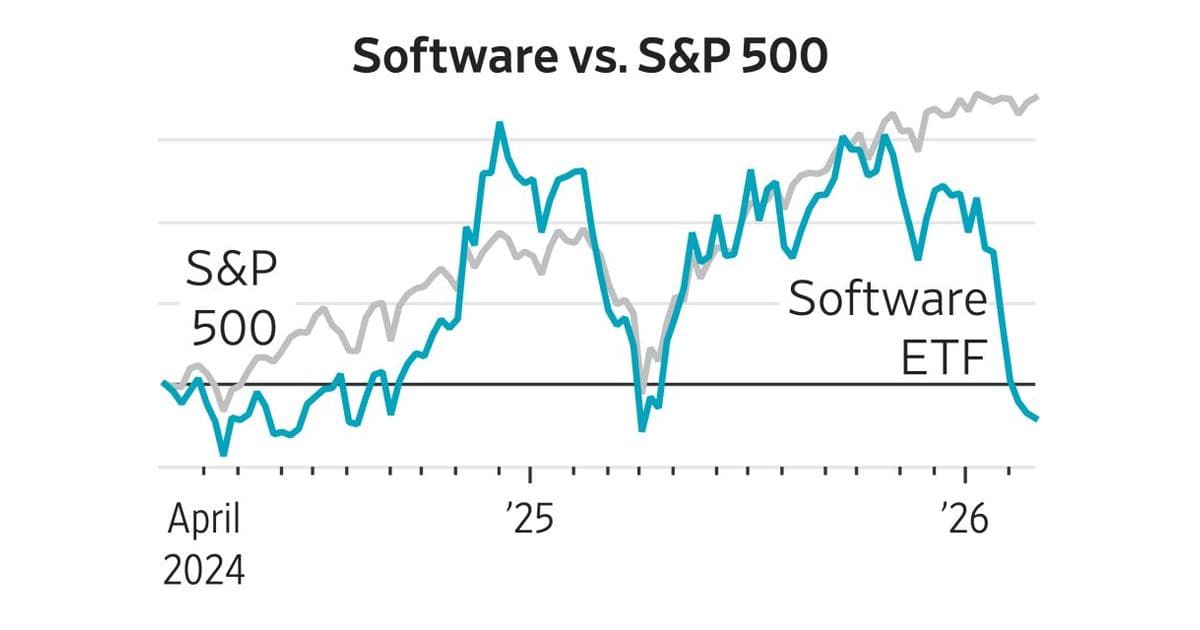
State Street ETF software stocks lost $1.6 trillion in market cap in 2026 amid AI disruption concerns, with Microsoft, AppLovin, Intuit, and Salesforce each losing over $50 billion.
The software industry is experiencing a seismic valuation reset as investors grapple with the disruptive potential of artificial intelligence, resulting in a staggering $1.6 trillion loss in combined market capitalization across State Street ETF software stocks in 2026 alone.
The magnitude of this market correction reflects growing anxiety about how AI technologies might fundamentally alter business models that have underpinned the software industry for decades. Companies that once enjoyed premium valuations based on recurring revenue streams and high margins now face questions about their long-term competitive positioning in an AI-driven landscape.
Microsoft, despite its aggressive AI integration strategy, saw over $50 billion evaporate from its market cap. The company's dual position as both a major AI beneficiary through its OpenAI partnership and a potential AI disruption target has created investor uncertainty. While Microsoft has successfully embedded AI capabilities across its product suite, questions persist about whether traditional software licensing models can withstand the shift toward AI-powered automation and intelligent agents.
AppLovin, the mobile marketing and app development platform, experienced similar losses exceeding $50 billion. The company's business model, heavily reliant on app monetization and user acquisition strategies, faces potential disruption from AI systems that could optimize marketing spend and user engagement in ways that bypass traditional advertising channels.
Intuit, the financial software giant behind TurboTax and QuickBooks, lost more than $50 billion as investors questioned whether AI-driven tax preparation and accounting solutions might commoditize services that have historically commanded premium prices. The company's recent earnings projections falling short of Wall Street expectations only amplified concerns about its ability to maintain pricing power in an AI-enhanced competitive environment.
Salesforce, the enterprise software leader, saw its market cap shrink by over $50 billion amid fears that AI-powered customer relationship management tools could disrupt traditional CRM architectures. The company's CEO Marc Benioff has attempted to counter the narrative of a "SaaS-pocalypse" by arguing that AI actually increases demand for software services, but investor skepticism remains palpable.
The broader market reaction suggests a fundamental reassessment of software industry economics. Traditional metrics like recurring revenue growth, customer acquisition costs, and lifetime value are being reevaluated through the lens of AI's potential to automate processes, reduce human intervention, and compress margins.
This valuation reset extends beyond individual companies to entire business models. Software-as-a-Service companies that built empires on subscription-based pricing are now confronting the possibility that AI agents might perform tasks traditionally handled by human users, potentially reducing the need for seat licenses and user-based pricing structures.
The market's reaction also reflects uncertainty about the timeline and nature of AI's impact. While some investors fear immediate disruption, others recognize that the technology's full potential may take years to materialize. This uncertainty has created a holding pattern where companies with strong AI strategies are still penalized for the broader industry's perceived vulnerability to technological change.
Interestingly, the market's response varies significantly based on how companies position themselves relative to AI. Those seen as AI enablers or infrastructure providers have generally fared better than those perceived as potential AI disruption targets. This dynamic has created a bifurcation in the software sector between companies that provide the building blocks for AI applications and those that might be replaced by them.
The $1.6 trillion market cap reduction also reflects broader macroeconomic concerns about AI's impact on employment, productivity, and economic growth. Investors are increasingly factoring in scenarios where AI could simultaneously boost productivity while reducing the need for human workers, creating complex implications for software demand and pricing power.
For software companies, the challenge lies in communicating their AI strategies effectively while demonstrating that their core value propositions remain intact. Many are emphasizing how AI enhances rather than replaces their existing offerings, but the market appears to be demanding more concrete evidence of sustainable competitive advantages in an AI-dominated future.
The valuation reset also highlights the speed at which technological disruption can reshape market perceptions. Just a few years ago, software companies enjoyed some of the highest multiples in the market based on their predictable revenue streams and high margins. Today, those same characteristics are viewed with suspicion as potential vulnerabilities to AI-driven business model innovation.
As the software industry navigates this transition, the companies that emerge strongest will likely be those that successfully integrate AI capabilities while maintaining the trust, reliability, and user experience that have defined successful software products. The $1.6 trillion market cap reduction serves as a stark reminder that in the age of AI, even the most established technology companies must continuously reinvent themselves or risk becoming obsolete.
The coming months will be critical as software companies report earnings and outline their AI strategies. Investors will be looking for evidence that these companies can maintain their growth trajectories while adapting to an AI-enhanced competitive landscape. The market's current skepticism suggests that mere AI adoption may not be sufficient – companies will need to demonstrate how AI strengthens rather than undermines their core business models.
This valuation reset represents more than just a market correction; it signals a fundamental shift in how investors value software companies in an AI-driven world. The $1.6 trillion question facing the industry is whether traditional software business models can evolve quickly enough to remain relevant, or whether AI will indeed trigger the "SaaS-pocalypse" that some investors fear.
Comments
Please log in or register to join the discussion