PromptQL's Tanmai Gopal argues that semantic layers—centralized interfaces for data metrics—are fundamentally flawed for AI-driven decision-making. Instead, organizations should embrace a Wikipedia-like wiki as the core knowledge substrate, treating the semantic layer as a compiled artifact. This shift could unlock more adaptive and context-aware AI systems.
For years, the semantic layer has been hailed as the cornerstone of data-driven organizations—a governed interface where metrics are standardized, definitions are centralized, and truth is singular. But in the age of AI, this approach is showing fatal cracks. In a provocative blog post, Tanmai Gopal, co-founder of PromptQL, declares: "The semantic layer is dead." Instead, he proposes a radical alternative: model organizational knowledge like Wikipedia.
Why Semantic Layers Fail AI
Semantic layers, Gopal argues, are designed for human consumption of numbers, not for inhabiting the rich, messy reality of organizational meaning. They prioritize clean abstractions over the contextual, political, and operational nuances that determine whether a metric is truly useful—or even correct. Key shortcomings include:
- Context Collapse: Metrics like "revenue" vary by role (CFO vs. Sales VP), product line, or geography. Semantic layers force a single definition, erasing critical context.
- Static Definitions in a Dynamic World: Business priorities shift, ownership changes, and what "counts" evolves quarterly. "Static interfaces pretend meaning is stable when it's negotiated," Gopal writes.
- Missing Operational Intelligence: Real-world decision-making relies on heuristics, anomaly patterns, and "if X then check Y" protocols—none captured in a declarative formula.
- Ignoring History: Metric versions, backfills, and silent breaks are narrative, not schema. Without this temporal layer, AI can't discount historical noise.
Worse, the operating model is structurally unsound. Centralized semantic layers become "planned cities: beautiful in the blueprint, empty in practice." Experts won't contribute high-value context because their time is better spent solving problems, not documenting for strangers. Central data teams move too slowly for business cadences, leading to stale layers, shadow metrics, and spreadsheet anarchy.
The Wikipedia Blueprint
{{IMAGE:2}}
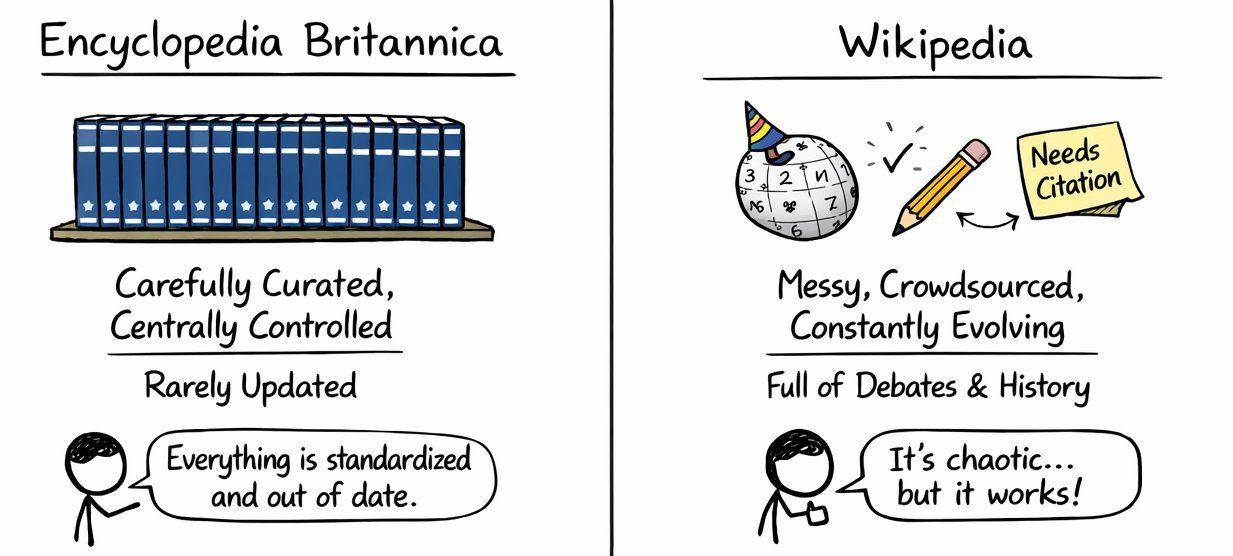
Caption: A Wikipedia model is a better way to think about organizational meaning.
The solution, Gopal suggests, lies in a system already proven at global scale: the wiki. Wikipedia thrives because it embraces messiness:
"contribution is granular, continuous, and opportunistic; disagreement is expected and recorded; history is first-class; coverage emerges from use, not mandates; accuracy improves via collaborative iteration, not certification."
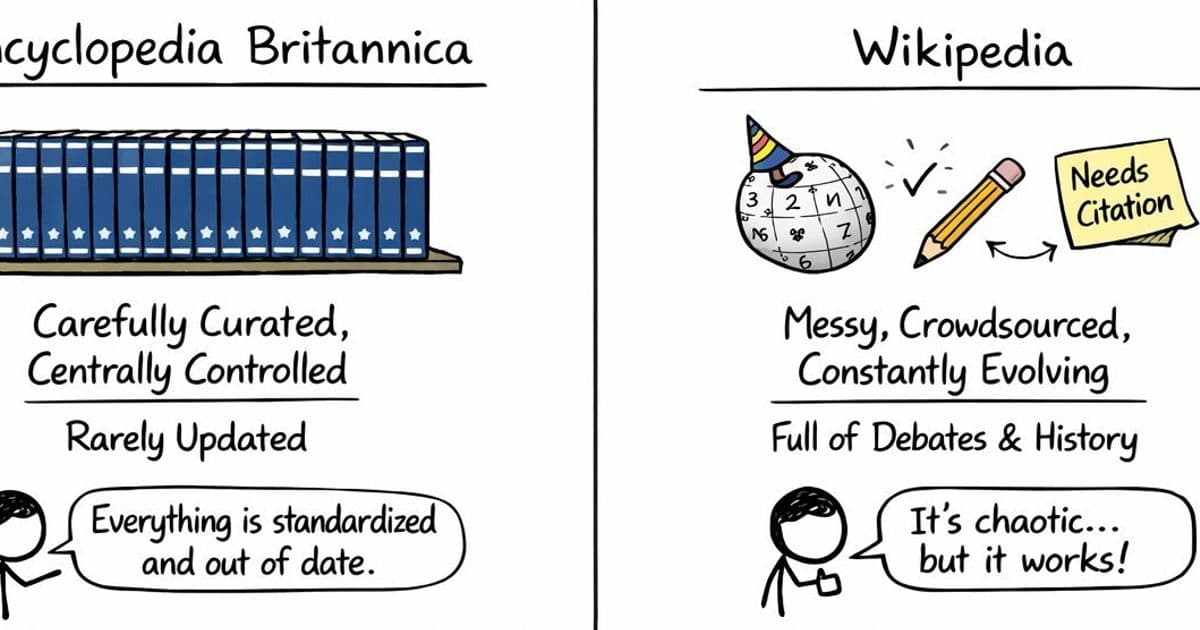
Organizations, he argues, resemble Wikipedia more than Encyclopedia Britannica. Meaning isn't decreed; it's negotiated, iterative, and role-specific.
Building the Organizational Brain
Gopal's proposal flips the traditional stack: Don't make the semantic layer the source of truth. Derive it from a living wiki.
- Start with a Wiki: Let operators, analysts, and domain experts capture knowledge—context, runbooks, trade-offs—as they work.
- Put AI in the Loop: Use AI to query this wiki, generate analyses, and feed new insights back into it. This creates a "virtuous cycle": usage drives coverage, coverage improves AI, and improved AI drives more usage.
- Compile, Don't Curate: Semantic layers become downstream artifacts, generated or validated against the wiki's evolving knowledge.
The result? A sociotechnical system where the wiki acts as the organization's "brain," storing intent and interpretation, while AI serves as "octopus arms"—executing tasks and navigating ambiguity. "If your AI on data initiative isn't gaining adoption," Gopal concludes, "it’s probably because you’re trying to encode a living, political, temporal system into a static interface. Stop. Build the wiki."
Source: PromptQL Blog
Comments
Please log in or register to join the discussion