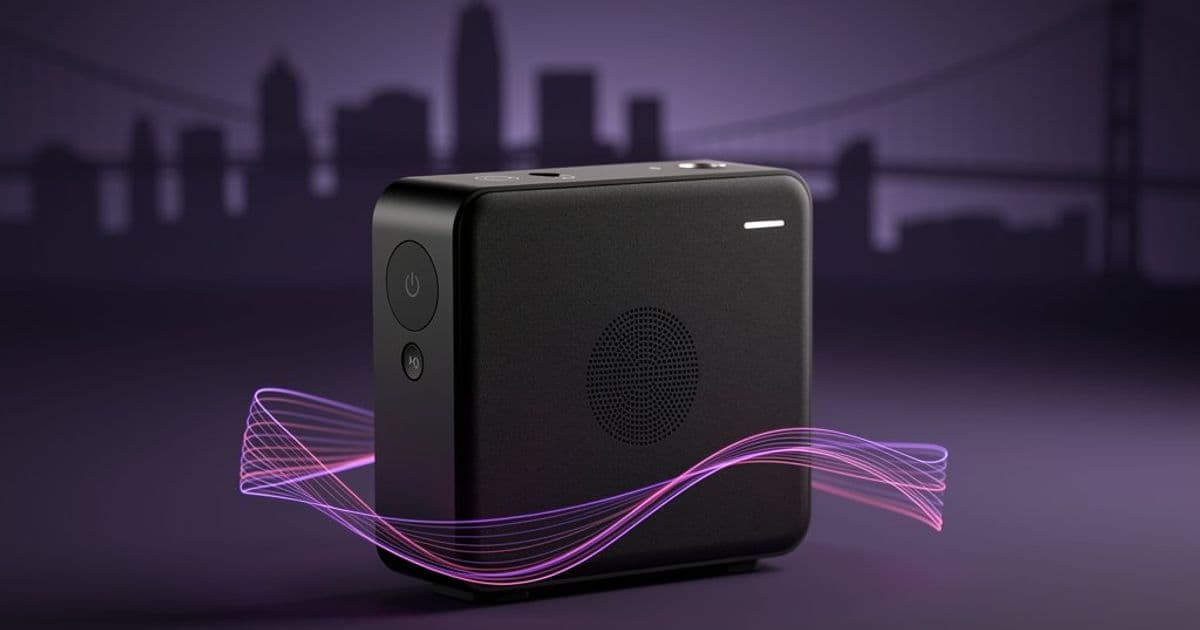
Riley Walz, a software engineer and audio enthusiast, has created a unique, location-based radio station in San Francisco that broadcasts the sounds of the city's streets, offering a real-time, ambient audio map of the urban environment.
Riley Walz, a software engineer known for his work on projects like the Bop City radio station, has developed a novel application that turns San Francisco's streets into a live, streaming audio feed. The project, called Bop City, uses a network of microphones placed throughout the city to capture ambient sounds—traffic, conversations, street performers, and the general hum of urban life—and broadcasts them online. This isn't just a novelty; it's a technical implementation of a real-time audio streaming system that raises questions about privacy, data collection, and the nature of public soundscapes.
What's Claimed
The project is presented as a way to "listen to the city." The marketing emphasizes the immersive, almost voyeuristic experience of tuning into a specific neighborhood's soundscape. It's framed as an art project and a tool for urban exploration, allowing remote listeners to feel connected to the city's rhythm.
What's Actually New
The core technology isn't groundbreaking. Live audio streaming has existed for decades. What's interesting here is the application and scale. Walz has built a distributed system of audio nodes, likely using Raspberry Pi devices or similar low-cost hardware, each equipped with a microphone and a network connection. These nodes capture audio, compress it, and stream it to a central server, which then makes the feed available via a web interface or a dedicated app.
The novelty lies in the curation and the real-time, geographically-tagged aspect. Unlike a single microphone on a street corner, this system provides a multi-point, city-wide audio map. The user interface allows listeners to select a location on a map and hear what's happening there right now. This requires robust backend infrastructure to handle multiple concurrent audio streams, low-latency delivery, and synchronization. The system likely uses a combination of WebRTC for peer-to-peer streaming or a centralized media server like GStreamer or FFmpeg for processing and distribution.
Limitations and Technical Challenges
Audio Quality and Compression: Streaming high-fidelity audio from multiple sources consumes significant bandwidth. To make it practical, the audio is heavily compressed (likely using codecs like Opus). This results in a loss of detail, turning the rich tapestry of city sounds into a more abstract, often lo-fi representation. The "crunch" of gravel or the specific timbre of a distant siren gets flattened.
Latency: For a truly live experience, latency must be minimal. However, network conditions, especially on public Wi-Fi or cellular networks used by the nodes, introduce variable delays. A listener might hear a bus pass 5 seconds after it actually happened, breaking the illusion of real-time presence.
Privacy and Ethics: This is the most significant limitation. The system is essentially a network of always-on microphones in public spaces. While the project's website states it only streams public areas and doesn't store recordings, the potential for capturing private conversations is real. California's two-party consent laws for recording conversations are complex in public spaces, but the ethical line is blurry. A person discussing sensitive information near a node would be unknowingly broadcast. Walz has addressed this by stating the system doesn't record or archive audio, only streams it live, but the infrastructure to record is inherent in the design.
Environmental Noise and Signal-to-Noise Ratio: Urban soundscapes are noisy. The raw audio feed can be overwhelming, a wall of sound that's difficult to parse. The system does little to no active noise cancellation or filtering. This means the most prominent sounds (traffic, construction) often drown out subtler ones, which can be a limitation for listeners seeking specific types of audio experiences.
Scalability and Maintenance: Deploying and maintaining hardware across a large city is a logistical challenge. Devices need power, network access, and physical protection from weather and vandalism. The cost and effort to scale beyond a few dozen nodes are substantial.
Practical Applications and Broader Context
While framed as an art project, the technology behind Bop City has practical applications. It's a real-world testbed for distributed sensor networks. Similar systems are used for:
- Urban Planning: Monitoring noise pollution levels in real-time to inform city planning decisions. The San Francisco Municipal Transportation Agency uses noise data, but a granular, real-time network like this could provide higher-resolution data.
- Disaster Response: In the event of an earthquake or other disaster, a network of audio sensors could help first responders locate areas of distress or assess structural damage through sound analysis (e.g., detecting the sound of collapsing structures or cries for help).
- Wildlife Monitoring: Adapted for natural environments, this could track animal populations or monitor ecosystem health through bioacoustics.
The project also taps into a broader trend in "sonification"—the process of turning data into sound. Just as data visualization helps us understand complex information through sight, projects like Bop City use audio to create an intuitive, if abstract, understanding of a city's dynamic state.
The ML Practitioner's View
From a machine learning perspective, the raw audio stream is a rich, unlabeled dataset. While the project itself doesn't appear to use ML, the potential is there. One could train models to:
- Classify sounds: Automatically tag streams with labels like "traffic," "construction," "music," or "crowd."
- Detect anomalies: Identify unusual sounds (e.g., breaking glass, a car crash) for public safety applications.
- Generate synthetic soundscapes: Use generative models like WaveNet or AudioLM to create realistic, but artificial, urban audio environments for training autonomous vehicles or testing audio-based AI systems.
However, these applications introduce their own ethical concerns, particularly around surveillance and bias in sound classification models.
Conclusion
Riley Walz's Bop City is a clever, technically competent project that highlights the possibilities and perils of ubiquitous sensing. It's not a "revolutionary" breakthrough in audio technology, but a thoughtful application of existing tools. Its value is less in the novelty of the stream itself and more in the questions it forces us to ask: What does a city sound like? Who gets to listen? And what are the boundaries of public space in an age of constant, ambient data collection? For anyone interested in the intersection of urbanism, technology, and ethics, it's a project worth monitoring, both literally and figuratively.
Comments
Please log in or register to join the discussion