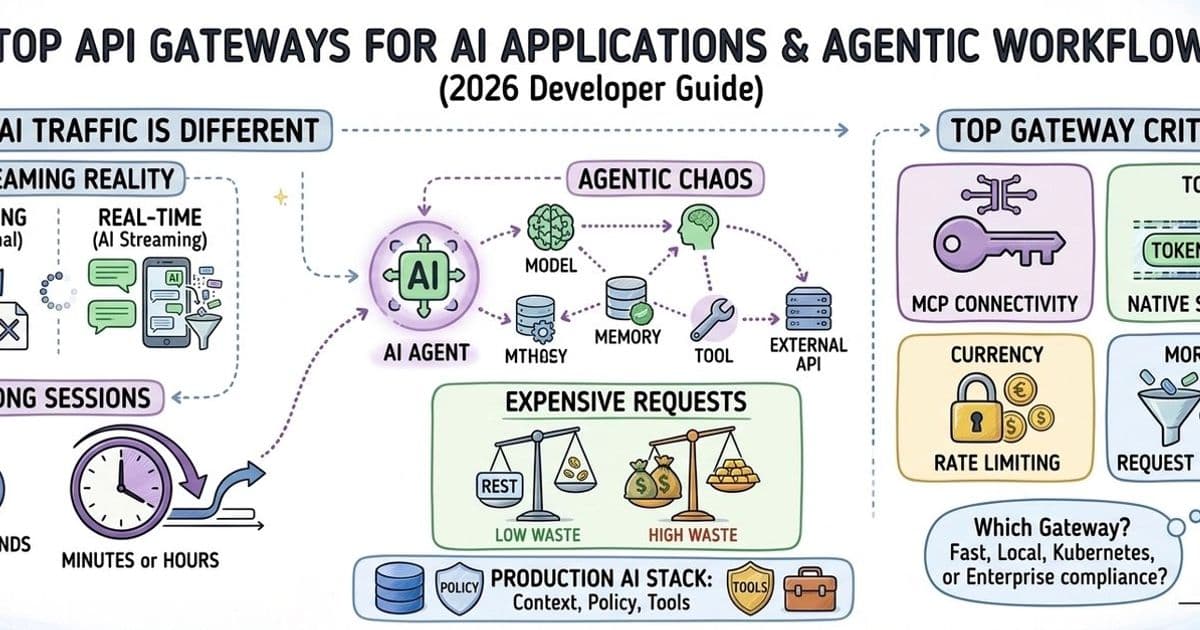
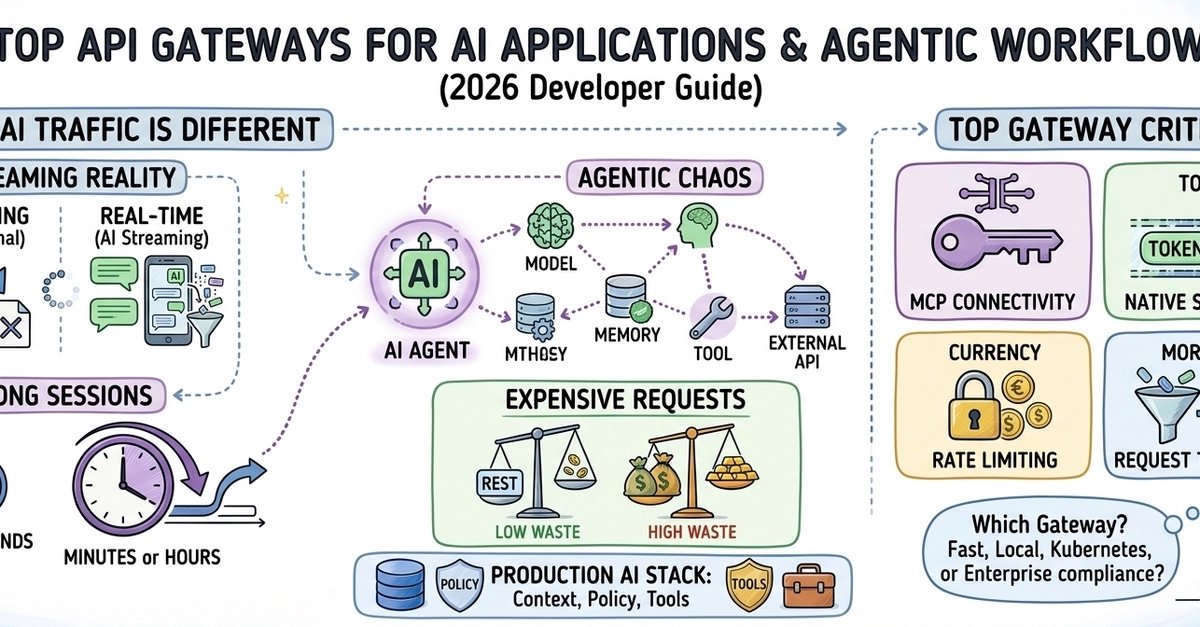
AI workloads demand gateways that handle streaming, long‑lived connections, tool orchestration and costly model calls. This guide compares the leading 2026 gateways—ngrok Universal Gateway, Kong, AWS API Gateway, Traefik and Apigee—highlighting where each excels, where it falls short, and which team contexts make the most sense.
Top API Gateways for AI Applications and Agentic Workflows (2026 Developer Guide)
A lot of AI apps die at the moment real users start showing up. The code that calls an LLM works fine in a notebook, but once traffic grows you hit token‑budget overruns, streaming timeouts, or a cascade of tool calls that turn debugging into a nightmare. Suddenly you need authentication, observability, audit logs and rate limiting. The simple prototype becomes a distributed system, and an API gateway is no longer optional.
What is an AI API Gateway?
An AI API gateway sits between users, LLM providers, MCP (Model Context Protocol) servers, vector stores and any backend services your agents need. It provides the same core functions as a traditional gateway—auth, rate limiting, routing, observability—but it must also understand:
- Streaming token delivery (SSE, WebSockets)
- Long‑lived connections that can stay open for minutes
- Complex orchestration where a single user request spawns dozens of model calls, tool invocations and external API hits
- High per‑request cost that makes early quota enforcement essential
Why AI Traffic Differs from Traditional REST
| Traditional REST | AI‑centric traffic |
|---|---|
| Millisecond‑scale request/response | Seconds to minutes per request |
| Single request, single response | Streams of tokens, incremental delivery |
| Predictable payload size | Variable token count, cost spikes |
| Simple routing | Multi‑model routing, dynamic prompt shaping |
| Minimal policy enforcement | Early quota checks, per‑token limits |
Streaming Changes Everything
If a gateway buffers the whole response before forwarding it, the user sees a delayed chat experience. A proper AI gateway must forward tokens as they arrive, preserving the real‑time feel of the conversation.
Agentic Workflows Generate Complex Patterns
An autonomous coding assistant may:
- Call an LLM for a plan
- Invoke a code‑execution tool
- Query a vector DB for context
- Call a third‑party API for data
- Loop back to the model with new context The gateway becomes the coordination hub for all these hops.
Core Capabilities to Look For
| Capability | Why It Matters |
|---|---|
| Native streaming support | Avoids token buffering, keeps latency low |
| Fine‑grained authentication (JWT, OAuth, API keys) | Protects expensive model endpoints |
| Token‑aware rate limiting | Stops a single user from burning the budget |
| Request/response transformation | Enables prompt injection, model selection |
| Observability (traces, logs, metrics) | Critical for debugging long agent runs |
| MCP compatibility | Future‑proofs the stack for tool orchestration |
| Kubernetes operator / Gateway API support | Simplifies deployment in cloud‑native environments |
| Multi‑cloud / private networking | Allows hybrid stacks with on‑prem models |
| Replay / debugging tools | Reproduce hard‑to‑track agent failures |
Quick Comparison of the Top 2026 Gateways
| Gateway | Best For | Open‑Source / Cloud | Complexity |
|---|---|---|---|
| ngrok Universal Gateway | Production AI apps, agentic workflows, hybrid/private deployments | SaaS with open‑source edge components | Low |
| Kong Gateway (Enterprise) | Large orgs with existing Kong stack, deep plugin needs | Open‑source core, commercial plugins | High |
| AWS API Gateway | Serverless stacks fully inside AWS | Managed service | Moderate |
| Traefik | Kubernetes‑native teams, lightweight ingress | Open‑source | Moderate |
| Apigee | Enterprises needing strict governance, compliance | Managed SaaS | High |
1. ngrok Universal Gateway
Where it Shines
- Native streaming for SSE and WebSockets works out of the box. No token buffering, no extra code.
- Traffic Policy engine lets you declare JWT validation, OAuth, API‑key checks, rate limits and header rewrites without touching application code.
- MCP connectivity is built‑in, so agents can talk to tool servers through the same control plane.
- Hybrid support for local Ollama models, private VPC endpoints, and public LLM providers. Preview URLs and private tunnels make staging AI features painless.
- Replayable requests let you capture a full agent run and replay it later, a huge time‑saver when debugging multi‑step workflows.
Trade‑offs
- Edge‑focused; you’ll still need a service‑mesh solution for heavy east‑west traffic inside a large data center.
- Pricing scales with traffic volume; very high‑throughput workloads may need a custom contract.
Explore ngrok Universal Gateway
2. Kong Gateway (Enterprise)
Where it Works
- Massive plugin ecosystem (auth, ACL, rate limiting, logging) lets you craft highly customized policies.
- Proven self‑hosted model fits organizations that already run Kong for other services.
- Recent AI‑focused plugins add model‑selection routing and token‑aware throttling.
Trade‑offs
- Operational overhead is significant; you’ll spend weeks on deployment, scaling and monitoring before the AI layer is stable.
- Learning curve for the declarative Kong configuration language can slow early prototyping.
3. AWS API Gateway
Where it Works
- Tight integration with Lambda, Cognito, CloudWatch, and IAM makes a fully serverless AI stack trivial.
- Managed scaling removes the need to provision capacity for bursty token streams.
Trade‑offs
- Streaming support is limited to HTTP 2 + WebSocket integrations; you often need a Lambda proxy that re‑buffers data.
- Hybrid scenarios (on‑prem models, multi‑cloud vector stores) become awkward; you end up routing through VPC Peering or NAT gateways.
4. Traefik
Where it Works
- Kubernetes‑native: automatic service discovery, CRD‑based routing, and a lightweight footprint.
- Supports WebSocket and SSE streams, though you may need to tune timeouts manually.
- Ideal for teams already using Traefik as ingress for other services.
Trade‑offs
- No built‑in token‑aware rate limiting; you’ll have to implement custom middleware or external adapters.
- MCP support is not native; you’ll need a sidecar or custom plugin.
5. Apigee
Where it Works
- Enterprise‑grade governance, analytics, developer portal and policy enforcement.
- Strong compliance features (PCI, HIPAA) for regulated AI use cases.
Trade‑offs
- Heavyweight deployment; onboarding can take months.
- AI‑specific features lag behind the more lightweight, AI‑first platforms.
Decision Framework
| Situation | Recommended Gateway |
|---|---|
| Need to ship an AI product this sprint | ngrok |
| Already run Kong at scale, need deep plugins | Kong |
| Entire stack lives in AWS, serverless preferred | AWS API Gateway |
| Kubernetes‑only, want minimal footprint | Traefik (or ngrok’s K8s operator) |
| Strict compliance, multi‑region governance | Apigee |
Why MCP Support Is Becoming Essential
Agentic systems now communicate with tools, databases and external services using a structured protocol (MCP). Gateways must therefore:
- Preserve session state across bidirectional streams.
- Allow dynamic routing based on tool discovery messages.
- Enforce policy per‑session (e.g., limit tool calls per user). ngrok already treats MCP as a first‑class workload; the others require custom extensions.
Final Thoughts
Treating AI traffic like ordinary REST calls works for demos, but it breaks under production load. Streaming, long‑lived sessions, costly model calls and agentic orchestration impose a different set of requirements on the networking layer. The right gateway depends less on feature checklists and more on the surrounding ecosystem:
- Fast‑moving teams that need streaming and MCP out of the box should start with ngrok.
- Large enterprises with existing Kong deployments can extend their platform, accepting the operational cost.
- AWS‑only shops benefit from the managed convenience of AWS API Gateway, provided they stay inside the cloud.
- Kubernetes‑centric shops may prefer Traefik for its simplicity, adding custom middleware for token‑aware limits.
- Regulated industries will gravitate toward Apigee’s governance suite, despite the heavier lift.
Choosing early saves you from retrofitting rate limits, replay tools and streaming fixes after the fact. Align the gateway with your deployment model, traffic pattern and team bandwidth, and the AI stack will scale with far fewer surprises.
Written by Hadil Ben Abdallah, Software Engineer & Technical Writer
Comments
Please log in or register to join the discussion