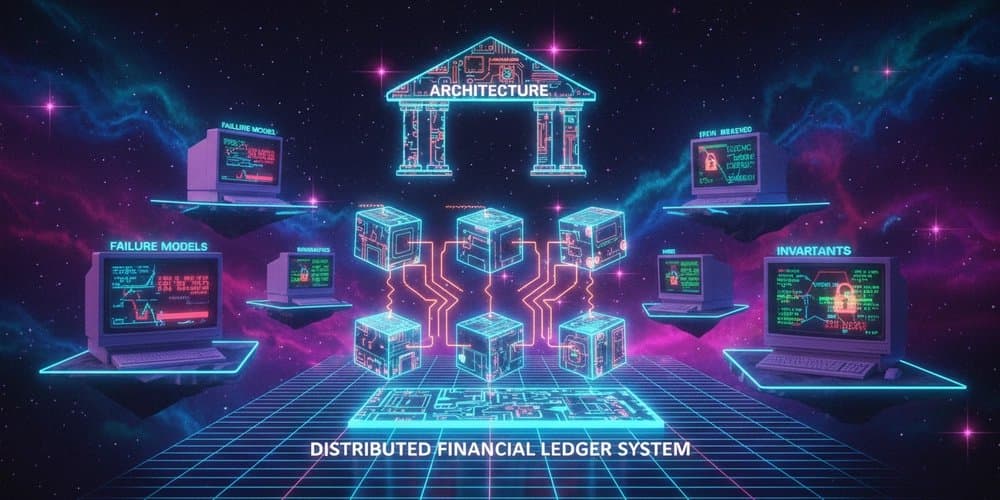
A comprehensive analysis of distributed ledger architecture, focusing on the fundamental invariants, ACID guarantees, and failure recovery mechanisms required for institutional-grade financial systems.
Financial systems fundamentally depend on one core component: the ledger. The ledger is the authoritative state machine responsible for maintaining financial integrity, enforcing conservation of value, and ensuring deterministic reproducibility of all financial operations.
This article presents a rigorous architectural and systems-level analysis of distributed double-entry ledger design, including formal invariants, transactional guarantees, concurrency control, failure recovery, isolation models, and scaling strategies required to support institutional-grade financial infrastructure.
The focus is on production-grade systems operating under real-world constraints: concurrent execution, partial failure, distributed architecture, strict auditability requirements, and strong consistency guarantees.
Ledger correctness is not merely an implementation detail. It is the foundation upon which all financial correctness depends.
1. System Model
We model the ledger as a deterministic, append-only state transition system:
Sₙ → T → Sₙ₊₁
Where:
- S represents complete system financial state
- T represents a transaction
- State transitions must preserve system invariants
The ledger functions as a financial state machine, where each transaction produces a deterministic transformation of system state.
State is derived entirely from transaction history:
S = f(transaction_log)
This provides:
- Determinism
- Auditability
- Recoverability
- Immutability
The ledger is not simply a storage system. It is a formally constrained state machine enforcing financial correctness.
2. Fundamental Invariant: Conservation of Value
The core invariant of a double-entry ledger system is:
∀ T: ∑ entries(T) = 0
This invariant enforces conservation of value. No transaction may create or destroy value.
Example:
Account A transfers 100 units to Account B:
- (Account A, -100)
- (Account B, +100)
Sum: -100 + 100 = 0
Invariant preserved.
This invariant must hold under all conditions:
- concurrent execution
- system crash
- network failure
- partial execution
- database recovery
Violation of this invariant represents financial corruption.
2.1 Formal System Properties
A correctly implemented ledger must satisfy the following formal properties:
Safety Property No valid execution path may violate value conservation invariant.
∀ T: ∑ entries(T) = 0
Liveness Property All valid submitted transactions must eventually resolve:
processed ∨ rejected
Determinism Property Given identical transaction log L:
State(L₁) = State(L₂)
Idempotency Property Repeated execution of transaction T must not alter state beyond initial execution.
Consistency Property System invariants must hold under concurrent execution.
Durability Property Committed transactions must survive all system failures.
3. Ledger as Deterministic State Machine
Ledger state is a pure function of transaction history:
State = f(transaction_log)
Balances are derived:
balance(account) = ∑ entries(account)
Balances are not primary state. Entries are primary state.
This provides:
- Deterministic reconstruction
- Full auditability
- Crash recovery capability
- Immutable history
This model ensures that ledger correctness is independent of runtime memory state.
4. Data Model
Minimal relational model:
Accounts table:
- account_id (primary key)
- currency
- created_at
Transactions table:
- transaction_id (primary key)
- timestamp
- reference
- status
Entries table:
- entry_id (primary key)
- transaction_id (foreign key)
- account_id (foreign key)
- amount
- created_at
Invariant constraint: CHECK (sum(entries.amount) = 0 per transaction)
Enforced at transactional level.
Entries are append-only. Updates and deletes are forbidden.
5. Transaction Processing Pipeline
Transaction execution must satisfy strict atomicity. Execution flow:
- Validate transaction structure
- Validate account existence
- Validate business constraints
- Begin database transaction
- Insert transaction record
- Insert debit entry
- Insert credit entry
- Validate invariant preservation
- Commit transaction
Failure at any step triggers full rollback. Partial state transitions are forbidden.
Atomicity guarantees correctness.
6. ACID Guarantees and Database Requirements
Ledger correctness depends on strict ACID guarantees.
Atomicity Transaction fully succeeds or fully fails.
Consistency All invariants preserved.
Isolation Concurrent transactions produce equivalent sequential result.
Durability Committed transactions survive system crash.
PostgreSQL provides:
- Write-ahead logging
- Crash recovery
- Serializable isolation
- Transactional integrity
These properties are essential.
7. Concurrency Control Model
Concurrent execution introduces potential invariant violations.
Example:
Initial balance: 100 Thread A reads 100 Thread B reads 100 Thread A withdraws 80 Thread B withdraws 80 Final balance: -60
Invariant violated.
Concurrency must be controlled.
Mitigation strategies include:
- Serializable isolation level
- Row-level locking
- Account-level execution serialization
- Per-account transaction queues
Correct concurrency control is mandatory.
7.1 Isolation Level Analysis
Isolation level selection is critical.
Read Committed Allows write skew anomalies. Insufficient.
Repeatable Read Stronger but allows phantom reads. Still insufficient.
Serializable Isolation Required isolation level. Provides equivalent sequential execution model.
Prevents:
- Double spending
- Write skew anomalies
- Phantom reads
- Invariant violations
Serializable isolation is mandatory for ledger correctness.
8. Failure Scenarios and Recovery Model
Ledger systems must tolerate failures:
- Process crash mid-transaction
- Database crash
- Power loss
- Kernel panic
- Network failure
Recovery relies on write-ahead logging. Database restores consistent state automatically.
No partial transactions survive crash.
8.1 Failure Atomicity Guarantees
Transaction commit process:
- Write WAL entry
- Flush WAL to disk
- Apply database page updates
- Mark transaction committed
Crash scenarios:
- Crash before WAL flush: Transaction aborted.
- Crash after WAL flush: Transaction recoverable.
- Crash after commit: Transaction durable.
Write-ahead logging guarantees atomic durability.
9. Distributed System Architecture Constraints
Distributed architecture introduces consistency risks.
Critical architectural rule:
Only ledger service may write ledger state.
Other services must submit requests to ledger.
Never allow external services to mutate balances directly.
Ledger emits events:
- TransactionCreated
- AccountDebited
- AccountCredited
Other services consume events.
Ledger remains single source of truth.
9.1 Consistency Model
Ledger systems require strong consistency.
Ledger guarantees:
- Serializable transaction execution
- Linearizable write operations
- Strong read-after-write consistency
Event consumers may operate under eventual consistency.
Ledger writes must remain strongly consistent.
10. Immutability and Correction Model
Ledger entries are immutable.
Corrections use compensating transactions.
Example correction:
Original:
- (Account A, -100)
- (Account B, +100)
Correction:
- (Account B, -100)
- (Account A, +100)
History preserved. State corrected. Audit trail intact.
11. Scaling Strategy
Scaling must preserve correctness.
Strategies include:
- Partitioning by account_id
- Read replicas
- Append-only storage
- Event streaming pipelines
Writes must remain serialized per account.
Correctness takes priority over throughput.
11.1 Performance Constraints
Ledger performance constrained by:
- Disk fsync latency
- Lock contention
- Index maintenance
- Transaction commit overhead
Optimization strategies include:
- Batch commit
- WAL optimization
- Partitioning
- Asynchronous read models
Write consistency cannot be relaxed.
12. Ledger vs Blockchain
Blockchain is a distributed ledger. Operational ledgers remain centralized.
Reasons:
- Lower latency
- Higher throughput
- Operational control
- Regulatory compliance
Blockchain often serves settlement layer. Operational ledger serves application layer.
13. Observability and Operational Requirements
Production ledger requires:
- Structured logging
- Transaction tracing
- Invariant monitoring
- Audit logging
- Failure detection
Ledger observability is critical.
14. Security Considerations
Ledger must prevent:
- Unauthorized transaction injection
- Replay attacks
- Privilege escalation
- Double execution
Mitigation strategies:
- Authentication
- Authorization
- Idempotency keys
- Audit logging
15. Engineering Tradeoffs
Ledger systems prioritize:
- Correctness over performance
- Consistency over availability
- Durability over latency
Financial correctness is non-negotiable.
Production Implementation Reality
In real-world financial infrastructure, the ledger is the most critical component. All financial correctness depends on ledger integrity.
Ledger failure results in:
- Financial loss
- Regulatory violation
- Operational failure
Ledger architecture must prioritize correctness above all other concerns.
Conclusion
The ledger is the authoritative financial state machine. Correct ledger architecture ensures:
- Integrity
- Determinism
- Auditability
- Failure safety
- Operational correctness
All financial infrastructure depends on ledger correctness. Ledger design is foundational engineering.
Author
Mayckon Giovani
LinkedIn Engineer specializing in distributed systems, financial infrastructure, and backend architecture.
Comments
Please log in or register to join the discussion