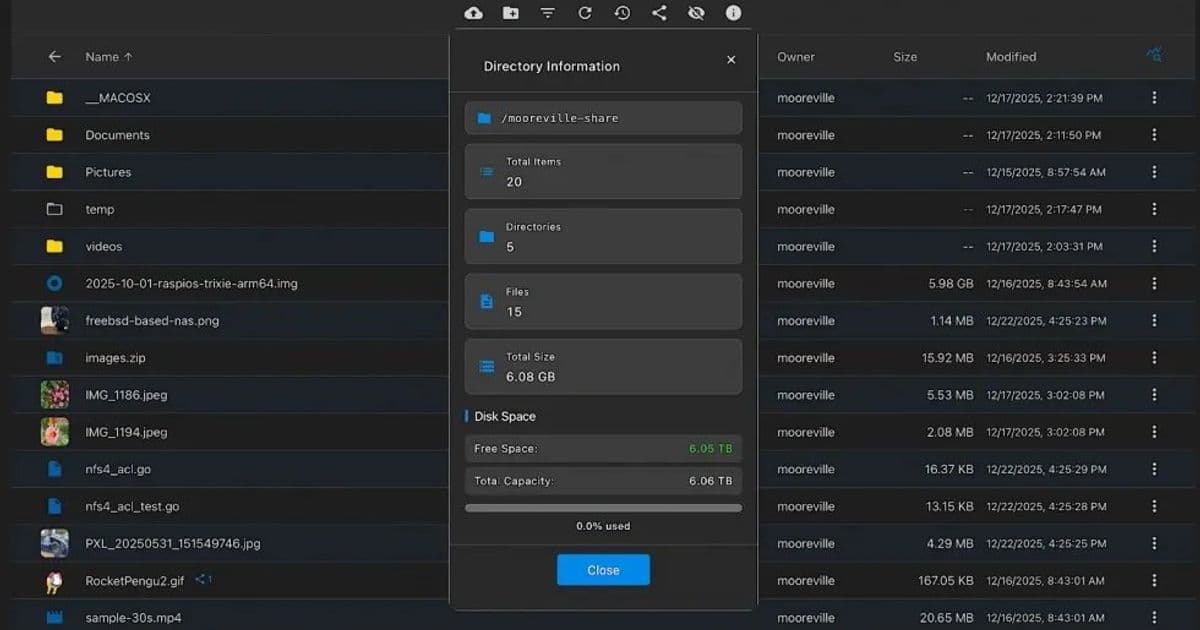
iXsystems introduces TrueNAS WebShare, a browser-based file sharing solution that leverages OpenZFS capabilities and HTTPS security, targeting enterprise environments where traditional SMB/NFS protocols face limitations on mobile and WAN scenarios.
TrueNAS is launching WebShare as a native solution for browser-based file access that addresses specific gaps left by traditional protocols. The announcement positions WebShare as more robust than WebDAV or generic FileBrowser applications, while solving connectivity challenges that arise when deploying SMB or NFS across wide area networks or to mobile devices.
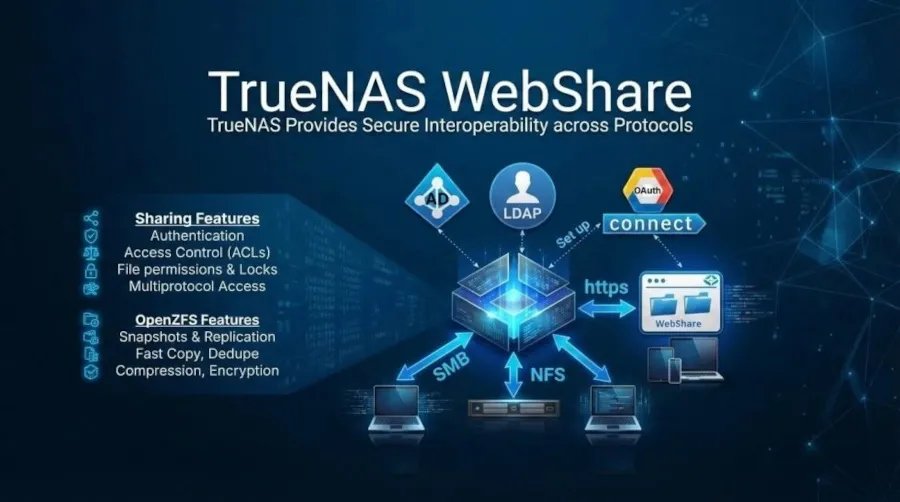
The solution integrates directly with TrueNAS' OpenZFS infrastructure, meaning administrators get copy-on-write snapshots, data integrity verification, and compression without additional configuration. WebShare runs over HTTPS by default, providing encrypted transport without the certificate management overhead typically required for secure file sharing deployments. For enterprises already invested in TrueNAS storage arrays, this creates a unified management experience where file sharing permissions and storage features coexist in a single interface.
Technical Architecture and Protocol Integration
WebShare operates as a TrueNAS middleware service rather than a simple web interface wrapper. The architecture sits alongside existing SMB and NFS services, sharing the same authentication backend and ZFS dataset permissions. This design choice means users can enable WebShare without disrupting current workflows—SMB shares remain active for Windows clients, NFS for Linux systems, while WebShare provides a third access layer.
The service handles file operations through a custom protocol translation layer. When a browser initiates a file upload, WebShare receives the stream and writes directly to the ZFS dataset with appropriate record size settings. Downloads follow the reverse path, reading from ZFS and streaming through HTTP/2 for efficient transfer. The system implements range requests for partial downloads, allowing resumable transfers and adaptive bitrate streaming for media files.
For mobile devices, WebShare's web interface uses responsive design principles but more importantly, it bypasses the need for SMB client software or VPN tunneling. A field technician with a smartphone can access technical documentation, CAD drawings, or log files through a standard mobile browser without installing third-party apps or configuring network settings.
Enterprise Feature Set
The initial release includes several enterprise-focused capabilities:
Access Controls: WebShare inherits TrueNAS' user and group management, supporting Active Directory and LDAP integration. Administrators can set share-level permissions or granular file-level ACLs through the web interface. The system logs all access attempts to the central TrueNAS audit trail.
Share Management: Each WebShare corresponds to a ZFS dataset or child dataset, maintaining the storage efficiency and snapshot capabilities of the underlying filesystem. Creating a share involves selecting a dataset, naming it, and setting permissions—no manual service configuration required.
Protocol Coexistence: The service maintains full compatibility with existing NFS and SMB exports. A dataset shared via WebShare can simultaneously be exported through other protocols without conflicts. This allows gradual migration or hybrid deployments where some users access files through the browser while others use native filesystem protocols.
Security Model: Beyond HTTPS encryption, WebShare implements session management with configurable timeouts, brute-force protection, and optional two-factor authentication. The service runs in an isolated containerized environment within TrueNAS, reducing the attack surface compared to traditional file sharing services.
Deployment Scenarios
The WebShare architecture addresses specific operational challenges:
Remote Access: Instead of opening SMB ports to the internet or maintaining VPN infrastructure, IT teams can expose WebShare through reverse proxies with TLS termination. Mobile workers gain secure file access through standard HTTPS, which traverses corporate firewalls more readily than SMB traffic.
Vendor Collaboration: External contractors or partners can be given temporary WebShare access to specific datasets without provisioning network accounts or exposing internal SMB infrastructure. Access can be time-limited and revoked instantly without affecting other sharing methods.
Cross-Platform Compatibility: WebShare eliminates platform-specific client requirements. A Linux engineer, Windows manager, and iOS field worker can access the same files through their respective browsers without protocol compatibility issues or client software installation.
Availability and Licensing
TrueNAS WebShare is initially positioned as a TrueNAS 26.04 Enterprise feature. Enterprise customers with valid support contracts will receive it as part of the standard TrueNAS Enterprise package. However, iXsystems plans to make the feature available to TrueNAS Community Edition users through TrueNAS Connect, though the exact timeline and feature parity for Community Edition remain unspecified.
The Community Edition distribution follows iXsystems' established pattern of core functionality remaining open-source while enterprise features require commercial licensing. This approach allows smaller deployments or homelab users to evaluate WebShare while ensuring enterprise support revenue.
Comparison with Existing Solutions
WebDAV: While WebDAV provides browser-based file access, it lacks native ZFS integration and often suffers from poor performance and compatibility issues across browsers and operating systems. WebShare's architecture is purpose-built for the TrueNAS environment, optimizing for ZFS characteristics and modern web standards.
FileBrowser Apps: Generic file browser applications typically run as separate services and require manual configuration to integrate with storage systems. WebShare operates as a native TrueNAS service with direct ZFS access, eliminating the abstraction layer that can introduce performance bottlenecks and management complexity.
SMB/NFS: Traditional protocols excel in LAN environments with native OS integration but struggle with NAT traversal, mobile clients, and internet-scale deployments. WebShare complements rather than replaces these protocols, providing an alternative for scenarios where traditional approaches prove cumbersome.
Implementation Considerations
Organizations evaluating WebShare should consider several factors:
Network Architecture: WebShare requires HTTPS port access (typically 443) but can leverage existing TrueNAS web interface infrastructure. Load balancing and reverse proxy configurations are supported for high-availability deployments.
Performance Characteristics: Browser-based transfers may not match native SMB/NFS throughput due to HTTP overhead and browser limitations. For bulk data operations, traditional protocols remain preferable. WebShare excels at targeted file access and mobile scenarios.
User Experience: The web interface provides basic file operations—upload, download, delete, rename—but lacks the deep integration of native filesystem clients. Power users requiring advanced features like locking or extended attributes should continue using SMB/NFS.
Storage Efficiency: Because WebShare writes directly to ZFS datasets, all ZFS features remain active. Snapshots capture WebShare activity, compression reduces storage footprint, and checksums verify data integrity. This integration distinguishes it from solutions that layer above the filesystem.
Future Development Trajectory
The initial WebShare release focuses on core file sharing functionality. Future versions may include:
- Collaborative editing features for document workflows
- Integration with TrueNAS' replication and backup systems
- Enhanced mobile applications that complement the web interface
- API access for programmatic file operations
- Advanced sharing features like expiring links and password protection
iXsystems has indicated that WebShare represents a long-term investment in modernizing TrueNAS' file sharing capabilities. The company's track record with TrueNAS SCALE and CORE suggests regular feature updates and community-driven improvements.
Strategic Implications
WebShare's introduction reflects broader trends in enterprise storage. As workforces become distributed and mobile, the demand for protocol-agnostic file access increases. Traditional protocols designed for local networks struggle in cloud-native and remote-first environments.
By embedding browser-based sharing directly into the storage platform, iXsystems reduces the need for third-party file sync-and-share solutions. Enterprises can maintain data on-premises while providing modern access patterns, potentially reducing costs and improving security posture compared to cloud-only alternatives.
For the TrueNAS ecosystem, WebShare strengthens the platform's position as a comprehensive storage solution. Rather than requiring separate file sharing appliances or cloud services, TrueNAS consolidates storage and sharing into a single managed system.
Conclusion
TrueNAS WebShare addresses a specific but growing need in enterprise storage: providing convenient, secure file access without the complexity of traditional protocol configuration or the risks of internet-exposed SMB services. Its integration with OpenZFS and the TrueNAS management platform creates a cohesive solution that maintains enterprise features while embracing modern web standards.
The feature's availability through TrueNAS Enterprise initially, with planned Community Edition access, follows a sustainable development model that funds ongoing improvement while keeping core functionality accessible. Organizations running TrueNAS should evaluate WebShare for mobile access, remote worker scenarios, and external collaboration—use cases where traditional protocols create friction.
As of January 2026, WebShare represents iXsystems' response to evolving file sharing requirements, built on the proven TrueNAS foundation and designed for the realities of modern, distributed enterprise environments.
For more information, visit TrueNAS.com.
Comments
Please log in or register to join the discussion