A deep dive into the political and economic constraints facing Trump as he attempts to address the cost of living crisis without confronting the corporate monopolies and oligarchs who benefit from the current economic system.
The political landscape presents an increasingly apparent paradox for the Trump administration: the need to address the cost of living crisis conflicts directly with the interests of the oligarch class that forms a key part of his political base. This fundamental tension reveals a structural constraint in modern governance where economic solutions for ordinary citizens often require confronting concentrated corporate power that benefits from the status quo.
The central dilemma facing Trump is straightforward yet politically fraught. To maintain support among working-class voters who elected him on promises of economic relief, he must demonstrate tangible improvements to their daily economic realities. However, the mechanisms driving inflation and cost increases—from grocery prices to entertainment costs—are controlled by corporate monopolies and oligarchs who have significant influence in Washington.
Consider the case of Ticketmaster, which extracts billions from consumers attending concerts, sporting events, and other entertainment. The revenue from these price-gouging practices ultimately flows to oligarchs who own stock in the parent company, Live Nation. As documented in Pluralistic, this represents a classic pattern of concentrated gains for a few and vast diffused losses across millions of consumers.
The grocery sector provides even more compelling examples of how corporate power directly impacts household budgets. Eggflation, for instance, was driven by Cal-Maine, a monopolist controlling virtually every egg brand in American supermarkets. The company openly admitted to raising prices not due to increased costs but because it knew consumers had no alternatives. Similarly, Pepsi and Walmart conspired to force retailers across the country to raise prices on all Pepsi products, allowing Walmart to simultaneously increase its own prices while maintaining competitive pricing against rivals.
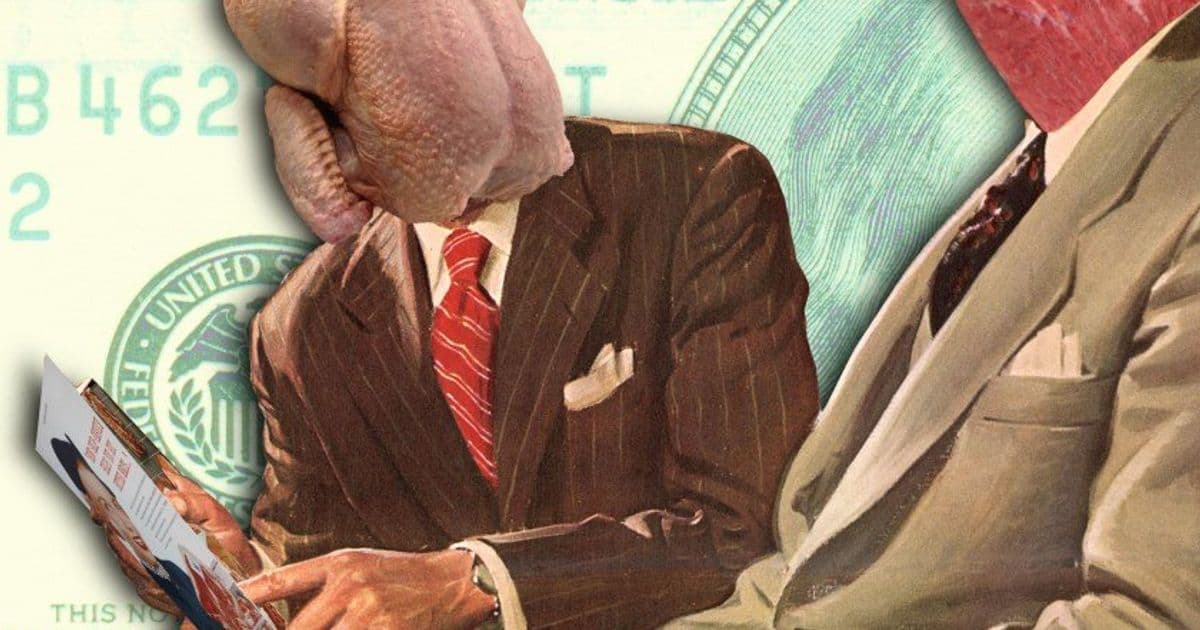
Perhaps most revealing is the meat industry, where four companies process 85% of all beef and nearly every chicken sold in the United States. Rather than explicitly colluding—which would be illegal—these companies use a "price consultancy" called Agri Stats to coordinate price increases. The packers share detailed cost and pricing data with Agri Stats, which then "advises" all members to raise prices in unison. Any company that refuses to play along is effectively excluded from the cartel's information-sharing network.
This system operated for decades with impunity until the Biden administration's Department of Justice brought an antitrust case against Agri Stats in 2023. The case appeared straightforward and winnable, representing a clear opportunity to address one significant driver of food inflation. However, the Trump administration recently settled the case in a manner that benefits Agri Stats, allowing the company to expand its operations by charging restaurants, farmers, and other supply chain participants for access to the data it consolidates. As David Dayen notes in The American Prospect, the company has essentially been "sentenced to make money." This settlement exemplifies how political constraints limit meaningful action on economic issues affecting ordinary Americans.
The pattern extends beyond food and entertainment. In the housing market, companies like Realpage use similar techniques to fix rental prices across the country, contributing to the housing affordability crisis that affects millions of Americans. These systems demonstrate how concentrated market power translates directly into increased costs for consumers.
From a political perspective, this situation creates a no-win scenario for Trump. His base expects action on economic issues, but meaningful solutions would require confronting powerful corporate interests that fund political campaigns and influence policy decisions. The administration's response—focusing on union-busting, immigration enforcement, and military spending—fails to address the root causes of economic distress while potentially exacerbating them through policies that suppress wages and increase costs.
Some observers suggest that state-level action might provide an alternative path forward. Dayen points out that Democratic state Attorneys General have the ability to challenge the Agri Stats settlement through the Tunney Act, which allows them to petition a federal judge to review whether the settlement adequately serves the public interest. Whether any state AGs will seize this opportunity remains uncertain, but it represents a potential avenue for addressing corporate power without direct federal intervention.
The broader implications extend beyond any single industry or policy decision. This situation highlights a fundamental tension in modern capitalism where concentrated market power extracts value from ordinary consumers while simultaneously constraining the political ability to address these issues through democratic processes. The result is a system where economic outcomes increasingly diverge from the preferences of the majority, creating conditions of persistent economic distress that political leaders struggle to resolve.
As the cost of living continues to rise while wages stagnate, the gap between political promises and economic reality grows increasingly apparent. The Trump administration's dilemma—needing to satisfy both working-class voters and corporate benefactors—exposes a structural limitation in addressing economic inequality within a system where concentrated wealth translates directly into political influence.
Comments
Please log in or register to join the discussion