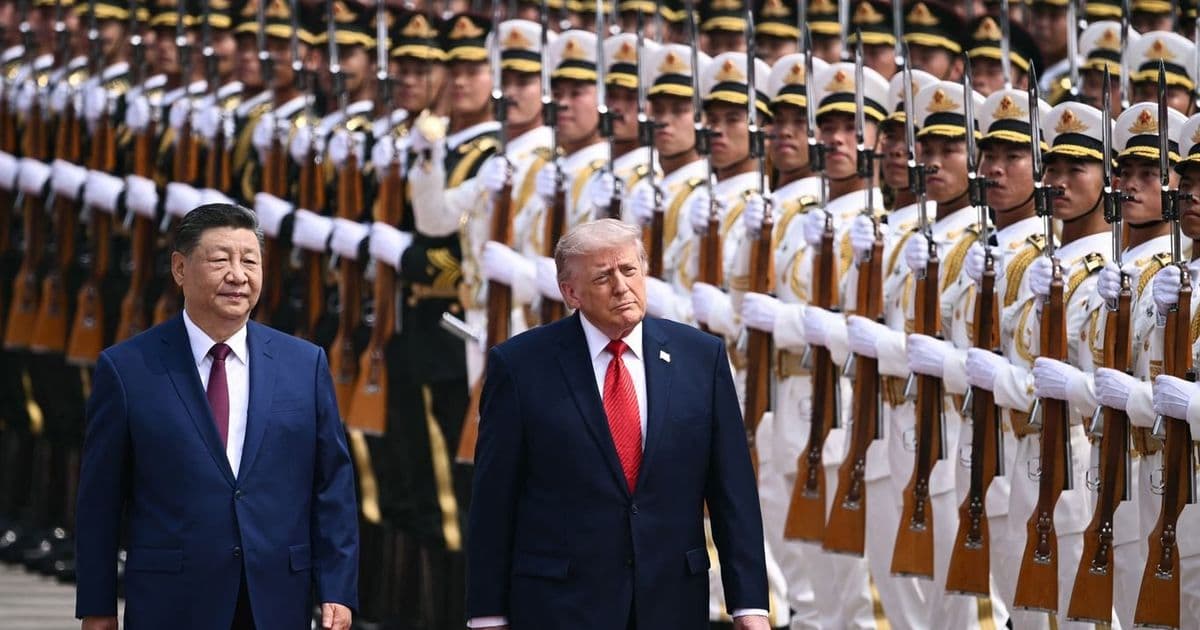
President Trump's apparent hesitation on a $14 billion arms sale to Taiwan following discussions with Chinese President Xi Jinping has created market uncertainty in defense and tech sectors, highlighting the delicate balance of US-China-Taiwan relations.
President Trump's ambiguous stance on a $14 billion arms sale to Taiwan, following his recent talks with Chinese President Xi Jinping, has sent ripples through international markets and raised questions about US commitment to the self-governing island. The potential reversal comes amid delicate diplomatic negotiations between the world's two largest economies, with significant implications for global supply chains, particularly in the semiconductor sector.
The proposed arms package, which includes advanced military equipment and technology, represents one of the largest defense deals in recent years. According to defense industry analysts, the sale includes F-16 fighter jets, missiles, and naval systems critical to Taiwan's defense capabilities. The agreement, initially approved under the previous administration, has been valued at approximately $14 billion, making it a significant economic driver for US defense contractors including Lockheed Martin, Raytheon, and Boeing.
Market analysts have noted immediate reactions to Trump's mixed signals. Defense stocks experienced volatility following the news, with companies heavily invested in Taiwan-related contracts seeing particular turbulence. "The uncertainty surrounding this deal creates immediate challenges for defense contractors who have already allocated resources for production and delivery," noted Sarah Chen, a defense industry analyst at GlobalStrat Partners.
Beyond the immediate financial implications, the potential arms sale reversal carries significant geopolitical weight. Taiwan, a critical player in global semiconductor manufacturing, produces over 60% of the world's semiconductors and accounts for approximately 90% of the most advanced chips produced by Taiwan Semiconductor Manufacturing Company (TSMC). Any disruption to the region's stability could have cascading effects on global tech supply chains already strained by pandemic-related disruptions and recent geopolitical tensions.
The timing of Trump's wavering stance coincides with broader trade negotiations between the US and China. China has consistently opposed US arms sales to Taiwan, viewing them as interference in its internal affairs and a violation of the "one-China" policy. The Trump administration's apparent reconsideration suggests potential concessions in exchange for other economic or diplomatic advantages.
"Taiwan's semiconductor dominance makes it both economically vital and geopolitically vulnerable," explained Dr. Michael Lin, a technology policy expert at the East-West Center. "The uncertainty surrounding US security commitments could lead Taiwan to accelerate its domestic defense capabilities while simultaneously diversifying its semiconductor production to reduce reliance on a single geographic location."
From a market perspective, the situation highlights the growing intersection of defense technology and commercial semiconductor production. Many advanced military systems depend on cutting-edge chips, creating a symbiotic relationship between defense contractors and semiconductor manufacturers. A disruption in arms sales could potentially impact R&D investments in next-generation defense technologies that often spin off into commercial applications.
The potential reversal also raises questions about the reliability of US foreign policy commitments under the current administration. Previous administrations have maintained a policy of "strategic ambiguity" regarding Taiwan's defense, neither confirming nor denying potential US military intervention in case of a Chinese invasion. Trump's apparent shift in approach could alter this long-standing policy with unpredictable consequences for regional stability.
Industry observers note that Taiwan has been gradually increasing its domestic defense capabilities, including developing indigenous fighter jets and missile defense systems. However, the island remains heavily dependent on US military equipment and technology. A significant reduction in US arms sales could accelerate Taiwan's efforts toward self-sufficiency while simultaneously creating opportunities for defense contractors in other countries, including European nations and Japan.
The situation also underscores the economic interdependence between the US, China, and Taiwan. While political tensions remain high, trade between these economies continues to grow, with Taiwan maintaining significant trade surpluses with the US. The semiconductor industry, in particular, has created deep economic interdependencies that complicate geopolitical decision-making.
According to the US Department of State, the US has maintained a policy of assisting Taiwan in maintaining a sufficient self-defense capability as outlined in the Taiwan Relations Act. This policy has consistently included arms sales, though the scale and timing have varied depending on broader US-China relations.
As the situation develops, market analysts will be watching for signals from both the Trump administration and Chinese officials regarding the future of the arms deal and broader US-China relations. The outcome could have lasting implications for defense contractors, semiconductor manufacturers, and global supply chains already navigating unprecedented levels of geopolitical uncertainty.
In the immediate term, defense industry executives are likely to engage in intensive lobbying efforts to secure the arms deal, while simultaneously developing contingency plans for potential reversals. The episode serves as a reminder of the increasingly complex relationship between political decisions and market outcomes in an interconnected global economy, as noted by analysts at the Office of the United States Trade Representative.
Comments
Please log in or register to join the discussion