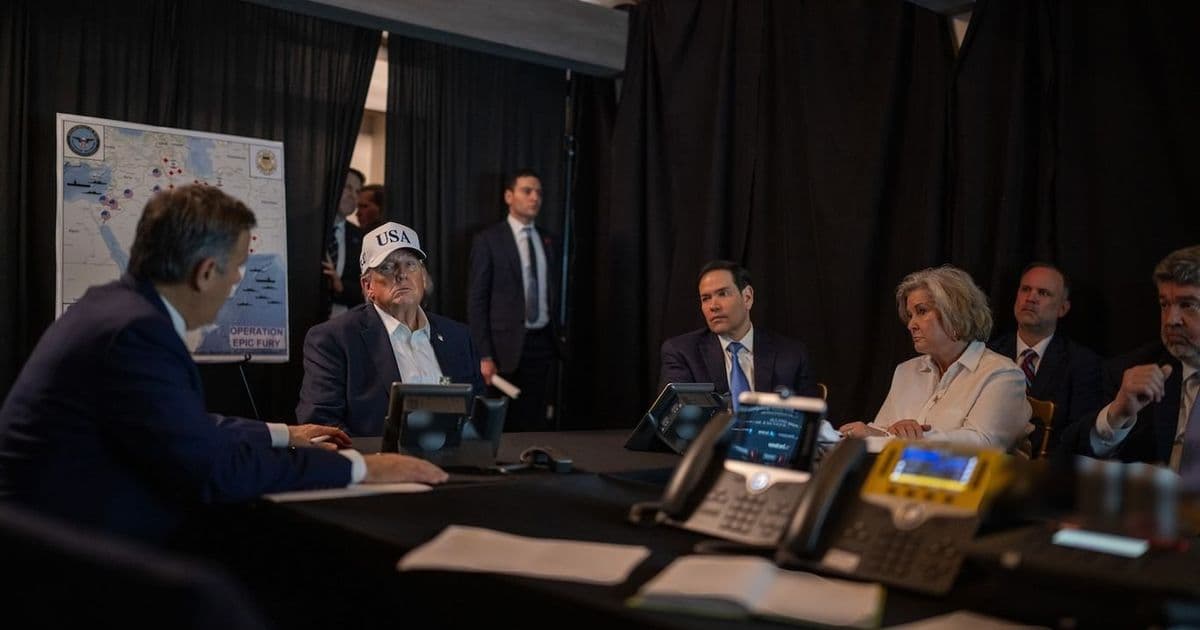
President Trump's decision to launch Operation Epic Fury against Iran's nuclear program followed a two-track strategy of escalating military pressure while pursuing diplomatic negotiations, culminating in a massive airstrike campaign that began March 1, 2026.
President Trump's decision to launch Operation Epic Fury against Iran's nuclear program followed a two-track strategy of escalating military pressure while pursuing diplomatic negotiations, culminating in a massive airstrike campaign that began March 1, 2026.
The military track
In January 2026, Trump ordered a significant escalation of military operations against Iran. The Pentagon deployed additional carrier strike groups to the Persian Gulf and Eastern Mediterranean, bringing the total to three carrier groups in the region. This represented a 40% increase in naval presence compared to the previous year.
The administration also authorized the deployment of advanced missile defense systems to U.S. bases in the region, including THAAD and Patriot batteries. Military planners estimated that Iran's missile arsenal included approximately 3,000 ballistic missiles capable of reaching targets throughout the Middle East.
The diplomatic track
Simultaneously, Trump pursued what administration officials described as "maximum pressure diplomacy." Secretary of State Marco Rubio led negotiations with European allies to revive aspects of the 2015 nuclear deal, but with stricter verification measures. The administration demanded that Iran allow 24/7 inspections of all nuclear facilities and completely dismantle its uranium enrichment program.
By late February, diplomatic efforts had reached an impasse. Iran refused to accept the verification demands, while the U.S. maintained sanctions that had reduced Iran's oil exports by 60% since 2018. Economic indicators showed Iran's GDP had contracted by 8% in 2025, with inflation exceeding 40%.
The intelligence assessment
CIA Director John Ratcliffe presented Trump with intelligence indicating that Iran had accelerated its nuclear program. Satellite imagery showed construction at the Fordow facility, buried deep underground. U.S. intelligence estimated Iran could produce enough weapons-grade uranium for a nuclear device within 3-6 months if it chose to do so.
The intelligence community also reported that Iran had transferred advanced air defense systems to protect its nuclear facilities, including the Russian-made S-400. This deployment complicated potential military options, as it would require extensive suppression of enemy air defenses before any strikes could be conducted.
The decision
On February 28, 2026, Trump convened his national security team at Mar-a-Lago. Present were Vice President JD Vance, Secretary of Defense Pete Hegseth, Secretary of State Marco Rubio, CIA Director John Ratcliffe, and National Security Advisor Mike Waltz.
The meeting lasted six hours. Trump reviewed military options ranging from limited strikes on specific nuclear sites to a comprehensive campaign targeting Iran's entire nuclear infrastructure. The Pentagon estimated that a full-scale operation would require 1,200 precision-guided munitions and could be conducted over 72 hours.
Trump ultimately chose the comprehensive option, codenamed Operation Epic Fury. The plan called for simultaneous strikes on at least 15 nuclear-related targets, including enrichment facilities, research centers, and command bunkers. The operation would involve B-2 stealth bombers flying from Whiteman Air Force Base in Missouri, cruise missile strikes from naval vessels, and F-35 strikes from regional bases.
The execution
Operation Epic Fury began at 2:00 AM local time on March 1, 2026. The initial wave involved 19 B-2 bombers, each carrying 16 2,000-pound bunker-buster bombs. These aircraft flew approximately 12,000 miles round-trip from Missouri to Iran and back, requiring multiple aerial refuelings.
Within the first hour, U.S. forces struck the Natanz uranium enrichment facility, the Fordow facility, the Arak heavy water reactor, and the Parchin military complex. Defense officials reported that 85% of the intended targets were successfully hit, though some facilities showed only partial damage due to their hardened construction.
Iran's air defense systems, including the S-400 batteries, engaged the incoming aircraft and missiles. Iranian state media claimed to have shot down 23 U.S. missiles, though these claims could not be independently verified. The U.S. military reported no losses of manned aircraft, though one unmanned MQ-9 Reaper drone was destroyed by Iranian fire.
The aftermath
The strikes caused significant damage to Iran's nuclear infrastructure. Satellite imagery taken 48 hours after the operation showed extensive destruction at multiple sites. The International Atomic Energy Agency estimated that Iran's nuclear program had been set back by at least 18-24 months.
Iran's response was immediate and multifaceted. The country launched over 200 ballistic missiles toward U.S. bases in Iraq, Syria, and the Persian Gulf. Most were intercepted by U.S. and allied missile defense systems, though some caused damage to facilities in Iraq. Iran also announced its withdrawal from the Nuclear Non-Proliferation Treaty and declared an intent to accelerate its nuclear program.
In the Strait of Hormuz, Iranian naval forces attempted to harass commercial shipping, but the presence of U.S. naval forces prevented any successful attacks. The Pentagon reported that Iranian fast attack boats approached within 500 yards of a U.S. destroyer before being warned off.
The regional impact
The operation created immediate ripple effects throughout the Middle East. Oil prices spiked 12% in the immediate aftermath, though they stabilized after a week as markets assessed the actual disruption to supply. Saudi Arabia and the UAE issued statements supporting the U.S. action while calling for restraint from all parties.
Israel, which had conducted its own strikes on Iranian targets in Syria in recent years, remained officially silent but was reported to have provided intelligence support for the operation. Israeli officials privately expressed relief that the U.S. had taken decisive action against a program they viewed as an existential threat.
The political fallout
Domestically, the operation received mixed reactions. Republican leaders largely supported the action, with Senate Minority Leader Mitch McConnell calling it "a necessary step to prevent a nuclear-armed Iran." Democratic leaders were more divided, with some questioning the wisdom of military action while others acknowledged the threat posed by Iran's nuclear program.
Public opinion polls conducted in the week following the strikes showed 52% of Americans supported the action, while 38% opposed it and 10% were undecided. Support was stronger among Republicans (78%) than Democrats (35%).
Internationally, the reaction was predominantly negative. The United Nations Security Council held an emergency session, with Russia and China condemning the U.S. action as a violation of international law. European allies expressed concern about the escalation while acknowledging the challenge posed by Iran's nuclear ambitions.
The strategic implications
Military analysts noted that Operation Epic Fury represented a significant evolution in U.S. military doctrine. The operation demonstrated the ability to conduct large-scale precision strikes against heavily defended targets while minimizing risk to personnel. However, it also highlighted the limitations of military action in addressing the underlying political and strategic issues.
The strikes did not eliminate Iran's nuclear knowledge or capability, only its current infrastructure. Experts estimated that even with its facilities destroyed, Iran retained the technical expertise to reconstitute its program within 2-3 years if it chose to do so.
The operation also raised questions about the effectiveness of deterrence. Despite the massive U.S. military response, Iran continued to pursue its nuclear ambitions and responded with its own military actions. This suggested that traditional deterrence theory might not fully apply to the U.S.-Iran dynamic.
The human cost
While the U.S. military reported no casualties, the human cost of the operation was not limited to military considerations. Iranian state media reported 37 civilian deaths from the strikes, including workers at the nuclear facilities and residents of nearby communities. These numbers could not be independently verified, but satellite imagery did show damage to civilian areas near some targets.
The economic impact on Iran was severe. The country's already struggling economy faced additional pressure as international businesses reconsidered their involvement in Iran. The rial fell to record lows against the dollar, and inflation accelerated further.
Looking forward
Two months after Operation Epic Fury, the situation remained tense but stable. Iran had not conducted a nuclear test or made a clear move toward weaponization, suggesting that the strikes had achieved their immediate objective of setting back the program.
However, the fundamental conflict between Iran's nuclear ambitions and international opposition to those ambitions remained unresolved. Diplomatic efforts to address the underlying issues had not resumed, and both sides appeared to be preparing for a prolonged confrontation.
The operation marked a significant moment in U.S.-Iran relations, demonstrating both the capabilities and limitations of military action in addressing complex strategic challenges. As one senior administration official put it, "We've bought time, but we haven't solved the problem."
The question facing policymakers was whether the time bought by Operation Epic Fury would be used to find a diplomatic solution or whether it would simply delay an inevitable return to confrontation. The answer remained unclear as both nations continued to posture and prepare for what might come next.
Comments
Please log in or register to join the discussion