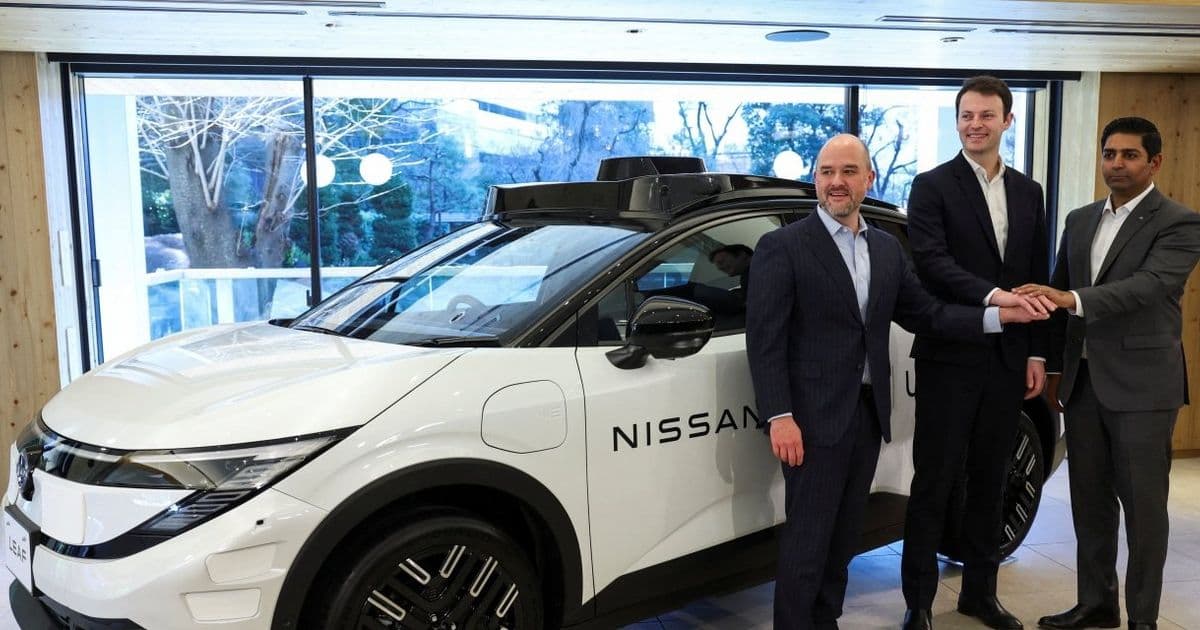
Uber partners with Nissan and Wayve to launch robotaxi services in Tokyo by late 2026, marking the company's first autonomous vehicle partnership in Japan.
Uber is expanding its autonomous vehicle ambitions with a new partnership in Japan, teaming up with Nissan Motor and UK-based autonomous driving company Wayve to launch robotaxi services in Tokyo. The pilot program, scheduled to begin in late 2026, represents Uber's first autonomous vehicle partnership in Japan and marks a significant step in the company's global autonomous driving strategy.
Under the agreement, Uber will integrate Wayve's self-driving technology into Nissan vehicles to offer robotaxi services through a licensed taxi partner in Japan. The companies announced the collaboration on Wednesday, positioning it as a milestone in bringing autonomous mobility solutions to one of the world's largest and most technologically advanced markets.
The partnership brings together three key players in the autonomous vehicle ecosystem: Uber's ride-hailing platform and customer base, Nissan's automotive manufacturing expertise and vehicle fleet, and Wayve's cutting-edge AI driving technology. Wayve, headquartered in London, has been developing embodied AI systems for autonomous vehicles and has been testing its technology on public roads in the UK.
This collaboration comes as Uber continues to expand its autonomous vehicle operations globally. The company has been working with various partners to deploy self-driving cars in different markets, including partnerships with Waymo in the United States and other autonomous vehicle companies in different regions.
For Nissan, the partnership represents an opportunity to showcase its vehicles equipped with advanced autonomous driving capabilities in a major metropolitan market. The Japanese automaker has been investing in autonomous driving technology and sees the Tokyo pilot as a way to demonstrate its commitment to future mobility solutions.
The timing of the Tokyo launch, planned for late 2026, suggests the companies are taking a measured approach to deployment. This timeline allows for extensive testing, regulatory approvals, and infrastructure preparation before commercial operations begin. Tokyo's complex urban environment, with its dense traffic, narrow streets, and unique driving conditions, will provide a challenging but valuable testing ground for the autonomous technology.
Wayve's involvement brings its AI-first approach to autonomous driving to the Japanese market. The company's technology focuses on learning from human driving patterns and adapting to various road conditions, which could be particularly valuable in navigating Tokyo's diverse and sometimes unpredictable traffic scenarios.
The partnership also highlights the growing trend of collaboration in the autonomous vehicle industry, where technology companies, automakers, and ride-hailing platforms are joining forces to accelerate the development and deployment of self-driving vehicles. Rather than each company trying to develop complete autonomous systems independently, these partnerships allow each player to focus on their core competencies while leveraging the strengths of their partners.
For Uber, expanding into the Japanese market through autonomous vehicles could help the company strengthen its presence in Asia, where it has faced competition from local ride-hailing services. The robotaxi service could also help Uber diversify its revenue streams and reduce its reliance on human drivers, potentially lowering operational costs in the long term.
The Tokyo pilot will likely face various regulatory and technical challenges, including obtaining necessary approvals from Japanese transportation authorities, ensuring the safety of autonomous operations in a busy urban environment, and addressing public acceptance of self-driving vehicles. The companies will need to demonstrate that their technology can handle Tokyo's specific driving conditions, including heavy pedestrian traffic, complex intersections, and varying weather conditions.
This partnership also reflects the broader industry trend toward autonomous vehicle deployment in major cities worldwide. As technology improves and regulatory frameworks evolve, companies are increasingly looking to launch commercial autonomous services in urban areas where they can provide efficient transportation solutions while gathering valuable real-world data to improve their systems.
The success of this Tokyo pilot could pave the way for broader autonomous vehicle deployment in Japan and potentially serve as a model for future partnerships in other Asian markets. It also represents another step in Uber's long-term vision of creating a global autonomous mobility network that can operate seamlessly across different regions and cultures.
As the launch date approaches, the companies will likely provide more details about the specific vehicles to be used, the extent of the service area, pricing models, and safety protocols. The Tokyo pilot will be closely watched by industry observers, regulators, and competitors as a test case for autonomous vehicle deployment in one of the world's most demanding urban environments.
The collaboration between Uber, Nissan, and Wayve demonstrates the complex ecosystem required to bring autonomous vehicles to market, involving technology development, automotive manufacturing, ride-hailing operations, and regulatory compliance. As these elements come together in Tokyo, the partnership could help accelerate the timeline for commercial autonomous vehicle services in Japan and beyond.
Comments
Please log in or register to join the discussion