
New UK regulations requiring 'robust' age verification for adult websites take effect, mandating methods like facial scans and ID checks. While aimed at protecting minors, experts warn of VPN workarounds, data privacy risks, and potential user migration to unregulated platforms.

A seismic shift in online content regulation is underway in the UK. As of July 25, websites hosting pornography must implement "robust" age verification systems under the Online Safety Act, replacing the long-standing honor system where users simply ticked a box declaring they were over 18. Non-compliant platforms face staggering fines—up to £18 million or 10% of global revenue. Ofcom, the UK's media regulator overseeing enforcement, estimates 14 million UK adults consume online pornography and asserts these measures will significantly curb minors' exposure to explicit material.
The Verification Toolkit: From Facial AI to Credit Cards
Ofcom has outlined seven permissible age-check methods, including:
- Credit card verification: Confirming payment card validity and holder age
- Photo ID matching: Scanning government-issued IDs (passports, driver's licenses)
- Facial age estimation: AI analysis of selfies with "liveness" detection to prevent photo spoofing
- Digital identity wallets: Third-party services confirming age without sharing full ID details
 Facial age estimation uses liveness checks to block static photos, while email verification typically requires code retrieval from a user's inbox.
Major platforms like Pornhub (owned by Aylo), Reddit, X (formerly Twitter), Grindr, and Discord have committed to implementing checks. X plans to deploy proprietary facial estimation AI, while Discord offers UK users face or ID scanning. Despite thousands of sites pledging compliance, cybersecurity experts question both effectiveness and privacy implications.
The VPN Loophole and Enforcement Challenges
A prevalent user reaction highlights a critical flaw:
"Sure, I will give out my sensitive information to some random, unproven company or... I will use a VPN. Difficult choice."
Virtual Private Networks (VPNs) mask user locations, allowing access to geo-blocked or restricted content. Ofcom mandates platforms remove content promoting VPNs for circumvention, and the government confirms such promotion is illegal under the Act. However, Katie Freeman-Tayler of child safety group Internet Matters predicts increased VPN adoption:
"VPN use is only likely to increase when measures come into force later this week."
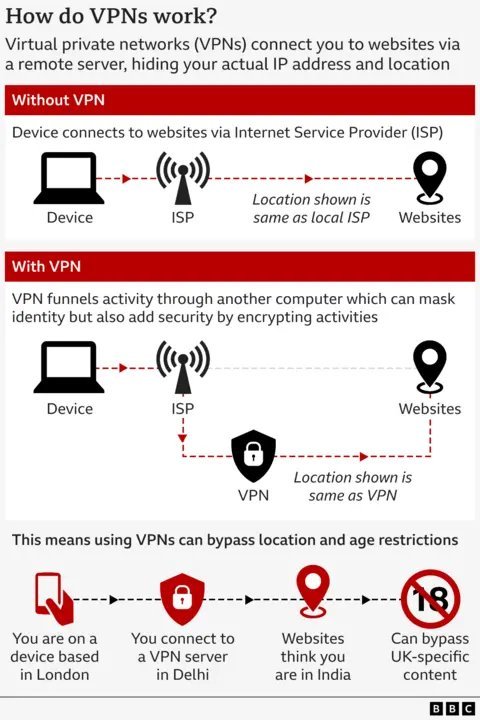 VPNs reroute traffic through remote servers, bypassing location-based restrictions like the UK's new age checks.
Cybersecurity analyst Chelsea Jarvie acknowledges verification methods include anti-circumvention controls but warns:
"Determined users will try to find ways around them, potentially migrating to more anonymous platforms." She also highlights pervasive distrust: "Many remain cautious about handing over personal identity information."
Privacy Fears and Unintended Consequences
User interviews reveal deep unease. Tom, a frequent porn consumer in his 20s, fears data breaches could expose private viewing habits, particularly for LGBTQ+ individuals not publicly out:
"It's not a question of if something will leak, but when."
Another user, Shea, dismisses ID uploads as invasive:
"Please upload a face scan of your ID and passport? No thank you." He predicts the friction will push users toward unregulated "fringe" sites with fewer safeguards—ironically increasing risks for minors and adults alike.
Age-check firms like Verifymy insist they don't retain personal data, but Andy Lulham concedes:
"An adult could complete a check on behalf of a child, comparable to buying a pornographic magazine for them."
Regulatory Tightrope: Safety vs. Privacy
This mandate places the UK at the forefront of a global debate. France enacted similar rules, prompting Pornhub's temporary exit, while Texas mandates porn site ID checks. As platforms scramble to comply, fundamental tensions emerge: Can age verification be both "robust" and privacy-respecting? Will regulatory walls fragment the internet? And does this model set a precedent for broader online age-gating? The technical execution of these systems—and users' reactions—will shape answers with implications far beyond adult content.
Source: BBC News
Comments
Please log in or register to join the discussion