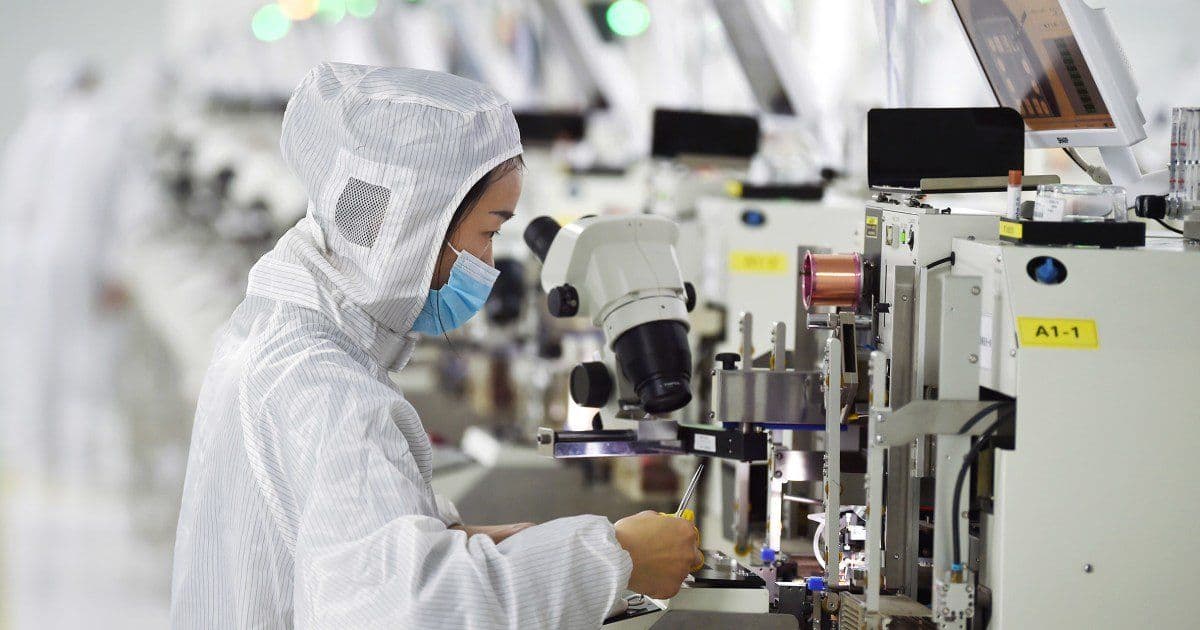
A proposed US bill seeks to ban exports of DUV lithography technology to China, targeting a critical choke point for AI development as China's chipmaking equipment imports surge from $10.7B in 2016 to $51.1B in 2025.
The US is moving to tighten restrictions on semiconductor manufacturing technology exports to China with the introduction of the MATCH Act, which would ban exports of deep ultraviolet (DUV) lithography equipment - a critical technology for AI chip production.
China's Chip Equipment Imports Surge
According to data cited in the bill, China's imports of chipmaking equipment have grown dramatically over the past decade:
- 2016: $10.7 billion
- 2025: ~$51.1 billion
The MATCH Act (Manufacturing and Advanced Chip Technology for China) would build on existing restrictions by closing loopholes in DUV lithography technology exports, which remain a critical choke point for China's AI industry development.
Why DUV Lithography Matters
DUV lithography equipment is essential for producing advanced semiconductors used in AI applications. While not as cutting-edge as extreme ultraviolet (EUV) technology, DUV systems are still crucial for manufacturing chips at nodes below 7nm.
China has been investing heavily in domestic semiconductor manufacturing capabilities, but still relies on foreign equipment for advanced production. The proposed ban would significantly impact China's ability to produce AI chips domestically.
Industry Context
This legislative move comes amid broader tensions between the US and China over technological supremacy in AI and semiconductor manufacturing. The US has already implemented export controls on advanced AI chips and semiconductor manufacturing equipment, but DUV technology has remained accessible to Chinese manufacturers.
Broader AI Industry Developments
While the US-China tech tensions escalate, the AI industry continues rapid evolution:
Google's Gemma 4 Launch Google has released Gemma 4, described as its "most intelligent" open model family, built for advanced reasoning and agentic workflows. The models are available under an Apache 2.0 license, allowing for commercial use and customization.
Arcee AI's Open Source Push Arcee AI has released Trinity-Large-Thinking, a 399B-parameter text-only reasoning model under an Apache 2.0 license, continuing the trend toward open-source AI development.
Anthropic's Biotech Acquisition Anthropic has acquired Coefficient Bio for approximately $400 million. The startup was developing a platform enabling AI to run biotech tasks such as planning drug research, signaling AI's expanding role in life sciences.
Global AI Divide
Meanwhile, some startups and researchers unable to access the most advanced chips are adopting a "frugal AI" approach, building smaller models on open-weight systems. This trend highlights the widening global divide in AI adoption and the push for more efficient, accessible AI solutions.
The MATCH Act represents a significant escalation in US efforts to maintain technological superiority in AI and semiconductors, potentially reshaping global supply chains and accelerating China's push for domestic semiconductor independence.
Comments
Please log in or register to join the discussion