Verizon has begun issuing $20 account credits to customers affected by last week's nationwide cellular outage, which left millions stuck in SOS mode. While the gesture acknowledges the disruption, the incident raises deeper questions about network resilience and the growing dependence on cellular connectivity for essential services.
Verizon customers across the United States began receiving text messages this week with instructions to redeem a $20 account credit for the widespread outage that occurred on January 14. The message, which states the credit is intended to cover "multiple days of service," represents the company's formal response to an incident that left millions unable to make calls, send texts, or access data for several hours.
"We let you down this week. For that we are truly sorry," the text message reads. "We would like to extend you a $20 account credit that can be easily redeemed via the link below. On average, this covers multiple days of service. This credit isn't meant to make up for what happened. But it's a way of acknowledging your time and showing that this matters to us."
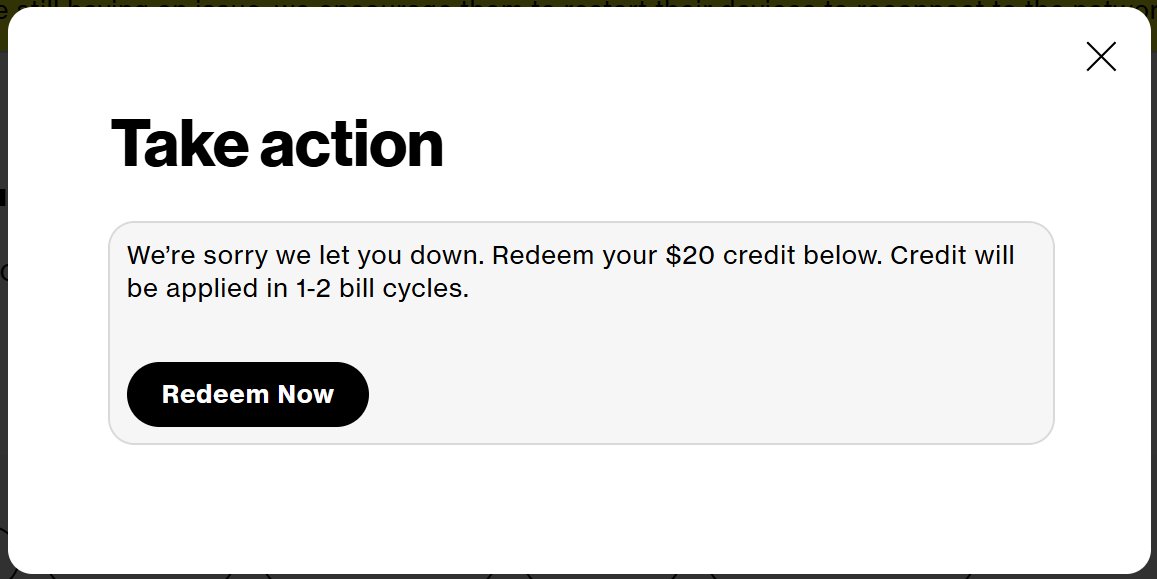
The credit redemption process requires customers to log into their Verizon.com account, navigate to the mobile section, and click a "Redeem Now" button under a "Take action" prompt. Verizon is issuing one credit per account, regardless of how many lines are associated with it, and only the primary account holder will receive the notification.
The Outage in Context
The incident began around 12 PM ET on January 14, when customers nationwide reported sudden loss of cellular service. Many phones automatically switched to "SOS mode," a feature that allows emergency calls only when no cellular network is available. The outage lasted approximately 10 hours, with Verizon confirming resolution around 10:20 PM ET that night.
Verizon initially attributed the problem to a "software issue" and stated there was no indication of a cybersecurity incident. However, the company has not provided technical details about which systems were affected, what specific software failed, or how the problem propagated across its network infrastructure.
This lack of transparency is particularly notable given the outage's scale. Unlike localized tower failures, a nationwide outage suggests a systemic issue—likely involving core network systems, routing protocols, or authentication mechanisms that affect multiple regions simultaneously.
The Growing Cost of Connectivity Dependence
While $20 represents a nominal credit for most consumers, the outage's impact extends far beyond direct financial loss. Modern life increasingly depends on cellular connectivity for:
- Emergency services: SOS mode, while functional, limits users to emergency calls only, cutting off access to non-emergency medical services, family check-ins, and other critical communications.
- Work continuity: Remote workers, gig economy drivers, and field technicians lost access to essential applications and communication tools.
- Financial transactions: Mobile banking, payment apps, and digital wallets became inaccessible for millions.
- Transportation: Ride-sharing services, navigation apps, and vehicle connectivity features (like Tesla's cellular-dependent functions) were disrupted.
For small business owners who rely on mobile point-of-sale systems or delivery drivers using real-time mapping, even a few hours of downtime can mean significant revenue loss—far exceeding $20.
Network Architecture and Failure Points
Modern cellular networks are complex systems with multiple layers of redundancy, but they remain vulnerable to certain types of failures:
Core Network Dependencies: Cellular networks consist of radio access networks (towers), backhaul connections, and core networks that handle authentication, routing, and service delivery. A software failure in the core network—particularly in systems like the Home Location Register (HLR) or Home Subscriber Server (HSS)—can prevent devices from authenticating with the network, leaving them unable to connect even when towers are operational.
Software-Defined Networking: Many carriers now use software-defined networking (SDN) and network function virtualization (NFV) to manage traffic more efficiently. While these technologies offer flexibility, they also introduce new failure modes. A bug in virtualized network functions can propagate rapidly across the infrastructure.
Geographic Redundancy: Carriers typically maintain redundant systems across multiple data centers, but a configuration error or software update that affects all instances simultaneously can defeat these safeguards.
The fact that Verizon restored service by "restarting devices" suggests the issue may have involved authentication or registration processes. When networks experience certain failures, devices can become stuck in a registration loop or fail to re-authenticate after the core issue is resolved. A device restart forces a fresh network registration attempt.
Industry Patterns and Precedents
This outage follows a pattern of increasing network disruptions in recent years:
- July 2022: AT&T experienced a nationwide outage affecting 911 services in multiple states.
- February 2024: T-Mobile had a brief nationwide outage impacting voice and data services.
- August 2024: A major European carrier experienced a multi-day outage affecting millions of customers.
These incidents highlight a troubling trend: as networks become more software-dependent and integrated, the potential for widespread failures increases. The shift from hardware-based network elements to virtualized software functions creates new attack surfaces and failure modes.
Practical Implications for Consumers
While the $20 credit provides some compensation, customers should consider several practical steps:
Verify credit receipt: Only the primary account holder will receive the text message. Other lines on the account won't receive individual notifications but will benefit from the credit.
Document the outage: For business users or those who suffered significant losses, documenting the outage's impact may be necessary for insurance claims or business interruption considerations.
Evaluate alternatives: Consider whether you need backup communication methods for critical situations. This might include:
- Wi-Fi calling capabilities (though these depend on internet connectivity)
- Satellite messaging services for emergencies (like Apple's Emergency SOS via satellite)
- Alternative carriers for essential devices
Monitor network status: Verizon and other carriers typically maintain status pages. Bookmark these for future incidents:
- Verizon Network Status
- Downdetector for real-time user reports
The Bigger Picture: Network Resilience
This outage serves as a reminder that cellular networks, while generally reliable, are not infallible. As we increasingly rely on these networks for critical functions—from healthcare monitoring to emergency services—the industry must prioritize resilience over pure efficiency.
For network operators, this means:
- Implementing more robust testing procedures for software updates
- Maintaining better isolation between network segments to prevent cascade failures
- Improving transparency about outage causes and prevention measures
- Developing faster recovery mechanisms that don't require customer intervention
For consumers, it means recognizing that connectivity is a utility with inherent reliability limitations, and planning accordingly for critical communications.
The $20 credit acknowledges customer inconvenience, but the real value lies in the incident serving as a catalyst for examining our collective dependence on these networks and the importance of building more resilient communication infrastructure for the future.
*For ongoing updates on network reliability and security best practices, *
Comments
Please log in or register to join the discussion