
Microsoft's attempt to automatically attribute code to Copilot in commit messages sparked developer outrage, revealing tensions between AI assistance and developer autonomy in the modern coding landscape.
The development community erupted recently when Microsoft's VS Code began automatically adding "Co-authored-by: Copilot" to commit messages, even when users had disabled AI features. This seemingly small change touched on a fundamental question in the age of AI-assisted development: who gets credit for code, and how much control should developers have over their own work?
The Technical Timeline
The controversy began in VS Code version 1.110, when Microsoft introduced a setting called git.addAICoAuthor with three possible values:
off- no attribution regardless of Copilot assistancechatAndAgent- attribution only for code generated via chat featuresall- attribution for any AI-generated code (chat, inline completions, NES)
Initially, the default was set to off. However, in version 1.117 (released April 22), Microsoft changed the default to all without clear communication. This led to commit messages automatically including "Co-authored-by: Copilot [email protected]" even when users had disabled AI features through the disableAIFeatures setting.
A subsequent update in version 1.118 (released April 29) changed the default to chatAndAgent, but the damage was done. The feature had already claimed credit for work done entirely by developers in numerous repositories.
The Developer Backlash
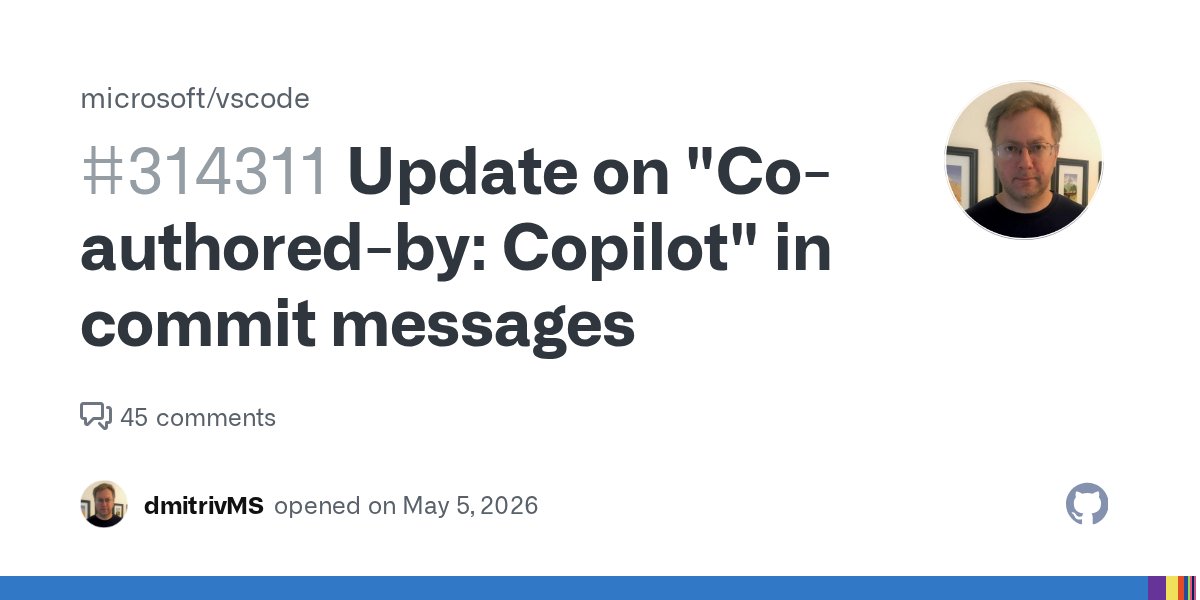
The GitHub issue tracking this problem (#314311) quickly gained traction, with over 100 negative reactions and dozens of developer comments expressing frustration. The backlash wasn't just technical—it struck at the core of professional identity and attribution in software development.
"Automatically enabling this was bad," commented developer martinbean. "Then claiming it was to 'fix a bug' is utterly ridiculous. We've seen Microsoft shoehorning Copilot into literally everything it can, so when automatically adding 'Co-authored by Copilot' to commits from inside a Microsoft code editor is claimed to be an 'accident', you can understand how people just aren't going to believe that. At all."
The sentiment was echoed by many developers who felt their professional work was being co-opted by an AI tool without their consent. This raises important questions about attribution in an era where AI assistance is becoming ubiquitous in development environments.

Process Failures and Cultural Issues
Beyond the technical implementation, the controversy exposed significant process failures at Microsoft. The feature was pushed by a Product Manager who admitted in comments that "the way this was implemented and rolled out fell short. In particular, we didn't meet the bar on correctness, respecting user settings, and the level of validation expected for a change like this."
The original pull request implementing this change had no description, raising questions about code review processes. Developer drtaru commented: "My real question is why was the original PR opened by a PM with 'No description provided.' And how on earth was such an empty PR approved and merged?"
This suggests a broader cultural issue where significant changes to developer tools are being implemented without proper oversight or consideration of their impact on the development community.
The Broader Context: AI Attribution in Development
This controversy occurs as AI tools like GitHub Copilot, Amazon CodeWhisperer, and others become increasingly integrated into development workflows. The question of how to attribute AI-assisted code is becoming more pressing as these tools generate larger portions of code in real-world applications.

Some developers have suggested alternative approaches, such as using "assisted-by" instead of "co-authored-by" for AI agents, as proposed in GitHub issue #313962. This would acknowledge AI assistance without claiming equal authorship, which many developers find inappropriate.
The issue also touches on business concerns. In regulated industries like fintech, improper attribution could potentially cause developers and their employers to fail audits or breach contracts, as noted by developer davmillar: "For some developers of closed-source, proprietary business software in certain applications (fintech comes to mind) this could be something that causes a developer to fail an audit. More importantly, the dev's employer could fail an audit and face steep financial penalties or risk massive business loss due to breach of contract."
Microsoft's Response and Future Plans
In response to the backlash, Microsoft has taken several steps:
- Reverted the default for AI attribution back to "off"
- Ensured the feature is disabled when
disableAIFeaturesis set to true - Promised to require user consent before adding commit trailers
- Indicated a possible shift to "assisted-by" attribution instead of "co-authored-by"
- Promised to add model information to attribution
"We'll make/retain the following changes: The attribution is never applied for changes that are not AI-related," wrote developer dmitrivMS. "Before adding a commit trailer, the user will have to give consent, no matter the default value of the setting."
{{IMAGE:3}}
Implications for the Development Ecosystem
This controversy highlights several important trends in the development ecosystem:
Growing skepticism of AI attribution: As AI tools become more capable, developers are becoming more protective of their professional identity and work product.
Process failures in large organizations: The ease with which significant changes can be pushed to widely-used tools like VS Code raises questions about governance and oversight in large tech companies.
The tension between innovation and respect: Companies are eager to showcase AI capabilities but must balance this with respect for user autonomy and professional standards.
Regulatory concerns: As AI-generated code becomes more prevalent, questions about attribution, intellectual property, and compliance will become increasingly important.
The GitHub Copilot team, backed by Microsoft's substantial resources, continues to iterate on these features. However, this incident serves as a reminder that even well-funded, well-intentioned AI tools can face significant backlash when they overstep boundaries in how they interact with and claim credit for developer work.
As the development community continues to grapple with AI integration, this controversy will likely be remembered as a pivotal moment in the conversation about AI attribution, professional identity, and the future of human-AI collaboration in software development.
Comments
Please log in or register to join the discussion