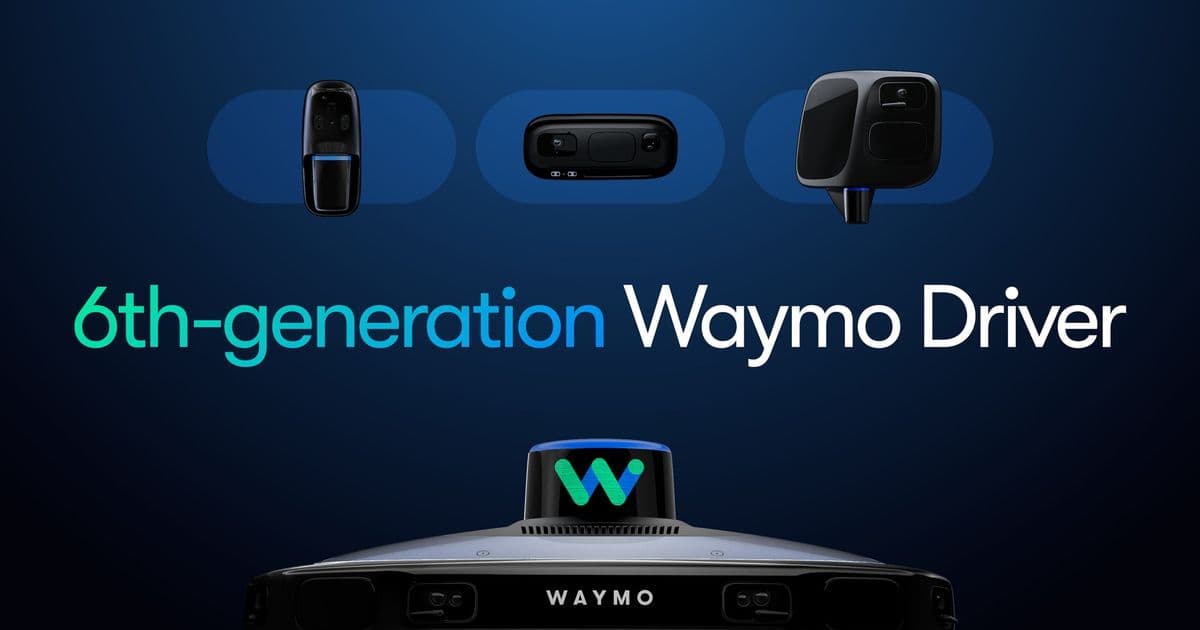
Waymo is launching fully autonomous operations with its 6th-generation Driver, featuring enhanced sensors, reduced costs, and expanded capabilities for diverse environments.
Waymo is taking a significant leap forward in autonomous vehicle technology with the launch of its 6th-generation Driver, marking a pivotal moment in the company's journey toward widespread autonomous transportation. This latest iteration represents not just incremental improvements but a fundamental reimagining of how autonomous systems perceive and navigate the world around them.
The Foundation of Scale
The 6th-generation Waymo Driver emerges from seven years of real-world experience, having safely navigated nearly 200 million fully autonomous miles across 10+ major cities and expanding freeway networks. This extensive operational history has provided Waymo with unique insights into the complexities of autonomous driving at scale.
"Demonstrably safe AI requires equally resilient inputs," Waymo emphasizes, highlighting why their approach centers on a custom, multi-modal sensing suite. This philosophy recognizes that true autonomy demands redundancy and diversity in perception—relying on any single sensor type would leave critical gaps in the system's understanding of its environment.
Advanced Vision System
At the heart of the new system lies a breakthrough 17-megapixel imager that dramatically outperforms traditional automotive cameras. This high-resolution sensor captures millions of data points, creating incredibly sharp images while maintaining exceptional thermal stability across varying automotive conditions.
The vision system's capabilities extend far beyond human perception. While it interprets the same semantic details—traffic light colors, road signs, pedestrian movements—it operates with awareness no person can match. The system can simultaneously monitor all directions around the vehicle, pulling critical details from deep shadows while being hit with direct glare from high-beams or emergency vehicle lights.
A key innovation is the system's efficiency: using fewer cameras than previous generations while delivering superior performance. By pushing more processing complexity into custom silicon chips rather than relying on multiple hardware components, Waymo achieves better results with remarkable efficiency. The new cameras outperform the highly capable 5th-generation system while using less than half the number of cameras.
Lidar: Seeing Through Weather
Waymo's lidar technology represents a significant advancement in autonomous sensing. Unlike cameras that rely on reflected light, lidar uses laser beams to create detailed 3D point cloud images of the surrounding environment. This capability proves especially valuable in challenging conditions like rain, snow, or darkness on freeways.
The 6th-generation lidar leverages dramatic cost reductions in the industry over the past five years, particularly as affordable lidar increasingly appears in consumer vehicles. By combining these market efficiencies with custom-designed chips and optical designs—with core components designed and built in California—Waymo has developed a system that sees at greater distances with better fidelity and higher robustness.
Strategic placement of short-range lidars provides redundant coverage to cameras, enabling the system to associate accurate distance measurements with camera imagery. This centimeter-scale accuracy proves critical when navigating alongside vulnerable road users, opening car doors, or handling other urban situations where precise distance measurement matters.
Waymo has also reengineered how its lidar illuminates scenes and processes data internally. These upgrades help the lidar penetrate weather conditions and avoid point cloud distortion near highly reflective signs, expanding the system's ability to see through heavy road spray on freeways and other complex edge cases.
Radar: All-Weather Perception
Waymo's imaging radar creates dense, temporal maps that instantly track the distance, velocity, and size of objects in all lighting and weather conditions. By leveraging radar chipsets that have become more sensitive and affordable, Waymo benefits from industry-wide cost reductions while expanding its own capabilities.
The next-generation radar builds on the foundation of the 5th-generation system, using new in-house algorithms to deliver improved performance in rain or snow. This 6th-generation system maximizes the benefit of sensor fusion by leveraging lightweight, powerful machine-learned models to extract maximum information from each sensor and dynamically optimize the performance of every sensing component.
Audio Sensing: Hearing the Road
Complementing the visual sensors, the Waymo Driver utilizes external audio receivers (EARs) that help detect important sounds on the road, such as approaching emergency vehicles and railroad crossings. Strategically placed around the central perception dome, these EARs optimize the system's ability to hear sirens and localize their direction while reducing wind noise susceptibility, especially at high speeds.
The EARs enable the Waymo Driver to often hear and identify which direction a siren is traveling before it can even see it—a crucial capability for safe autonomous operation in complex urban environments.
Platform Versatility
A defining characteristic of Waymo's approach is its focus on building a Driver rather than a specific vehicle. This philosophy has led to a versatile, integrated autonomous driving system that can be adapted to various platforms and use cases over time.
The system's versatility allows Waymo to reconfigure sensors and generalize AI to meet each platform's unique needs—whether it's the Ojai or the Hyundai IONIQ 5—providing optimal views of surroundings while streamlining for efficiency.
Manufacturing Scale
The 6th-generation system marks a major shift at Waymo's autonomous vehicle factory in Metro Phoenix, where the company is beginning to meaningfully scale toward a capacity of tens of thousands of units per year. By collaborating with OEM partners to ensure base vehicles are Waymo Driver ready, the company has engineered a system built for high-volume production.
This manufacturing approach allows Waymo to unlock greater economies of scale as it brings its technology to more people, driving down costs while maintaining uncompromising safety standards.
The Path Forward
As Waymo transitions to fully autonomous operations with the 6th-generation Driver on the Ojai, the company will continue providing employee and guest trips while refining the rider experience. The public launch is anticipated soon, representing a significant milestone in bringing autonomous transportation to mainstream adoption.
Waymo is also actively seeking innovators and visionaries to join the effort in building the next generation of sensing technology and custom compute. From the silicon up, the company is designing hardware that allows the Waymo Driver to see, think, and scale globally.
This 6th-generation system represents more than just technological advancement—it embodies Waymo's commitment to making autonomous driving safe, accessible, and scalable. By combining cutting-edge sensing technology with practical manufacturing considerations and real-world operational experience, Waymo is positioning itself at the forefront of the autonomous vehicle revolution.
Comments
Please log in or register to join the discussion