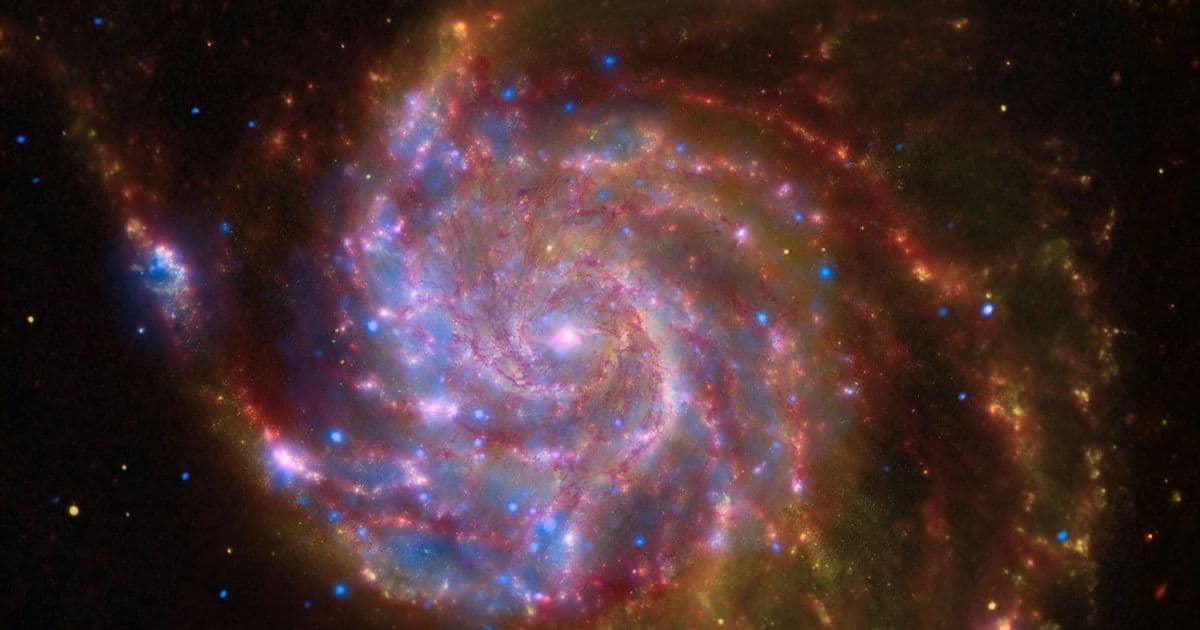
The James Webb Space Telescope has revealed extraordinary details of galaxy M77 (NGC 1068), showcasing its extremely bright core, supermassive black hole, and intricate spiral structure with unprecedented clarity.
The James Webb Space Telescope continues to revolutionize our understanding of the cosmos, recently capturing stunning images of galaxy M77 (NGC 1068) located approximately 45 million light-years from Earth. This remarkable observation provides astronomers with never-before-seen details of a galaxy containing over 300 billion stars and vast amounts of cosmic dust.
What's New in Webb's Observation of M77
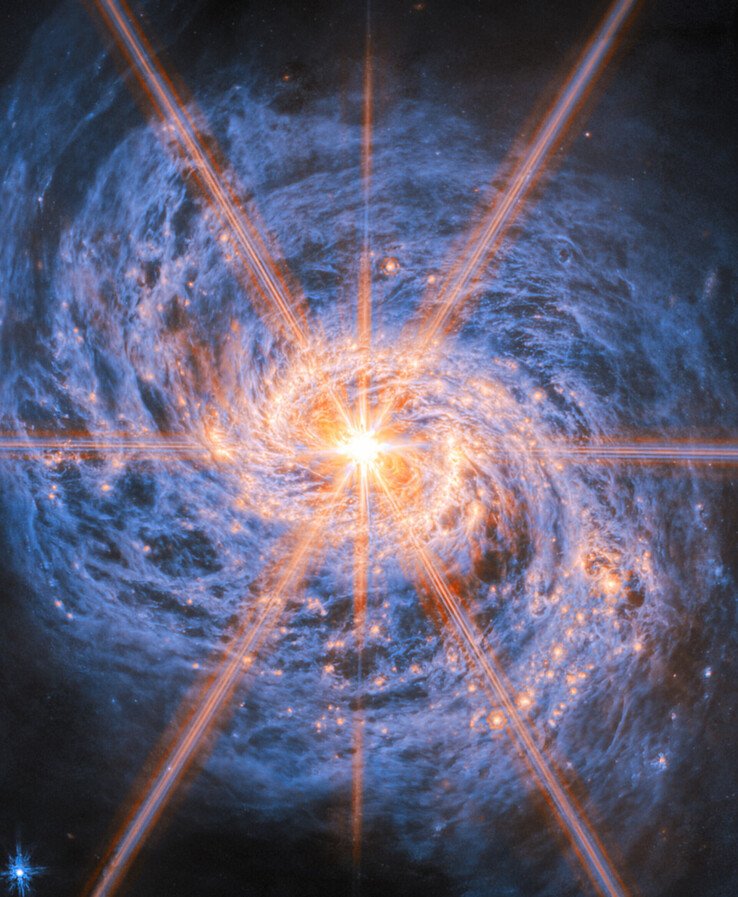
Webb's advanced infrared capabilities have captured extraordinary details of M77's core, which shines with exceptional brightness due to matter heated to extremely high temperatures at the galaxy's center. The image reveals the galaxy's intricate spiral arms, composed primarily of hydrogen, stretching approximately 90,000 light-years in diameter. These observations represent a significant leap forward from previous imaging capabilities, allowing scientists to study the galaxy's composition and structure with unprecedented clarity.
At the heart of M77 lies a supermassive black hole with a mass approximately eight million times that of our Sun. Webb's instruments have detected the gas orbiting this black hole at speeds approaching the speed of light, providing valuable insights into the extreme physics occurring in galactic centers. The bright diffraction spikes visible in the image are artifacts created by light interacting with Webb's mirror structure, but they don't diminish the scientific value of the surrounding observations.
How Webb Compares to Previous Space Telescopes
The James Webb Space Telescope represents a significant technological advancement over its predecessor, the Hubble Space Telescope. Webb's larger primary mirror (6.5 meters compared to Hubble's 2.4 meters) and specialized infrared instrumentation allow it to observe objects with greater sensitivity and resolution. This capability has proven essential for studying distant galaxies like M77, where Webb can penetrate through cosmic dust clouds that obscure visible light observations.
While Hubble provided valuable initial observations of M77, Webb's infrared capabilities reveal structures and details completely invisible to previous instruments. The telescope's position at the second Lagrange point (L2) approximately 1.5 million kilometers from Earth provides a more stable observation platform and protection from solar interference, further enhancing its observational capabilities.
For Whom These Observations Matter
These detailed observations of M77 are particularly valuable for astronomers studying galactic evolution, black hole physics, and star formation processes. The data from Webb will help researchers develop more accurate models of how supermassive black holes influence their host galaxies and the role of dust in star formation cycles.
Cosmologists and astrophysicists will benefit from Webb's ability to observe the infrared signatures of complex molecules in M77's arms, providing insights into the chemical processes occurring in distant galaxies. The telescope's observations of the black hole's accretion disk offer a laboratory for studying extreme gravitational environments that cannot be replicated on Earth.
The James Webb Space Telescope continues to demonstrate its value as humanity's most powerful space observatory. Each new image and data set not only provides breathtaking views of our universe but also advances our understanding of fundamental cosmic processes. The observations of M77 exemplify how Webb's technological capabilities are transforming astronomy, allowing scientists to explore the universe with unprecedented clarity and depth.
ESA, the European Space Agency, manages Webb in partnership with NASA and the Canadian Space Agency. The telescope's mission is designed to last at least five years, with the possibility of extension, promising many more groundbreaking discoveries in the years to come.
For more information about the James Webb Space Telescope and its observations, visit ESA's Webb page or NASA's Webb mission site.
Comments
Please log in or register to join the discussion