
Western Digital unveils vertical-emitting laser technology and 14-platter designs that will enable 140TB+ hard drives by 2030, fundamentally resetting HAMR's scaling trajectory.
Western Digital this week revealed the roadmap that will carry hard drive technology from today's 40TB capacities to over 140TB by the end of the decade, with a critical breakthrough in laser technology that solves the fundamental limitations of current HAMR implementations.
The Current HAMR Bottleneck
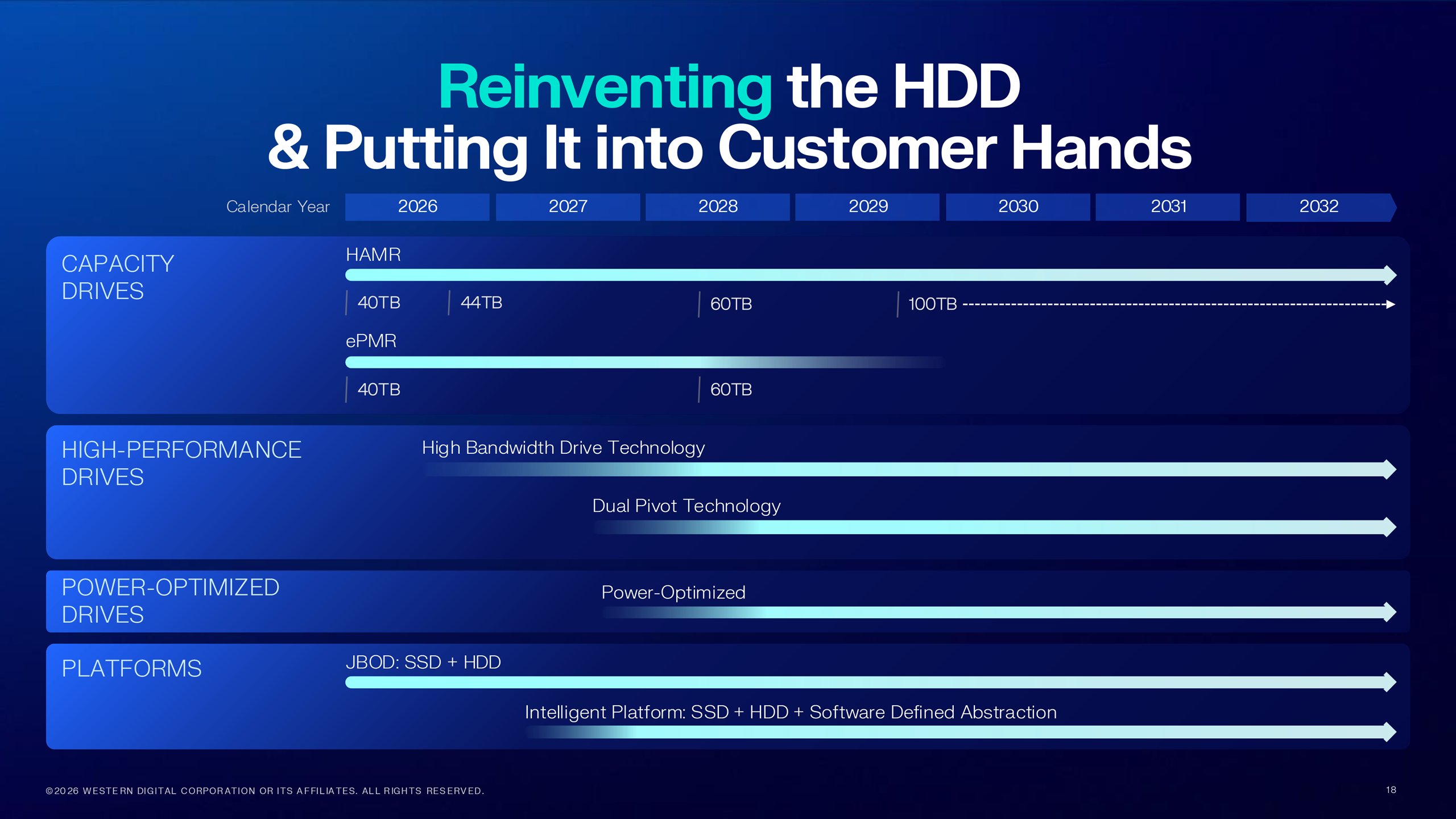
Western Digital plans to begin volume production of its first commercial HAMR drives next year, with capacities starting at 40TB (CMR) or 44TB (SMR) in late 2026. These initial drives use the company's proven 11-platter platform with high-density media and HAMR heads featuring edge-emitting lasers.
These edge-emitting lasers work by heating iron-platinum alloy (FePt) on platters to their Curie temperature—the point where magnetic properties change—before writing data. However, according to Ahmed Shihab, Western Digital's chief product officer, these lasers suffer from three critical limitations:
- Energy waste: Part of the generated light is wasted rather than being used for heating
- Physical height: The tall laser design forces additional spacing between platters
- Manufacturing yield: Edge-emitting lasers rely on mechanical cleaving, precision optical alignment, and thermal screening, preventing wafer-level testing and reducing yields
The Vertical Laser Breakthrough
To overcome these limitations, Western Digital has spent six years developing a patented vertical-emitting laser that fundamentally changes how HAMR works. Unlike conventional edge-emitting designs, this new laser emits light straight down onto the magnetic media.
This seemingly simple change enables two parallel advances:
- Higher areal density: From today's 4TB per platter to 10TB per platter by 2028
- Thinner head assembly: Allows more disks to be packed into the same 3.5-inch drive
(Image credit: Western Digital)
"By emitting more light, harnessing more of that light into the recording technology, we will increase the aerial density of the HAMR platters from four terabytes all the way to 10 terabytes by 2028 per platter," Shihab explained. "This technology is not theoretical. It is actually already in the labs. We have watched it during the recording."
14-Platter Platform and 140TB Capacity
The vertical laser technology is only half of Western Digital's capacity expansion strategy. The company is also developing an HDD platform capable of housing up to 14 platters—a significant increase from the current 11-platter designs.
This 12-platter platform will first be used with 60TB ePMR drives in 2028, with HAMR drives using the same platform. The combination of 10TB per platter density and 14 platters points directly to the 140TB figure Shihab teased: "10 terabytes, 14 platters, that sounds like 140 terabytes."
(Image credit: Western Digital)
Dual Pivot Technology for AI Workloads
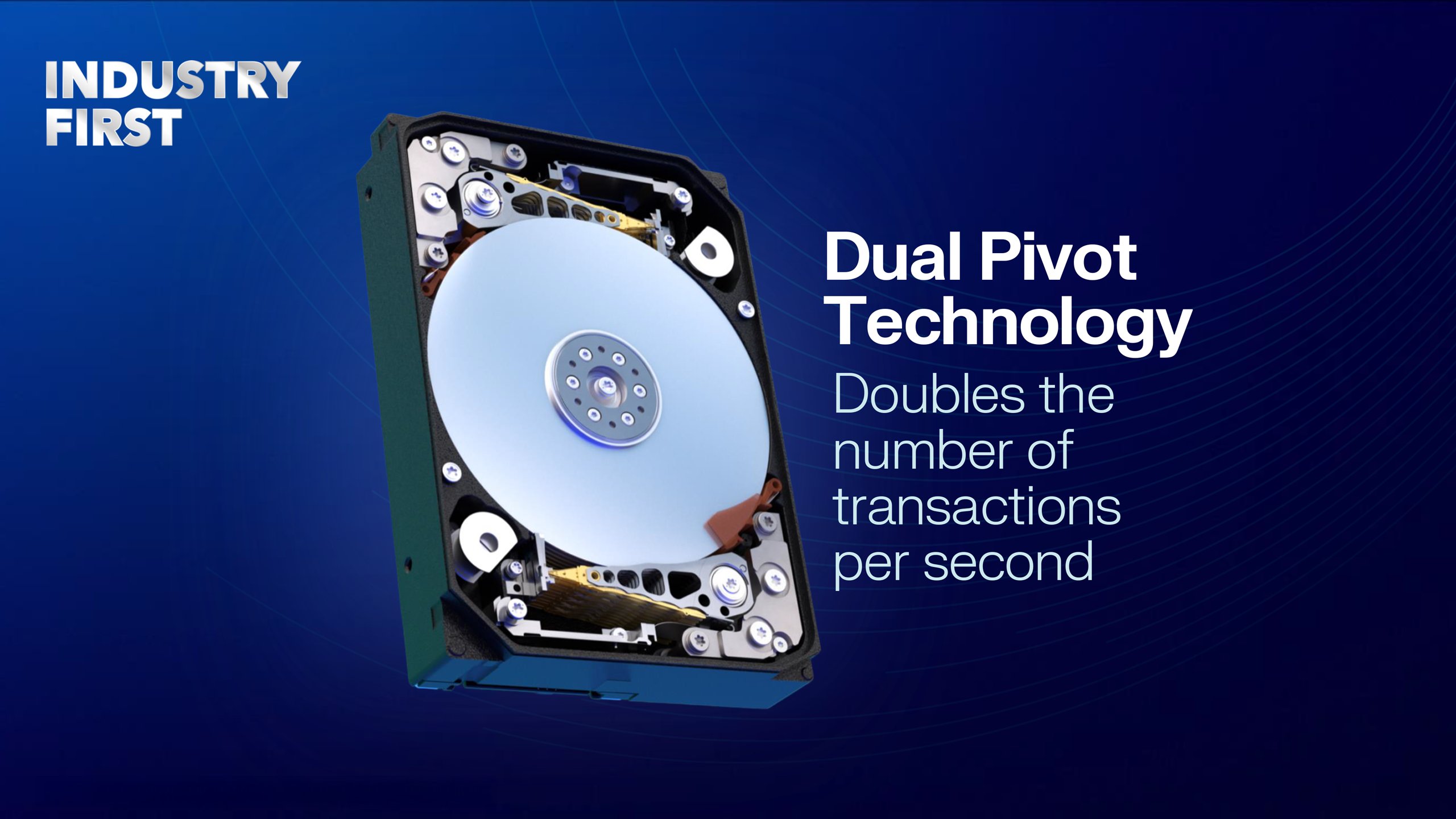
Alongside these capacity improvements, Western Digital is introducing Dual Pivot technology that promises to double both bandwidth and sequential I/O IOPS performance. These high-bandwidth drives will enter the market at 60TB capacity, though Western Digital hasn't disclosed whether they use ePMR or HAMR recording technology.
"Dual Pivot technology helps customers focus their software effort on improving more performance for AI versus having to deal with how the hard drives work," Shihab said. "We will introduce this at the 60 TB mark."
Beyond 140TB: The Next Frontier
After reaching the 140TB milestone, Western Digital will need to adopt ordered granular (OG) and eventually bit patterned media (BPM). These technologies involve patterning HDD disks using sophisticated etching, nanoimprint lithography, e-beam lithography, or photolithography.
BPM technology will require next-generation laser designs that combine heating performance with extreme precision. Excess energy can disturb neighboring bits, while insufficient energy prevents reliable writes.
Market Implications
The significance of Western Digital's roadmap extends beyond raw capacity numbers. The vertical laser technology represents a fundamental reset of HAMR's scaling curve, moving from incremental improvements to aggressive growth starting in 2028.
This aggressive scaling trajectory is expected to enable 100TB HDDs by 2029-2030, with 140TB+ drives following shortly after. For cloud providers and AI infrastructure operators, this means dramatically increased storage density without proportional increases in power consumption or physical footprint.
Western Digital's approach of solving the fundamental physics limitations rather than simply iterating on existing designs could give the company a significant competitive advantage in the high-capacity enterprise storage market through the end of the decade.
Comments
Please log in or register to join the discussion