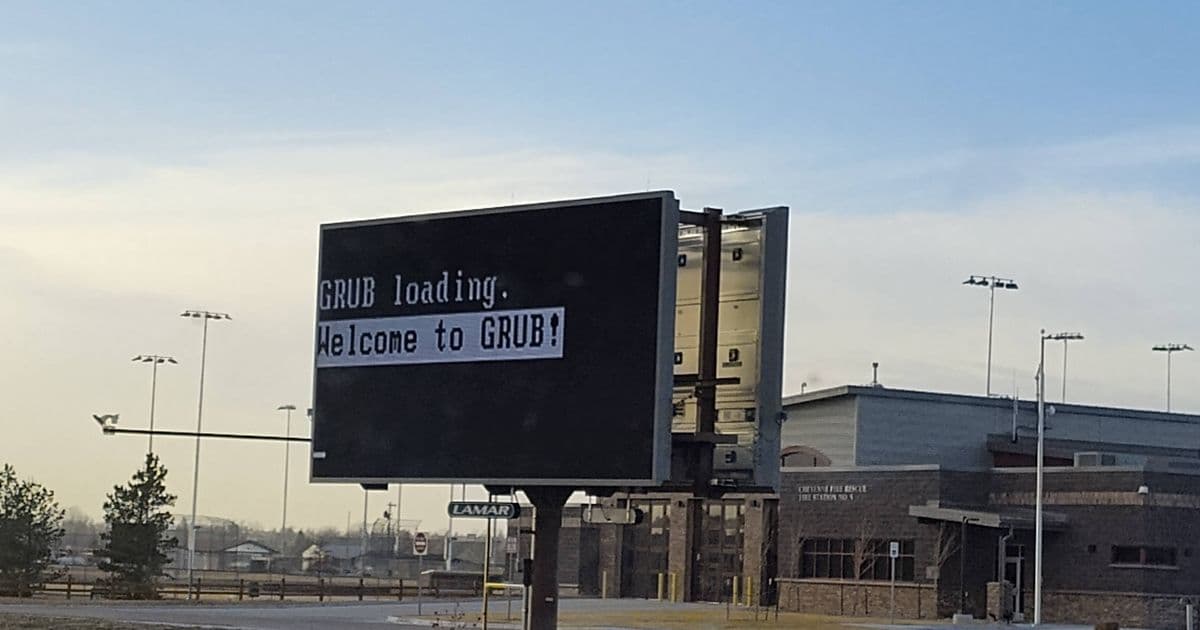
A roadside billboard in Wyoming displayed a GRUB bootloader message instead of its intended advertisement, revealing a Linux system failure that left drivers wondering about the state of local IT infrastructure.
A roadside billboard in Cheyenne, Wyoming, has become an unlikely monument to system administration misfortune, displaying a GRUB bootloader message to passing motorists instead of its intended advertisement.
The billboard, which weathered recent storms that brought winds gusting up to 92mph (148kph) and caused widespread power outages across the city, somehow managed to keep its physical structure intact. However, the digital display system powering the advertisement encountered a more fundamental problem during the boot process.
GRUB, short for GRand Unified Bootloader, is the software responsible for loading operating systems on many Linux distributions. Under normal circumstances, it operates entirely behind the scenes, presenting users with a brief splash screen before handing control to the operating system. When functioning correctly, most users never even realize it's there.
The appearance of GRUB on a public billboard suggests something has gone significantly wrong with the system's configuration or hardware. Potential causes range from corrupted configuration files to missing boot devices, or even a failed hard drive. Whatever the specific issue, the result is the same: a digital advertisement that refuses to display its intended content, instead presenting a technical error message to anyone driving by.
Our eagle-eyed reader who spotted the borked billboard noted that while much of Cheyenne experienced power outages due to the severe weather, another screen displaying content for the opposite direction of traffic was functioning normally. This observation suggests the problem may be specific to this particular billboard's hardware or configuration rather than a city-wide infrastructure issue.
The incident raises questions about the reliability of digital billboard systems and the challenges of maintaining them in harsh weather conditions. While the physical structure survived winds that would have damaged many conventional signs, the electronic components proved more vulnerable to whatever combination of factors led to the boot failure.
There's also an interesting linguistic coincidence at play here. "Grub" is a Britishism that has made its way across the Atlantic, commonly used to refer to food or a hearty meal. This dual meaning creates an amusing possibility that the billboard might actually be part of a marketing campaign for a local restaurant, though the technical nature of the displayed message makes this seem unlikely.
The universality of technical failure language adds another layer to the story. Just as the Blue Screen of Death (BSOD) has become a globally recognized symbol of Windows system failure, with even the French adopting the acronym despite their own term "écran bleu de la mort," the appearance of GRUB on a public display immediately signals to anyone familiar with Linux that something has gone seriously wrong somewhere in the system's administration.
For Linux administrators and enthusiasts, seeing GRUB where it shouldn't be is akin to spotting a BSOD on an ATM screen or airport departure board. It's a clear indication that somewhere, someone is dealing with a significant technical problem, likely involving emergency troubleshooting, system recovery attempts, and potentially some difficult conversations with management about why a critical advertising system is offline.
The incident serves as a reminder of the complexity hidden behind modern digital infrastructure. What appears to be a simple billboard is actually a computer system running an operating system, complete with bootloaders, configuration files, and hardware dependencies. When any part of this chain fails, the results can be both technically interesting and publicly embarrassing.
As digital displays become increasingly common in public spaces, from billboards to smart city installations, the potential for such failures to become public spectacles will only increase. Each incident provides both entertainment value for technically-minded observers and valuable lessons for system administrators about the importance of robust error handling and graceful degradation in public-facing systems.
For now, drivers in Cheyenne can enjoy the unintended public art installation, knowing that somewhere in the city, an administrator is likely working through a very bad day indeed, trying to figure out why a billboard decided to show its technical undergarments to the world.
Comments
Please log in or register to join the discussion