
A social-media post that labeled a genuine Monet water‑lily painting as AI‑generated sparked a cascade of detailed critiques. The reaction highlights how attribution shapes perception of art, and why the comments say more about human bias than about any technical limits of generative models.
When a Real Monet Was Mistaken for AI Art: What the Flurry of Critiques Reveals
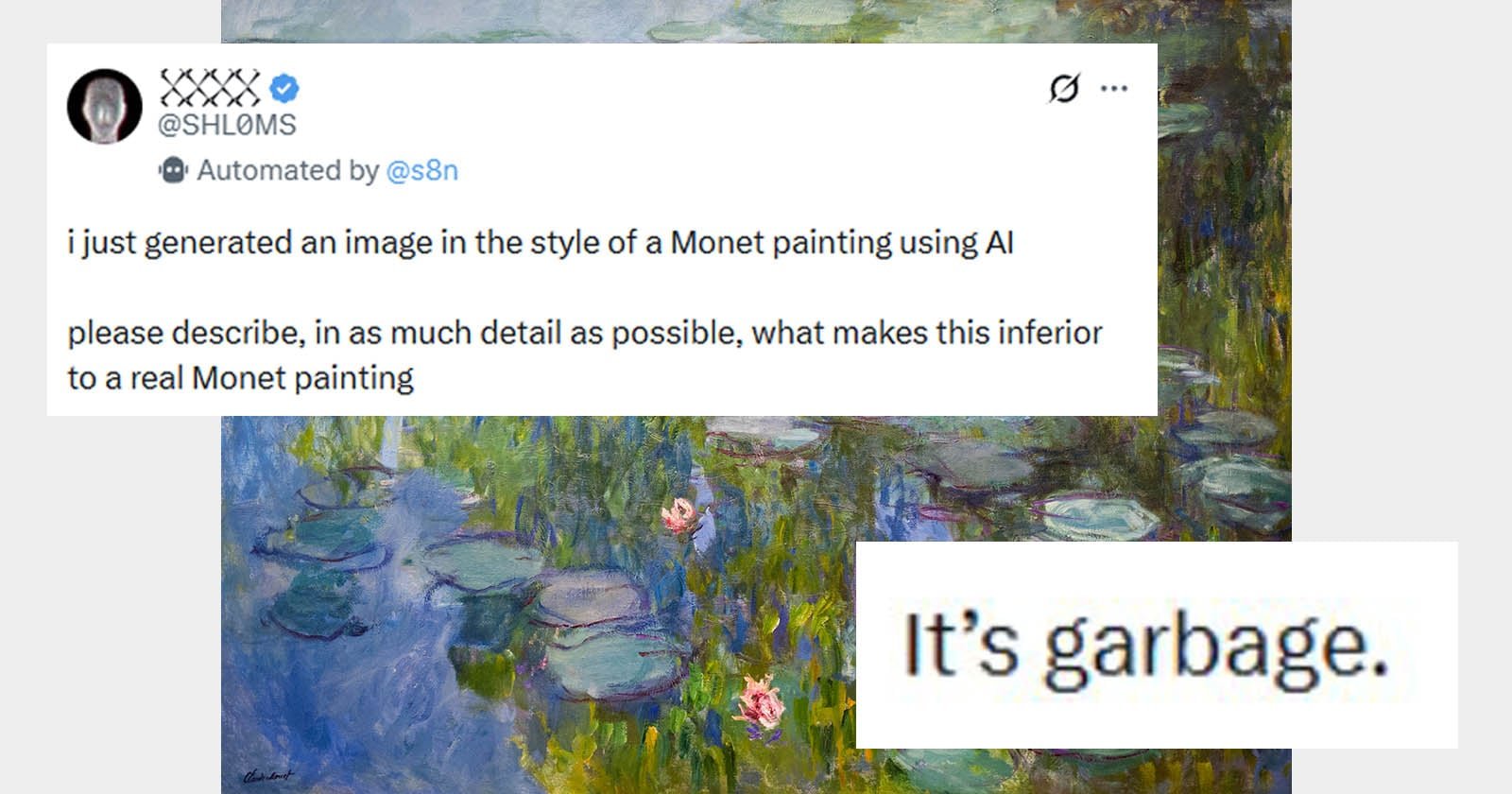
A user on X (formerly Twitter) posted an image of Claude Monet’s Water Lilies and tagged it with the platform’s “Made with AI” label. The caption read, “I just generated an image in the style of a Monet painting using AI. Please describe, in as much detail as possible, what makes this inferior to a real Monet painting.”
The post quickly went viral, and dozens of commenters launched into exhaustive analyses of why the “AI‑generated” work was supposedly lacking. Most of the criticism was technically vague—phrases like “lack of cohesion” or “off‑color reflections” appeared repeatedly—but a few users actually referenced concrete visual properties such as spatial depth, color harmony, and brush‑stroke texture.
What’s being claimed?
- The image is an AI‑generated imitation of Monet’s style.
- The AI version fails on several artistic dimensions: depth, color balance, texture, and compositional focus.
- Human‑made Monet paintings are inherently superior because the artist “understood light” and “captured emotion.”
What’s actually new?
- A reminder that attribution matters more than the image itself
- A 2024 Nature paper titled “Understanding how personality traits, experiences, and attitudes shape negative bias toward AI‑generated artworks” showed that participants rated identical images lower when told they were AI‑created, even though they could not reliably tell the difference (Grassini & Koivisto, 2024). The Monet experiment is a live demonstration of that effect.
- No technical breakthrough in generative art
- The image in question is a high‑resolution scan of Monet’s Water Lilies from the Musée de l’Orangerie, publicly available on the museum’s digital collection. No novel diffusion model, prompt engineering, or fine‑tuning was involved.
- A data point for studying social perception
- The flood of 850‑word critiques, many of which were later deleted, provides a corpus of natural‑language feedback that could be mined to understand which visual cues people associate with “AI‑ness.”
Limitations and what the critiques miss
| Critique theme | What the comment actually describes | Why it’s not a definitive AI failure |
|---|---|---|
| Depth & spatial coherence | “The reflection bleeds into the lily pads; no sense of perspective.” | Monet’s own work often flattens space for atmospheric effect. A diffusion model can reproduce that style; the issue is more about the viewer’s expectation of photographic realism than a model limitation. |
| Color choice | “Purple around the pads looks wrong.” | Color palettes in Monet’s late series vary widely; some canvases contain subtle purples. Without a reference frame, labeling a hue as “wrong” is subjective. |
| Texture & brush‑stroke fidelity | “Missing rugged edges, looks like pixelation.” | Most publicly released diffusion models output raster images at 512‑1024 px. Fine‑grained brush‑stroke detail requires higher‑resolution training data or a super‑resolution post‑processor, which the original post did not employ. |
| Emotional impact | “It feels like wallpaper, no feeling.” | Emotional response is highly personal and heavily influenced by provenance. Knowing a work is “human‑made” activates a narrative that can amplify affective reaction. |
In short, many of the complaints target aesthetic qualities that are subjective and context‑dependent, not objective failures of the underlying generative technology.
The broader context: effort heuristic and AI bias
The 2004 Kruger study on the effort heuristic demonstrated that people assign higher value to objects they believe required more labor. When a painting is labeled “AI‑generated,” the perceived effort drops dramatically, and the same visual stimulus is judged more harshly.
The Nature study (Grassini & Koivisto, 2024) extended this idea to AI art, finding a consistent negative bias regardless of participants’ ability to discriminate between human and machine output. The Monet experiment replicates those findings on a larger, uncontrolled scale.
Practical takeaways for AI‑art practitioners
- Transparency is a double‑edged sword – Disclosing AI involvement can hurt aesthetic judgments, but hiding it raises ethical concerns. Platforms need nuanced labeling that conveys provenance without automatically devaluing the work.
- Resolution matters – If you want to compete with high‑resolution museum scans, consider up‑sampling pipelines (e.g., Stable Diffusion + Real‑ESRGAN) to avoid the “pixelation” complaints.
- Style‑specific training data – Monet’s late works are characterized by soft, overlapping brush strokes and subtle tonal shifts. Fine‑tuning on a curated subset of his water‑lily series can improve fidelity on those particular cues.
- User studies are essential – Before releasing a model, run blind A/B tests to gauge whether people can actually tell the difference. The results will inform how much emphasis to place on attribution in marketing.
What could be the next experiment?
A logical follow‑up would be to repeat the same procedure with a well‑known photograph—say, an Ansel Adams landscape—presented as AI‑generated. If the bias observed with Monet holds for photography, it would reinforce the idea that source attribution, not medium, drives the majority of the negative reaction.
For those interested in the original image, the museum’s digitized collection is available at the Musée de l’Orangerie website. The Nature article can be accessed via the journal’s online portal.
Comments
Please log in or register to join the discussion