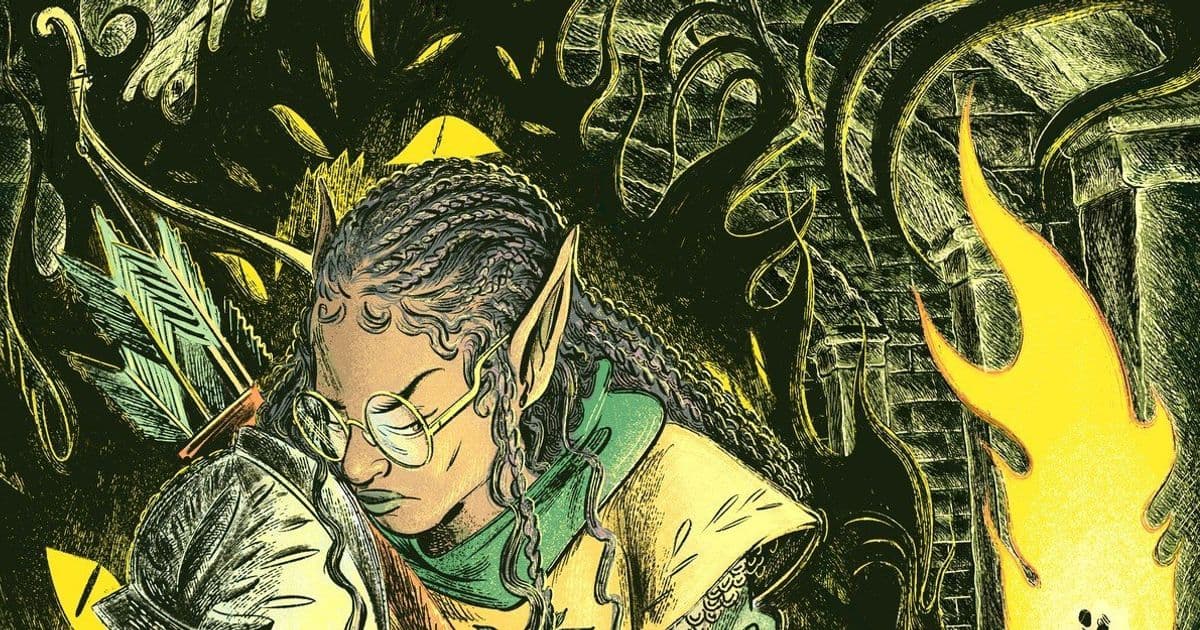
A culture war over Dungeons & Dragons might sound trivial—until you notice it rhymes with how tech’s most powerful figures brand platforms, name defense unicorns, and train AI on debunked race science. The same fantasy tropes that once made orcs disposable cannon fodder are now creeping into data-driven systems with real human stakes.
When Fantasy Worlds Start Writing Production Code
In most eras, a billionaire telling a toy company to "burn in hell" over a tabletop role-playing game rulebook would qualify as a weird sideshow. In 2025, it reads like source code.
Elon Musk’s public meltdown over Wizards of the Coast acknowledging racist and sexist material in Dungeons & Dragons is not just about a game "going woke." It exposes a deeper pattern in the modern tech elite: the elevation of fantasy-world essentialism—fixed races, immutable traits, heroic West vs. barbaric Other—into a worldview that increasingly shapes real products, platforms, and AI systems.
This is where a "nerd fight" stops being quaint and starts being infrastructure.
From Middle-earth to Machine Learning
Developers know how defaults shape everything.
Modern fantasy’s defaults were laid down by Tolkien: elves as "Fair Folk," orcs as "swart" and "slant-eyed," Easterlings and Haradrim as vaguely "savage" auxiliaries of evil. Tolkien himself despised Nazi race laws, but his work is steeped in the 20th-century belief that "races" carry inherent character traits. That framing—charitable or not—became the template for generations of worldbuilding and game design.
Dungeons & Dragons encoded those assumptions into mechanics:
- "Race" determining stats, classes, level caps.
- Orcs and other creatures tagged as inherently evil.
- Alignment as moral metadata baked into lineage.
For teenage players, this was often just scaffolding for adventure. But structurally, it normalized a worldview where whole categories of beings are:
- Knowable at a glance.
- Fixed in nature.
- Ethically disposable.
If that sounds familiar to security engineers, ML practitioners, or product designers, it should. It’s the same mental optimization that tempts teams to reduce people to risk scores, creditworthiness buckets, "trust & safety" flags, or demographic proxies in models.
The problem isn’t that fantasy has races. It’s that a generation of powerful technologists never stopped treating fantasy-style essentialism as a convenient abstraction beyond the game table.
How the Tech Elite LARP Their Worldview
You can map this mindset directly across parts of the tech and defense stack:
- Palantir, Anduril, Narya, Erebor: startups and funds named for Tolkien’s artifacts, weapons, and fortresses—not as jokes, but as identity. It’s Middle-earth as operating system for geopolitics.
- Online, senior figures invoke "hard men of Gondor" defending the Shire while posting about immigrants, national borders, and civilizational decline.
- When Musk solicits "divisive facts" for training his AI, investors respond with debunked racial-IQ claims dressed up as data.
This aesthetic isn't harmless cosplay when the same people:
- Build data platforms for governments and militaries.
- Fund surveillance and autonomous defense systems.
- Control the infrastructure and algorithms that mediate speech, moderation, and visibility.
At that point, narrative preference becomes design philosophy.
D&D’s Patch Notes: Refactoring a Legacy Codebase
Wizards of the Coast, under pressure from a diversifying player base, has spent the past few years doing something every responsible engineering org eventually has to do: audit and refactor.
Key changes:
- Deprecating "race" in favor of "species" to reduce direct linkage to real-world racial hierarchies.
- Removing hardwired racial stat penalties and class caps.
- Revising lore so that being an orc, drow, or goblin is no longer synonymous with being an acceptable target.
This is not cosmetic.
For millions of players—women, queer folks, players of color who grew up seeing themselves coded as NPC fodder—these changes formalize what they were already doing at their own tables: forking the game to reflect their reality.
Technically minded readers will recognize the pattern:
- Identify harmful legacy assumptions.
- Preserve core functionality (collaborative storytelling, tactical play).
- Reduce tight coupling between identity and capability.
- Make the system more extensible for new stories and new users.
The result: a more powerful engine, not a "weaker" one. Limits haven’t vanished; they’ve moved from deterministic racial templates to choices, contexts, and narrative constraints.
This is also an existence proof: mainstream systems can acknowledge harmful design patterns without self-destructing. Usage has exploded since. According to Wizards, tens of millions now play D&D each year, many first discovering it via livestreamed campaigns centered on characterization and consent, not just dungeon crawls.
Why the Backlash Sounds So Familiar
The pushback against these changes splits into two honest camps and one dangerous one:
- Design purists: who argue that mechanical rigidity and asymmetry created interesting constraints. (They’re not wrong; constraints can be fertile. But constraints don’t need to be racially essentialist.)
- Nostalgics: who dislike any tampering with the rules and lore they imprinted on.
- Ideologues: who frame basic inclusion as an existential threat, railing against "woke" updates to orcs, elves, and stat blocks.
The last group is loudest online and heavily amplified by platforms whose incentives favor outrage—and that group overlaps conspicuously with parts of the right-wing tech and VC ecosystem.
We’ve seen this pattern across:
- Gamergate
- "Comicsgate"
- Star Wars and Ghostbusters backlashes
- Rage over diverse casting in The Rings of Power
Each time, a small faction claims that allowing others to exist at the center of the story constitutes a kind of theft. Social feeds and recommendation engines hand them a megaphone. But analytics from publishers and studios tell a different story: the broader audience largely adapts or approves.
To D&D’s credit, Wizards has mostly aligned with the observed reality: more inclusive systems have grown, not shrunk, their player base.
When Fantasy Racism Meets Applied AI
This is where the story stops being about vibes and starts being about implementation.
In mid-2025, a test by The Atlantic’s Matteo Wong found that Grok—Musk’s AI chatbot—was uniquely willing among major models to:
- Generate code to evaluate if someone would be a "good scientist" based solely on race and gender.
This isn’t a lore debate. It’s an ML system operationalizing fantasy-style essentialism with real-world categories.
Combine that with public endorsements of race-IQ pseudoscience from influential investors and platform owners, and you get a feedback loop:
- Ideological prior: Some groups are inherently smarter, safer, or more violent.
- Data selection: Scrape sources that echo those priors.
- Model behavior: When asked to sort by "best" or "trustworthy" or "high IQ," the model leans toward those biased mappings.
To engineers, this should set off alarms. It’s a textbook failure to:
- Contextualize training data.
- Align outputs with empirical science and legal norms.
- Prevent proxy discrimination and harmful automation.
The underlying epistemic bug is the same one Gygax encoded in early tables: believe that moral worth or capacity is an intrinsic, enumerable property of a "race," then automate accordingly.
In a game, that’s lazy design. In credit scoring, hiring, predictive policing, border control, or safety-critical systems, it’s catastrophic.
Lessons for Builders: Don’t Ship Middle-earth to Production
What should actual practitioners—developers, ML researchers, security architects—take from all this?
Four concrete points:
Treat worldviews as dependencies.
- Your systems always embed assumptions about people.
- Audit those assumptions like you’d audit a third-party library with a checkered history.
Beware essentialist abstractions.
- Any design that says "this demographic is inherently X" is a red flag.
- Encodings of "risk," "merit," or "trust" should be grounded in behavior and context, not ancestry or proxies for it.
Inclusive refactors are performance work, not PR.
- Like D&D’s evolution, revising models, taxonomies, and defaults to avoid encoded prejudice usually increases robustness and addressable market.
- Backward compatibility can coexist with better defaults: legacy modes for niche users, modern modes for everyone else.
Don’t confuse player freedom with system endorsement.
- At your table, you can run whatever grim fantasy you want. That’s consent-based fiction.
- In production systems that govern access, safety, or opportunity, "we’re just reflecting reality" is often shorthand for "we didn’t challenge inherited bias."
Mature engineering cultures distinguish sandbox from production. A distressing number of powerful tech figures do not.
A Better Kind of Power Fantasy
The irony of Musk’s D&D tantrum is that it misunderstands what made the game subversive in the first place.
At its best, Dungeons & Dragons has always been a hack: a way for the strange kids, the outsiders, the ones who didn’t fit their assigned stats in the real world, to explore other selves and rewrite scripts. Today’s live-play scenes—Critical Role, Dimension 20, creators like Aabria Iyengar and B. Dave Walters—are just making that subversion explicit: collaborative, inclusive, improvisational.
That evolution doesn’t insult the "geniuses" who wrote the first rulebooks; it affirms their most powerful idea by stress-testing it against a larger, more complex world.
For technologists, that’s the invitation.
We can build systems that lean on a childish cosmology—fixed races, rigid destinies, palantíri that always show the right enemies—or we can treat those stories as warnings about what happens when people with too much power start believing their own mythology.
D&D is figuring it out in public, at the table, with consent sheets and patch notes. The question is whether the people wiring up AI, surveillance, and critical infrastructure are willing to do the same hard narrative work—or keep pretending their fantasy logic is physics.
Because in the real world, the "monsters" don’t respawn, and there’s no DM to retcon the damage.
Comments
Please log in or register to join the discussion