A deep dive into how seemingly irreversible blur algorithms can be reversed to recover redacted information, with practical examples and reconstruction techniques.
If you follow information security discussions on the internet, you might have heard that blurring an image is not a good way of redacting its contents. This is supposedly because blurring algorithms are reversible. But then, it's not wrong to scratch your head. Blurring amounts to averaging the underlying pixel values. If you average two numbers, there's no way of knowing if you've started with 1 + 5 or 3 + 3. In both cases, the arithmetic mean is the same and the original information appears to be lost.
So, is the advice wrong? Well, yes and no! There are ways to achieve non-reversible blurring using deterministic algorithms. That said, in many cases, the algorithm preserves far more information than would appear to the naked eye — and does it in a pretty unexpected way.
In today's article, we'll build a rudimentary blur algorithm and then pick it apart.
One-dimensional moving average
If blurring is the same as averaging, then the simplest algorithm we can choose is the moving mean. We take a fixed-size window and replace each pixel value with the arithmetic mean of n pixels in its neighborhood. For n = 5, the process is shown below:
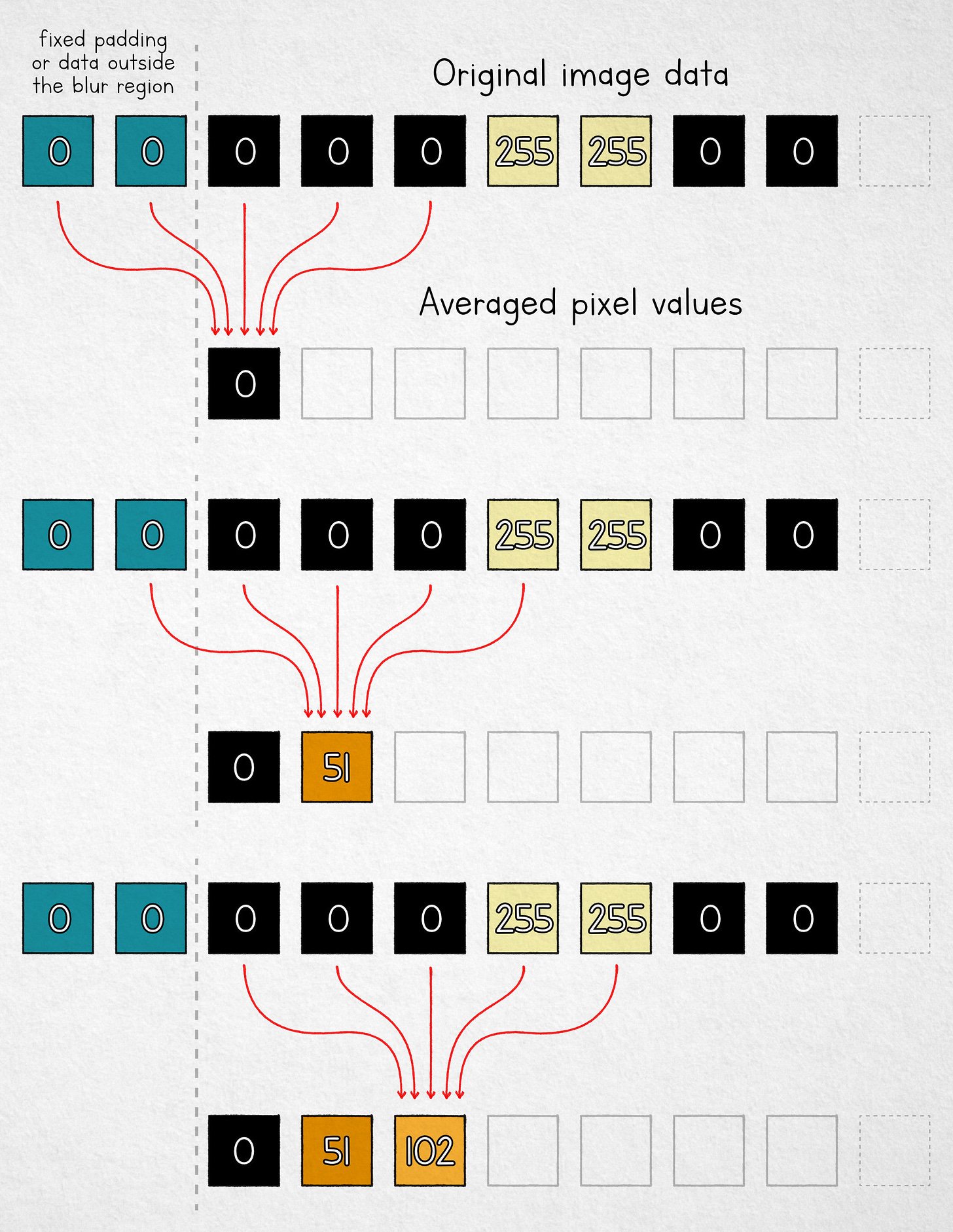
Moving average as a simple blur algorithm.
Note that for the first two cells, we don't have enough pixels in the input buffer. We can use fixed padding, "borrow" some available pixels from outside the selection area, or simply average fewer values near the boundary. Either way, the analysis doesn't change much.
Let's assume that we've completed the blurring process and no longer have the original pixel values. Can the underlying image be reconstructed? Yes, and it's simpler than one might expect. We don't need big words like "deconvolution", "point spread function", "kernel", or any scary-looking math.
We start at the left boundary (x = 0). Recall that we calculated the first blurred pixel like by averaging the following pixels in the original image:
$$b_{l!u!r}(0) = \frac{img(-2) + img(-1) + img(0) + img(1) + img(2)}{5}$$
Next, let's have a look at the blurred pixel at x = 1. Its value is the average of:
$$b_{l!u!r}(1) = \frac{img(-1) + img(0) + img(1) + img(2) + img(3)}{5}$$
We can easily turn these averages into sums by multiplying both sides by the number of averaged elements (5):
$$5 \cdot b_{l!u!r}(0) = img(-2) + img(-1) + img(0) + img(1) + img(2)$$ $$5 \cdot b_{l!u!r}(1) = img(-1) + img(0) + img(1) + img(2) + img(3)$$
Note that the underlined terms repeat in both expressions; this means that if we subtract the expressions from each other, we end up with just:
$$5 \cdot b_{l!u!r}(1) - 5 \cdot b_{l!u!r}(0) = img(3) - img(-2)$$
The value of img(-2) is known to us: it's one of the fixed padding pixels used by the algorithm. Let's shorten it to c. We also know the values of blur(0) and blur(1): these are the blurred pixels that can be found in the output image. This means that we can rearrange the equation to recover the original input pixel corresponding to img(3):
$$img(3) = 5 \cdot (b_{l!u!r}(1) - b_{l!u!r}(0)) + c$$
We can also apply the same reasoning to the next pixel:
$$img(4) = 5 \cdot (b_{l!u!r}(2) - b_{l!u!r}(1)) + c$$
At this point, we seemingly hit a wall with our five-pixel average, but the knowledge of img(3) allows us to repeat the same analysis for the blur(5) / blur(6) pair a bit further down the line:
$$5 \cdot b_{l!u!r}(5) = img(3) + img(4) + img(5) + img(6) + img(7)$$ $$5 \cdot b_{l!u!r}(6) = img(4) + img(5) + img(6) + img(7) + img(8)$$
$$img(8) = 5 \cdot (b_{l!u!r}(6) - b_{l!u!r}(5)) + img(3)$$
This nets us another original pixel value, img(8). From the earlier step, we also know the value of img(4), so we can find img(9) in a similar way. This process can continue to successively reconstruct additional pixels, although we end up with some gaps. For example, following the calculations outlined above, we still don't know the value of img(0) or img(1).
These gaps can be resolved with a second pass that moves in the opposite direction in the image buffer. That said, instead of going down that path, we can also make the math a bit more orderly with a good-faith tweak to the averaging algorithm.
Right-aligned moving average
The modification that will make our life easier is to shift the averaging window so that one of its ends is aligned with where the computed value will be stored:
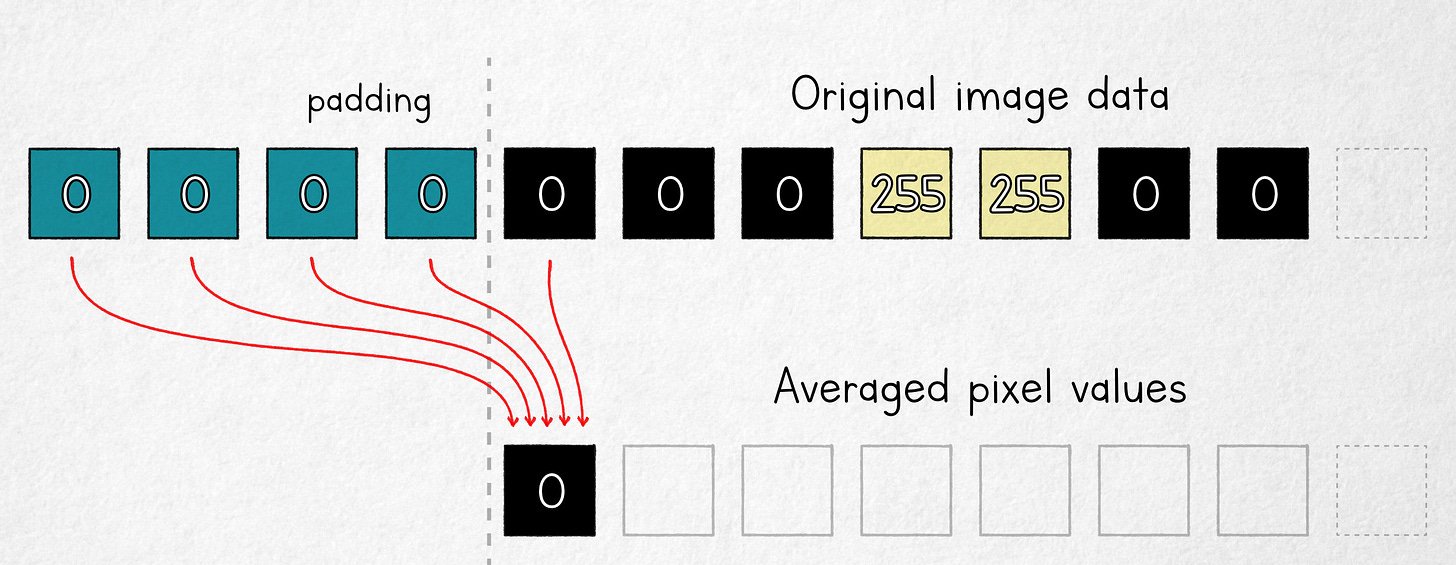
Moving average with a right-aligned window.
In this model, the first output value is an average of four fixed padding pixels (c) and one original image pixel; it follows that in the n = 5 scenario, the underlying pixel value can be computed as:
$$img(0) = 5 \cdot b_{l!u!r}(0) - 4 \cdot c$$
If we know img(0), we now have all but one of the values that make up blur(1), so we can find img(1):
$$img(1) = 5 \cdot b_{l!u!r}(1) - 3 \cdot c - img(0)$$
The process can be continued iteratively, reconstructing the entire image — this time, without any discontinuities and without the need for a second pass.
In the illustration below, the left panel shows a detail of The Birth of Venus by Sandro Botticelli; the right panel is the same image ran through the right-aligned moving average blur algorithm with a 151-pixel averaging window that moves only in the x direction:
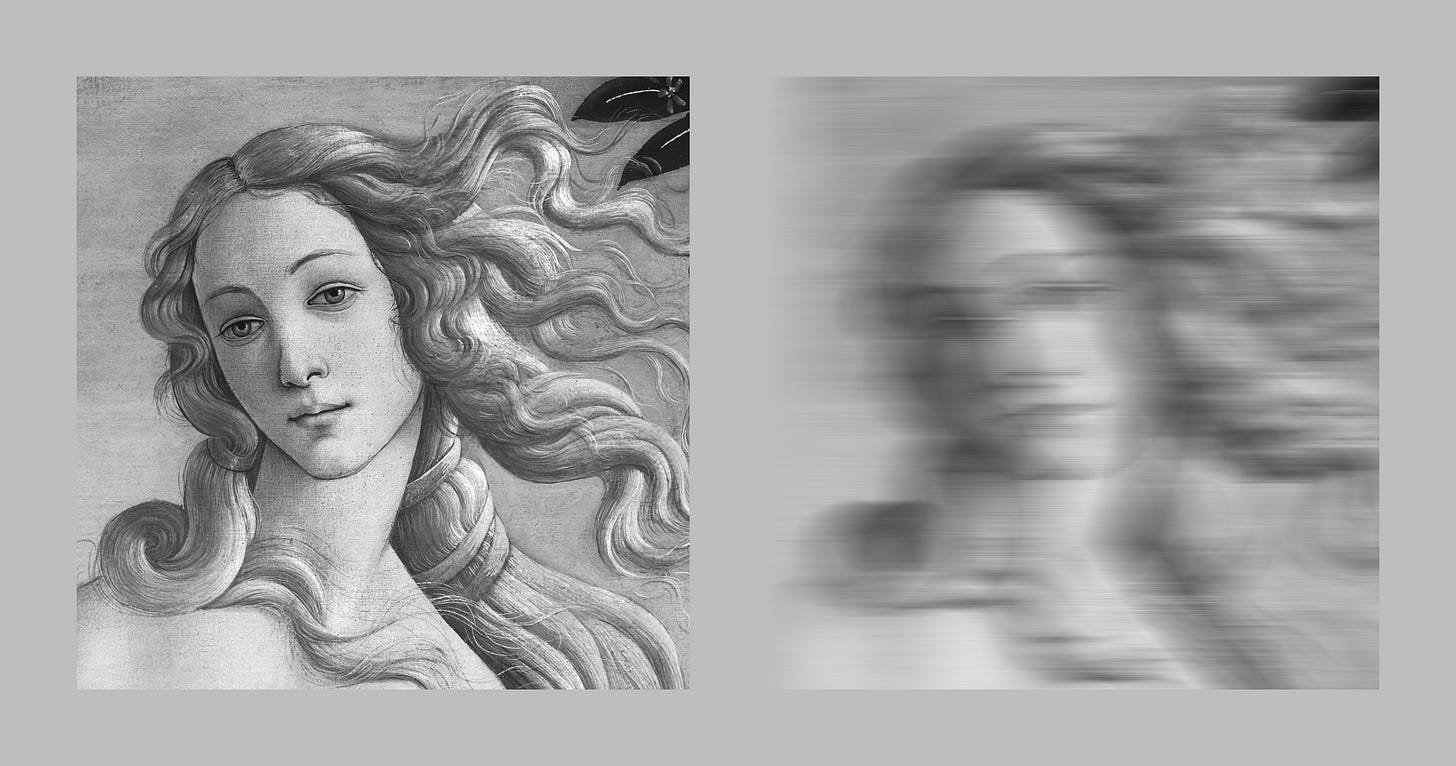
Venus, x-axis moving average.
Now, let's take the blurry image and attempt the reconstruction method outlined above — computer, ENHANCE!
The Rebirth of Venus.
This is rather impressive. The image is noisier than before as a consequence of 8-bit quantization of the averaged values in the intermediate blurred image. Nevertheless, even with a large averaging window, fine detail — including individual strands of hair — could be recovered and is easy to discern.
Into the second dimension
The problem with our blur algorithm is that it averages pixel values only in the x axis; this gives the appearance of motion blur or camera shake. The approach we've developed could be extended to a 2D filter with a square averaging window, but an expedient hack that doesn't require us to redo the math is to apply the existing 1D filter in the x axis and then follow with a complementary pass in the y axis. To undo the blur, we'd then perform two recovery passes in the inverse order.
Unfortunately, whichever route we take, we'll discover that the combined amount of averaging per pixel causes the underlying values to be quantized so severely that the reconstructed image is overwhelmed by noise:
Reconstruction from moving-average blur, X followed by Y.
That said, if we decide to develop an adversarial blur filter, we can fix the problem by weighting the original pixel a bit more heavily in the calculated mean. If the averaging window has a size W and the current-pixel bias factor is B, we can write the following formula:
$$b_{l!u!r}(n) = \frac{img(n - W) + \ldots + img(n - 1) + B \cdot img(n)}{W + B}$$
The following shows the result of a two-stage X-Y blur for W = 200 and B = 30:
Venus, heavy X-Y blur.
Surely, there's no coming back from tha— COMPUTER, ENHANCE!
Venus, recovered from heavy blur.
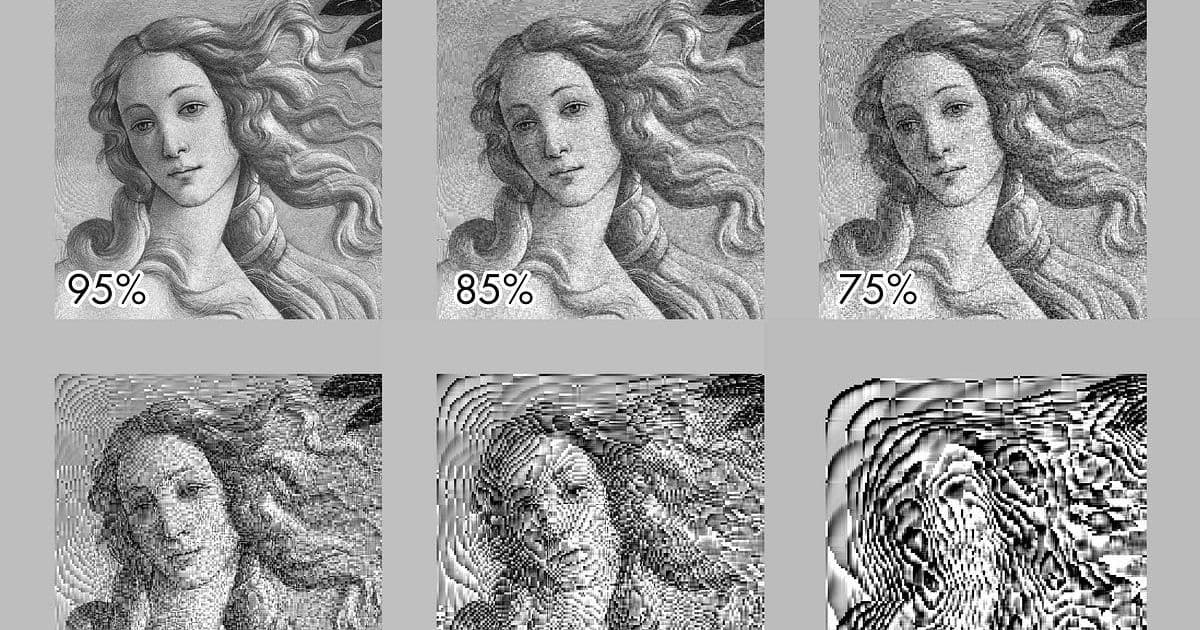
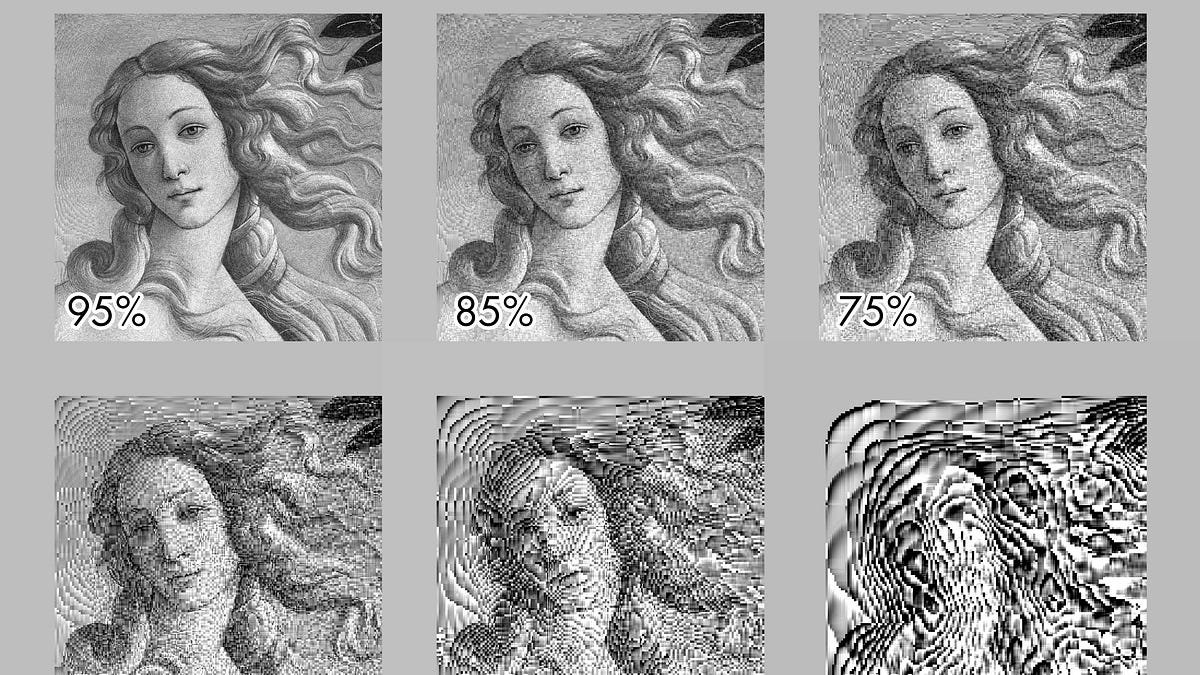
Remarkably, the information "hidden" in the blurred image survives being saved in a lossy image format. The top row shows images reconstituted from an intermediate image saved as a JPEG at 95%, 85%, and 75% quality settings:
Recovery from a JPEG file.
The bottom row shows less reasonable quality settings of 50% and below; at that point, the reconstructed image begins to resemble abstract art.
Practical implications
This analysis demonstrates why blurring is generally unsuitable for redacting sensitive information in images. The mathematical structure of simple averaging algorithms preserves enough information to enable reconstruction, even when the blur is severe.
For security-sensitive redaction, consider these alternatives:
- Pixelation: Using larger pixel blocks makes reconstruction significantly harder
- Content replacement: Overwrite sensitive areas with solid colors or unrelated content
- Multiple algorithms: Combine different blurring techniques to break the mathematical relationships
- Avoid saving intermediate states: Once blurred, don't save the image in formats that preserve more detail than visible
Remember that even if you can't reconstruct the image yourself, someone with more time or computational resources might succeed. When in doubt, use methods designed specifically for secure redaction rather than relying on visual obscurity.
Comments
Please log in or register to join the discussion