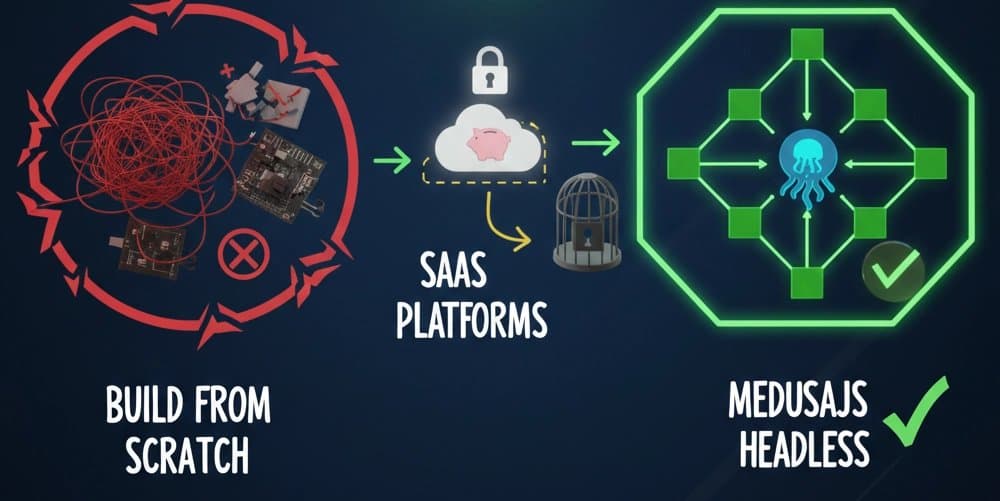
A developer's journey from painful custom e-commerce builds to discovering MedusaJS as the pragmatic solution for complex projects with evolving requirements.
There's a specific kind of pain that only developers who've built e-commerce from scratch truly understand. You start the project feeling confident, maybe even a little cocky. Then, slowly, the features start stacking up, and you realize that what you thought was "almost done" was really just the beginning.
We Thought We Were Almost Done. We Were Just Getting Started.
The first time I worked with a team to build an e-commerce platform from scratch, we genuinely believed we were ahead of schedule after getting the product catalog sorted. We were patting ourselves on the back, thinking the hard part was over. Then reality kicked in.
We still had order management to figure out. Then shipping logic. Then inventory. Each feature we added felt like pulling a thread on a sweater; one thing would change, and something else would unravel somewhere else in the system. It was a lot.
But the thing that really kept me up at night wasn't the features themselves. It was the realization that if the client ever came back asking for something new, like adding a discount engine, a loyalty system, anything, we'd be in serious trouble. Scaling it or adding new features would have been a nightmare. Every small improvement meant rewriting chunks of the system, and every new integration felt like walking a tightrope. I knew there had to be a better way. I just hadn't found it yet.
Then a Friend Got a Contract, and Everything Changed
About a year later, a friend of mine landed a contract to build a fashion e-commerce platform, but not just any platform. This one needed a loyalty system with a gamified experience built right into it. Points, rewards, levels, the works. He brought me on to handle the backend, and I knew from day one this wasn't going to be a simple project.
My first thought was Shopify. Use their API for the commerce side, then build the loyalty system as a headless layer on top. It made sense on paper. But when I actually started looking at what that would cost, both in API limitations and actual money, I knew I had to find something else.
That's when I stumbled across MedusaJS. The timeline was tight. We didn't have months to figure things out, so I needed a tool that was quick to get running, flexible enough to handle custom business logic like gamification, and solid enough to avoid falling apart when the client wanted changes down the line. MedusaJS seemed to tick every box, so I went with it.
Look, Building E-Commerce from Scratch Is Harder Than People Admit
Before I get into MedusaJS specifically, I want to be honest about something, because I think a lot of developers underestimate what they're signing up for when they decide to go fully custom.
Product and inventory management alone is way more complex than it looks. You're not just storing items in a database. You're dealing with variants, stock levels per location, pricing rules that change based on customer groups, bundles, and more. One small tweak can ripple through your whole system in ways you didn't anticipate.
Then there's payments and shipping. Every provider has their own API with its own quirks and edge cases. I've seen a poorly handled webhook take down an entire checkout flow before, and it's not a fun conversation to have with a client.
And once you're past all that, you still have to think about scale. Will this hold up if traffic doubles? If the product catalog grows to 10,000 items? If a new region needs to be supported? These aren't hypotheticals; they're inevitabilities if the project succeeds.
The truth is, a lot of the core e-commerce logic has already been solved. When you build from scratch, you're not being clever. You're just doing extra work to arrive at the same destination.
So How Do You Actually Choose What to Use?
When I was scoping out the fashion project, I mapped out three realistic options. The first was building from scratch again. I'd done it before, I knew the pitfalls, and honestly, I wasn't interested in going through that again. Full control, sure, but at what cost?
The second was going with a SaaS platform like Shopify or BigCommerce. Quick to spin up, reliable, tons of integrations. But the moment you need something custom, and with a gamified loyalty system we definitely did, you start hitting walls. And the pricing model isn't always friendly when you're building for a client on a fixed budget.
The third option was an open-source headless solution. That's where MedusaJS comes in. It gives you the commerce foundations that would take weeks to build yourself, while still letting you own the architecture and extend it however you need. For this project, that third option was the only one that made sense.
What Actually Made MedusaJS Work for Us
I don't want to make this sound like an ad, so let me just be practical about what I noticed. The headless architecture meant I could hook up whatever frontend the project needed without being forced into a specific stack. No monolithic walls to work around.
The core commerce features, products, variants, orders, and payments, were already there out of the box. That alone saved us weeks. I didn't have to build a cart system or figure out order state management from scratch. It was done, tested, and working.
The extensibility is where it really shone for this project, though. Because we were building a custom loyalty system, we needed to plug into things like order completion and customer activity without rewriting the core. Medusa's architecture made that feel natural rather than like a hack.
And when I got stuck, which happens, the documentation and community were actually helpful. That's not something I take for granted.
Okay, It Wasn't All Smooth Sailing
I want to be real here too, because I think a lot of "here's a tool I used" posts leave this part out. MedusaJS has a learning curve. Not a brutal one, but it's there, and it requires you to actually think differently about how you structure your backend.
The first thing that tripped me up was the event-driven architecture. I was used to just stacking logic where it made sense inline. But Medusa works through events and subscribers; when an order is placed, you don't handle the side effects right there in the controller, you emit an event and react to it elsewhere. Once I stopped fighting that pattern and started leaning into it, everything felt cleaner. But that mental shift took a minute.
Then there's how the modules connect through what Medusa calls "links." Products, orders, customers, and payments are all separate modules with defined relationships. I initially wanted to treat it like one big coupled system, which is what I was used to. That instinct will get you into trouble. Once I respected the boundaries the framework was trying to draw, things clicked.
The service layer and dependency injection were also different from what I was used to. Instead of just importing something directly, you resolve it through the container. It feels a bit ceremonial at first, but it's there for a good reason; it keeps everything modular.
Integrating Paystack is probably the best example of all of this coming together. I didn't rewrite the checkout flow. I extended the payment provider and plugged into the existing workflow. The moment that worked, I finally understood what Medusa was going for: you extend it, you don't rewrite it. That's the whole philosophy.
Where I Landed
Looking back, the learning curve was really just about understanding how Medusa thinks about commerce architecture, not about fighting bad design. And compared to what I went through building from scratch that first time, it felt structured and manageable in a way that actually gave me confidence as the project grew.
If you're a developer working on anything beyond a basic storefront, something with custom business logic, unique integrations, or a client who's going to have evolving requirements, I'd genuinely recommend at least giving MedusaJS a look before you commit to building it all yourself. You might be surprised how much ground it covers before you've even written a single line of custom code.
Have you worked with MedusaJS or gone through a similar journey choosing the right backend for an e-commerce project? I'd love to hear how it went. Drop a comment below.
Comments
Please log in or register to join the discussion