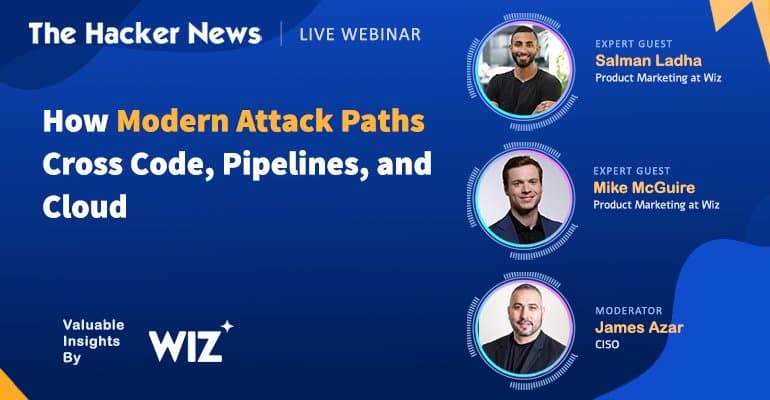
A recent Wiz webinar explained how attackers stitch together tiny code bugs, pipeline weaknesses, and cloud misconfigurations into a “lethal chain” that bypasses traditional alerts. Security leaders shared a practical framework for mapping real‑world attack paths, prioritizing truly dangerous flaws, and breaking the noise that overwhelms modern DevSecOps teams.
 )
)
The problem with “toast” alerts
Most security platforms act like a smoke alarm that blares every time you toast a slice of bread. Hundreds of low‑severity findings flood the dashboard, and teams eventually learn to ignore them. While analysts are busy dismissing “toast”, a sophisticated adversary can be quietly stitching together those crumbs into a Lethal Chain – a sequence of low‑risk flaws that, when combined, open a direct route to sensitive data.
What the Wiz experts said
“Attackers no longer need a single open door. They exploit the white space between development, CI/CD pipelines, and production cloud resources. The real risk is the connectivity of those tiny cracks, not the size of any individual one.” – Mike McGuire, VP of Cloud Security at Wiz
“If you only look at code or cloud in isolation, you’re flying blind. Mapping the end‑to‑end path lets you see which bugs are truly deadly.” – Salman Ladha, Director of Application Security at Wiz
Their message resonated with attendees: the industry’s current alert fatigue is a symptom of a deeper visibility gap.
How attackers build a lethal chain
| Stage | Typical low‑risk flaw | How it contributes to the chain |
|---|---|---|
| Code | Unvalidated input in a microservice (e.g., missing sanitization) | Provides a foothold for command injection that can be leveraged later. |
| Pipeline | Over‑permissive service‑account token stored in a CI secret store | Allows the attacker to pull down build artifacts or push malicious code. |
| Cloud | Misconfigured S3 bucket with public read/write | Gives exfiltration capability once the attacker has code execution. |
| Runtime | Unpatched container image with known CVE | Enables privilege escalation to the host OS. |
When each piece is present, the attacker moves from code → pipeline → cloud → runtime without triggering high‑severity alerts at any single point.
Practical framework to stop the noise
The webinar introduced a three‑step approach that teams can start using immediately:
- Map real‑world attack paths – Use a graph‑based model that links code repositories, CI/CD jobs, and cloud resources. Tools like Attack Surface Analyzer or Wiz’s own Attack Path Explorer can auto‑populate the graph.
- Prioritize by connectivity – Rank findings not by CVSS alone but by the number of downstream assets they can reach. A low‑CVSS bug that touches a production IAM role jumps to the top of the list.
- Automate remediation triggers – Tie the highest‑ranked paths to automated playbooks (e.g., rotate secrets, enforce least‑privilege IAM, patch containers). This reduces manual triage and cuts the time‑to‑fix from days to minutes.
“The key is to shift from alert volume to attack‑path impact. When you see a bug that connects to a misconfigured bucket, you know the chain is complete and you act fast.” – Mike McGuire
Immediate steps for your team
- Inventory the “white space.” Export a list of all service accounts, secret stores, and IAM policies used in your pipelines. Look for accounts that have both read and write permissions across environments.
- Integrate a path‑mapping tool into your CI pipeline. Run it on every PR merge to surface new connections before they reach production.
- Adopt a “kill‑chain” dashboard that visualizes the most critical paths. Highlight any node that appears in more than two distinct paths – those are your high‑impact choke points.
- Schedule a quarterly “attack‑path review.” Bring developers, DevOps, and security together to walk through the graph, validate assumptions, and prune unnecessary permissions.
Why this matters for DevSecOps
Traditional static analysis and cloud‑config scanners excel at finding isolated issues. Modern attackers, however, treat an organization’s environment as a network of tiny vulnerabilities. By adopting a holistic view that spans code, pipelines, and cloud, security teams can:
- Reduce alert fatigue by focusing on the few paths that actually lead to data exfiltration.
- Shorten the mean‑time‑to‑detect (MTTD) and mean‑time‑to‑respond (MTTR) for multi‑stage attacks.
- Align security investments with business risk, because the most connected flaws are the ones that could cause the biggest breach.
Register for the next briefing
If you missed the live session, you can still register for the recording and get access to the full slide deck. The webinar also includes a live Q&A where participants asked about specific pipeline tools (Jenkins, GitHub Actions, GitLab CI) and received tailored advice on tightening IAM scopes.
Stay ahead of lethal chains by mapping the whole attack surface, not just the individual cracks.
Comments
Please log in or register to join the discussion