
A Windows Defender Firewall alert appeared on a fast‑food point‑of‑sale screen in Sheffield, indicating that a network connection from the ordering software was blocked. The incident highlights the need for proper firewall rule configuration on commercial Windows deployments and provides a checklist for operators to bring their systems into compliance.
Regulatory action → What it requires → Compliance timeline
Regulatory trigger – The UK Information Commissioner's Office (ICO) has reaffirmed that any organisation using Windows‑based point‑of‑sale (POS) systems must keep the built‑in Windows Defender Firewall enabled and correctly scoped. Under the UK Data Protection Act 2018 (which incorporates GDPR), failure to block unauthorised outbound connections can be treated as a security breach.
What it requires – The firewall must:
- Block all inbound traffic unless explicitly required for payment processing, inventory management, or remote support.
- Restrict outbound traffic from the POS application to only the approved payment gateway IP ranges and internal inventory servers.
- Log any blocked connection attempts and retain those logs for at least 12 months for audit purposes.
- Generate a visible alert on the POS screen when a rule blocks traffic, but also forward the event to a central SIEM system for investigation.
Compliance timeline – The ICO gives organisations 30 days from the date of discovery to remediate firewall mis‑configurations and to document the corrective actions. A follow‑up review must be completed within 90 days to confirm that the firewall rules remain effective.
What happened at the Sheffield restaurant?
A customer reported a pop‑up on the order‑progress screen that read:
*"Windows Defender Firewall has blocked an application from making an outbound connection."
The message could not be dismissed by staff, but it did not affect the cooking equipment. The alert indicated that the POS software attempted to reach an external address that was not on the allowed list. In most cases this is caused by:
- An outdated payment‑terminal driver trying to contact a legacy server.
- A third‑party add‑on (e.g., a loyalty‑program module) that has not been whitelisted.
- Malware attempting to exfiltrate data.
Because the firewall was active, the potentially harmful traffic was stopped, but the visible warning also signalled a configuration gap that must be addressed.
Step‑by‑step compliance checklist for restaurant operators
- Inventory all Windows devices used for ordering, payment, and inventory. Record OS version, installed patches, and any third‑party software.
- Review the default firewall profile – ensure the Public profile is disabled on POS machines; use the Domain profile if the devices are joined to a corporate AD domain, otherwise the Private profile.
- Create explicit inbound rules only for the ports required by the payment processor (usually TCP 443 and a few legacy ports). Block everything else.
- Define outbound rules that allow traffic only to the IP ranges supplied by the payment gateway and to internal inventory servers. Use Scope fields to restrict by IP address, not by application name alone.
- Enable logging – set the firewall to log dropped packets to
%SystemRoot%\System32\LogFiles\Firewall\pfirewall.log. Verify that the log size is sufficient for a 30‑day retention period. - Integrate alerts with a SIEM – configure Windows Event Forwarding to send Event ID 2004 (blocked connection) to your central monitoring platform.
- Test the configuration – use
Test-NetConnectionor a third‑party port‑scanner from a controlled workstation to confirm that only the allowed destinations respond. - Document the rule set – keep a version‑controlled document that lists each rule, its business justification, and the date of last review.
- Train staff – ensure that any on‑site manager knows how to recognise a firewall alert and whom to contact for escalation.
- Schedule quarterly reviews – revisit the rule set after any software update, new payment‑gateway contract, or change in network topology.
Why the firewall matters for food‑service businesses
Even though a POS system is primarily a transaction device, it runs a full Windows stack. That means it inherits the same attack surface as a desktop computer. Attackers often target POS devices to steal credit‑card data because the machines handle payment information in clear text before encryption. By keeping the Windows Defender Firewall enabled and properly scoped, you create a first line of defence that can stop a malicious outbound request before it reaches the internet.
Next steps for the Sheffield outlet
- Assign a compliance lead – preferably the IT manager or the franchise’s regional tech support.
- Apply the checklist above within the next 30 days to meet the ICO deadline.
- Submit a brief report to the corporate security team, including the firewall log excerpt that captured the blocked connection.
- Plan a software update – the POS vendor has released a patch that removes the stray outbound call. Deploy it during the next scheduled maintenance window.
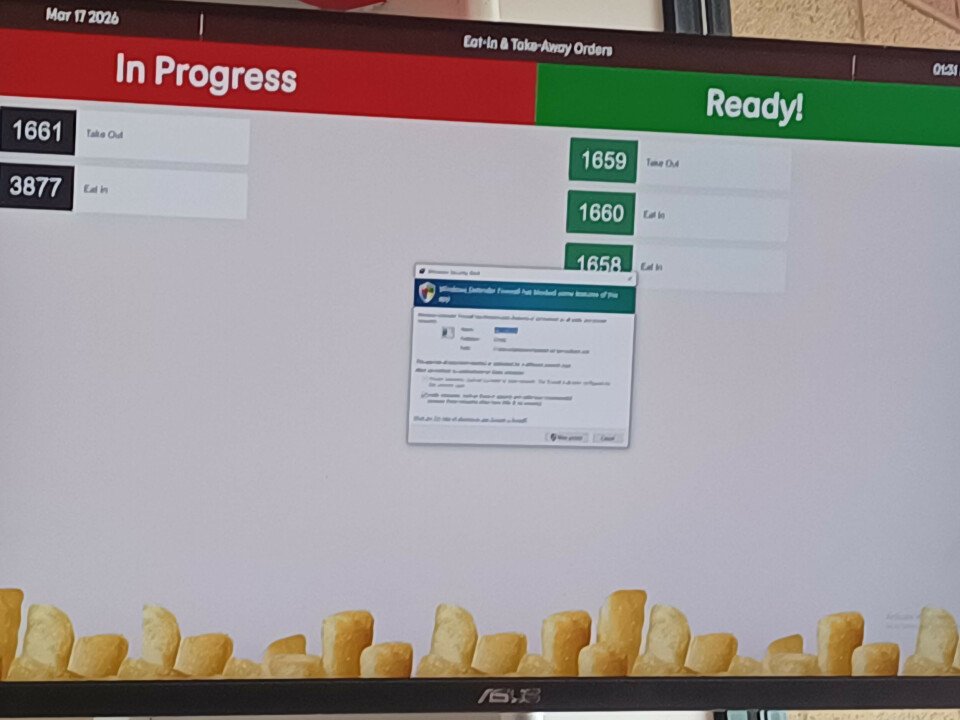
Caption: A Windows Defender Firewall warning displayed on a restaurant order‑progress screen.
By treating the firewall alert as a compliance signal rather than a nuisance, the restaurant can both protect customer data and avoid potential regulatory fines. The incident serves as a reminder that even a simple pop‑up can have significant legal and security implications.
Comments
Please log in or register to join the discussion