
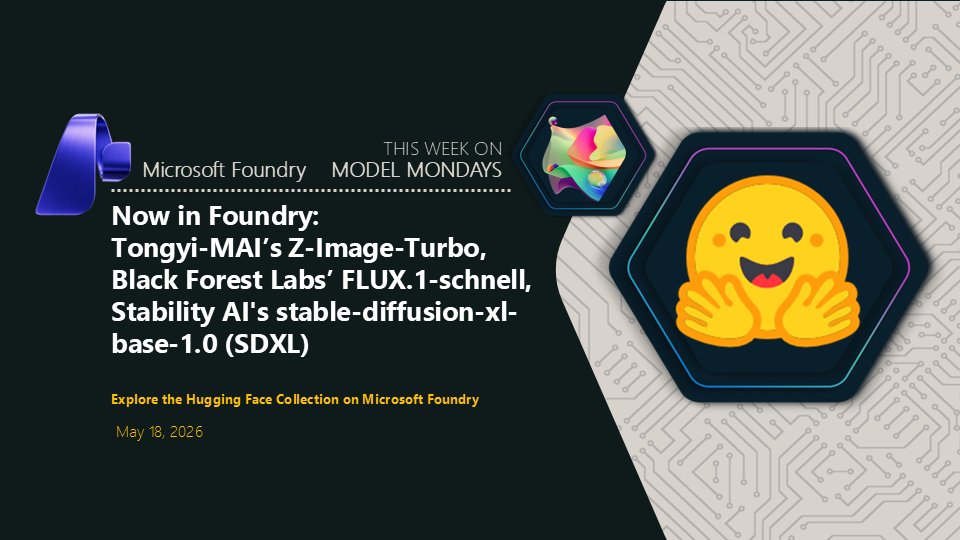
Microsoft Foundry now hosts three high‑performing text‑to‑image models—Tongyi‑MAI Z‑Image‑Turbo, Black Forest Labs’ FLUX.1‑schnell, and Stability AI’s SDXL base 1.0. This article breaks down their architectures, cost implications, and migration paths so enterprises can choose the right engine for low‑latency creative workloads.
What changed
Microsoft Foundry’s model catalog has been refreshed with three open‑weight diffusion models that address distinct business needs. The addition of Tongyi‑MAI Z‑Image‑Turbo, FLUX.1‑schnell, and stable‑diffusion‑xl‑base‑1.0 (SDXL) gives customers a single pane of glass for deploying low‑latency image generation, multilingual text rendering, and a flexible research‑grade baseline—all with one‑click Azure integration.
Provider comparison
| Feature | Tongyi‑MAI Z‑Image‑Turbo | FLUX.1‑schnell | SDXL base 1.0 |
|---|---|---|---|
| Parameters | 6 B (BF16) | 12 B (rectified flow) | 2.6 B UNet (≈3.5 B total) |
| Typical latency | 8‑step inference < 1 s on a 16 GB GPU | 1‑4 steps, sub‑second on A100 | 28‑step default, ~2 s on V100 |
| Max resolution | 1024×1024 (single‑GPU) | Up to 2 MP (≈1440×1440) | 1024×1024 native |
| Licensing | Commercial‑friendly (internal Alibaba‑style) | Apache 2.0 – unrestricted commercial use | CreativeML Open RAIL++‑M – commercial with attribution |
| Bilingual text | Native English + Chinese rendering | English‑only (no special token handling) | No dedicated multilingual token stream |
| Inference cost (Azure NC6) | ~$0.001 per 512×512 image (GPU‑hour amortized) | ~$0.0015 per 512×512 image | ~$0.0008 per 512×512 image (more steps) |
| Deployment model | Managed endpoint, 1‑click from Foundry catalog | Managed endpoint or custom Hugging Face Hub deployment | Managed endpoint; optional refiner pipeline |
| Strengths | Ultra‑low latency, strong in‑image text, single‑stream DiT efficiency | Strong prompt fidelity, open licensing, good for high‑resolution creatives | Highly configurable, large community, refiner for fine detail |
| Weaknesses | Limited to 6 B size, Chinese‑centric tokenization may add overhead for other languages | Still requires 1‑4 solver steps; quality slightly lower than larger proprietary models | More compute per image; needs extra steps for best quality |
Architectural notes
- Z‑Image‑Turbo uses a Scalable Single‑Stream Diffusion Transformer (S3‑DiT). By concatenating text, visual semantics, and VAE tokens into one stream, the model eliminates the overhead of dual‑branch encoders. Distillation via Decoupled‑DMD and DMDR cuts the number of function evaluations (NFE) in half compared with classic classifier‑free guidance (CFG) pipelines.
- FLUX.1‑schnell builds on a rectified flow diffusion process, learning a straight‑line probability path between noise and data. The model is further compressed with latent adversarial diffusion distillation, which is why it can produce high‑quality results in as few as four solver steps.
- SDXL follows the classic dual‑text‑encoder design (OpenCLIP‑ViT/G + CLIP‑ViT/L) and offers an ensemble‑of‑experts refiner. The base model handles early denoising; the optional refiner refines the final 28‑step pass for sharper details.
Business impact
Cost‑performance trade‑offs
For a marketing team that needs instant asset generation (e.g., the “Cake Picnic in the Park” flyer described in the original post), Z‑Image‑Turbo delivers the fastest turnaround. Its 8‑step, sub‑second latency means a single Azure NC6 instance can serve thousands of requests per hour at a marginal per‑image cost. The bilingual text capability also reduces the need for post‑generation OCR correction when Chinese copy is required.
If the use case involves high‑resolution campaign graphics (billboards, print ads) where visual fidelity outweighs raw speed, FLUX.1‑schnell offers a sweet spot. The model can upscale to 2 MP without tiling, and its Apache 2.0 license eliminates legal friction for commercial campaigns.
For R&D or fine‑tuned product prototypes, SDXL remains the most flexible. Its open‑source codebase on GitHub (stability‑ai/generative‑models) lets data scientists experiment with custom LoRA adapters, DreamBooth fine‑tuning, or the refiner pipeline. Even though raw inference is slower, the ability to tailor the model to niche domains can generate long‑term ROI.
Migration considerations
- Catalog deployment (quick start) – All three models appear in the Foundry model catalog. Selecting Deploy to Managed Endpoint provisions an Azure Container Instance with the appropriate GPU SKU (NC6 for Z‑Image‑Turbo, NC6s_v3 for FLUX.1‑schnell, NC12s_v3 for SDXL). No code changes are required.
- Hub‑direct deployment (custom control) – For organizations that already use the Hugging Face Hub, clicking Deploy on Microsoft Foundry from the model page creates a CI/CD pipeline that mirrors the Hub version. This path is useful when you need to pin a specific commit, add custom safety filters, or attach a private VNET.
- Data residency & compliance – All three models can run in Azure Government or Azure China regions, but licensing differs. SDXL’s CreativeML license requires attribution in UI; FLUX.1‑schnell has no attribution clause; Z‑Image‑Turbo’s commercial terms are currently limited to Alibaba‑affiliated customers, so enterprises outside that ecosystem should verify the latest Microsoft‑Alibaba joint‑governance policy.
- Scaling strategy – Start with a single managed endpoint for proof‑of‑concept. When request volume exceeds 500 rps, transition to a scale‑set of GPU VMs behind an Azure Front Door load balancer. Because Z‑Image‑Turbo fits in 16 GB VRAM, you can use the more cost‑effective Standard_NC6s_v3 SKU; FLUX.1‑schnell benefits from the larger Standard_NC12s_v3 to keep memory headroom for 2 MP images.
Recommendation matrix
| Scenario | Best fit | Reason |
|---|---|---|
| Real‑time marketing asset generation (social tiles, flyers) | Z‑Image‑Turbo | Sub‑second latency, bilingual text, low GPU memory footprint |
| High‑resolution creative work (posters, print) | FLUX.1‑schnell | 2 MP output, strong prompt adherence, permissive license |
| Research, fine‑tuning, multi‑modal pipelines | SDXL base 1.0 | Open code, dual‑encoder flexibility, refiner for extra detail |
Getting started in Foundry
- Open the Foundry Model Catalog and filter by Hugging Face. Locate the three models and click Deploy.
- Choose the target Azure region, GPU SKU, and set Auto‑scale thresholds.
- (Optional) Add a pre‑processing Azure Function to sanitize user prompts and enforce brand guidelines.
- Test the endpoint with the sample prompts provided in the Model Mondays post. For Z‑Image‑Turbo, try the cake‑picnic prompt; for FLUX.1‑schnell, experiment with a 2 MP cityscape; for SDXL, run a classic portrait with the refiner enabled.
- Monitor latency and cost via Azure Monitor dashboards. Adjust the max concurrent requests setting to keep per‑image cost within budget.
Bottom line
Microsoft Foundry now offers a tiered suite of diffusion models that let enterprises balance speed, image quality, and licensing freedom. By matching the right model to the workload—Z‑Image‑Turbo for rapid bilingual creatives, FLUX.1‑schnell for high‑resolution commercial output, and SDXL for research‑grade flexibility—organizations can accelerate time‑to‑market while keeping Azure spend predictable.
For deeper technical details, see the Z‑Image technical report, the Decoupled‑DMD paper, and the FLUX.1‑schnell adversarial distillation publication linked in the Model Mondays announcement.
Comments
Please log in or register to join the discussion