
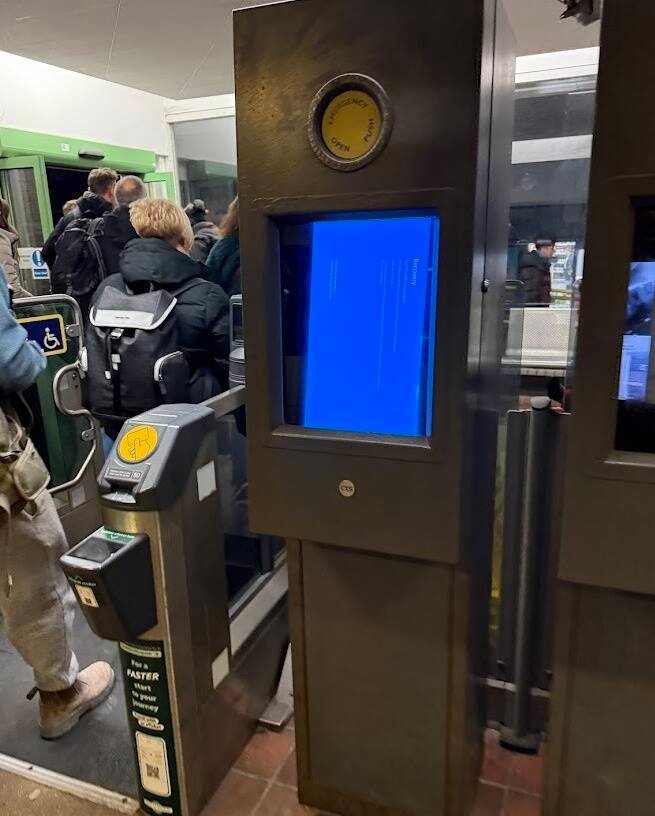
A Windows blue screen of death at Polegate station perfectly captures the UK rail experience - both systems equally prone to unexpected collapse.
A Windows blue screen of death at Polegate station perfectly captures the UK rail experience - both systems equally prone to unexpected collapse.
Windows Meets British Rail: A Match Made in Recovery Mode
If there's one thing the British love to complain about (aside from the weather and potholes), it's the state of the nation's railways. Despite decades of modernization efforts and the infamous Beeching cuts of the 1960s that closed thousands of miles of track, much of Britain's rail network still feels like it's stuck in a time warp. The tracks themselves are a century old in many places, and while some stations have received modern upgrades, the fundamental reliability issues persist.
Take Polegate station in East Sussex, for example. This modest stop on the Eastbourne line recently became an unintentional monument to both technological failure and British rail's ongoing struggles. When our eagle-eyed reader passed through recently, they encountered a scene that could only be described as poetic: a Windows blue screen of death (BSOD) displayed prominently on the station's ticket barrier system.
When Windows Joins the Rail Strike
The image tells a story all its own. The ticket barriers, equipped with barcode readers, contactless payment terminals, and traditional ticket slots, stood wide open. Meanwhile, a Windows recovery screen loomed in the background like a hungover commuter on the last train home after one too many pints.

It's not clear exactly what caused the operating system to crash. Was it an overflow error after the latest round of ticket price increases were fed into the system? A software conflict between the barcode reader and the contactless payment module? Or simply Windows being Windows?
What we do know is that when the photo was taken, the barriers were open, ticket inspection had apparently been suspended, and passengers were flowing through unimpeded. For once, the rail system was actually working efficiently - albeit unintentionally and thanks to a software failure rather than any deliberate policy.
The Reality Behind Open Barriers
Before we get too carried away with the romance of a free ride, it's worth noting that open barriers don't necessarily indicate a system failure. A lack of station staff can certainly be a factor, as can the sheer volume of passengers during peak times. For all their techno-wizardry, automatic barriers can actually hinder the flow of customers when things get busy.
However, the timing of this particular Windows crash feels almost too perfect. Britain's railways are currently grappling with chronic delays, cancellations, overcrowding, and the ongoing debate about nationalization versus privatization. The sight of Microsoft's flagship operating system collapsing in a heap at a railway station feels like a perfect metaphor for the entire British rail experience.
Localization at Its Finest
There's something delightfully British about this entire scenario. Windows, in its infinite wisdom, has managed to localize itself perfectly to the UK rail context - by failing in exactly the same unreliable, unpredictable manner that passengers have come to expect from their train services.
It's the kind of dark humor that only makes sense in Britain, where a software crash at a railway station becomes a moment of shared national experience rather than just another IT failure. The open barriers, the confused passengers, the blue screen mocking everyone from its corner - it's all part of the rich tapestry of British public transport.
The Bigger Picture
This incident at Polegate station is more than just a funny photo. It highlights the ongoing challenges of modernizing Britain's rail infrastructure while dealing with legacy systems, budget constraints, and the simple fact that much of the network was built for a different era.
The ticket barriers themselves represent an attempt at modernization - contactless payments, barcode scanning, automated ticket checking. But when the system that powers these barriers crashes, we're reminded that technology is only as reliable as the software that runs it.
For passengers at Polegate that day, the Windows crash might have actually improved their journey. No waiting at barriers, no technical issues with ticket scanning, just a smooth flow through the station. It's a reminder that sometimes the old ways - human ticket inspectors, manual barriers - might actually be more reliable than their high-tech replacements.
A Moment of British Schadenfreude
There's a certain satisfaction in seeing Windows fail in such a public, relevant way. After years of dealing with Windows updates at the worst possible moments, blue screens interrupting important work, and the general unpredictability of Microsoft's operating systems, watching it collapse at a railway station feels like cosmic justice.
The fact that it happened in service of Britain's beleaguered rail network only adds to the irony. Two systems, both prone to unexpected failures, both frustrating users on a daily basis, both seemingly held together by hope and temporary fixes rather than robust engineering.
Looking Forward
As Britain continues to debate the future of its railways - whether through nationalization, increased privatization, or some hybrid model - incidents like the Polegate Windows crash serve as a reminder of the challenges ahead. Modernizing infrastructure isn't just about laying new tracks or installing fancy ticket barriers. It's about ensuring that the software, systems, and processes that support these technologies are actually reliable.
Until then, we can all take comfort in knowing that somewhere in East Sussex, Windows is still in Recovery mode, the barriers are still open, and for one brief moment, Britain's rail network was actually working efficiently. Sometimes you have to laugh, because the alternative is crying into your overpriced, lukewarm tea while waiting for a train that may never come.
®
No more fake tech news! theregister.com/Bork) | More like these
Comments
Please log in or register to join the discussion