Scientists discover Messor ibericus ants defy evolutionary norms by cloning males of a different species to sustain their colonies. This 'xenoparous' reproduction reveals a symbiotic dependency where two species intertwine their life cycles, offering new insights into genetic manipulation and superorganism evolution.
In a discovery that rewrites fundamental biological rules, researchers have documented Messor ibericus ants performing nature’s most sophisticated cloning trick: queens produce male offspring belonging to an entirely different ant species, Messor structor. Published in Nature, this unprecedented reproductive strategy—termed xenoparity ("giving birth to other species")—reveals a complex dependency where colonies become multi-species superorganisms.
Breaking the Biological Contract
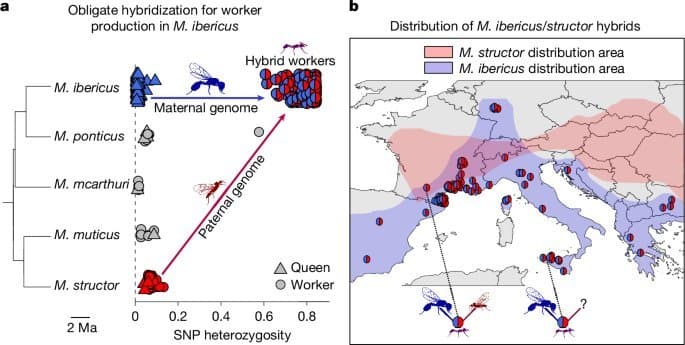
Traditionally, organisms produce same-species offspring. Yet genomic analysis of 390 ants across Europe showed M. ibericus workers are first-generation hybrids—maternally ibericus but paternally structor (diverged ~5 million years ago). Crucially, colonies couldn’t produce workers without structor sperm. But how did queens acquire this sperm in regions where structor colonies don’t exist? The answer: queens clone structor males themselves.
The Cloning Mechanism
Through phased genome sequencing and lab observations, researchers confirmed:
- Androgenetic Cloning: M. ibericus queens lay eggs containing only structor sperm DNA, excluding their own nuclear genetic material. These eggs develop into structor males.
- Spermatheca Stockpile: Queens mate with both structor and ibericus males, storing sperm to clone structor males or fertilize eggs for hybrid workers.
- Domesticated Lineage: Cloned structor males form a genetically distinct, low-diversity lineage maintained solely within ibericus colonies—akin to domestication. They’re morphologically distinct (hairless vs. wild structor’s hairy phenotype) and rarely interbreed with wild counterparts.
"Females need to propagate another species’ genome using their own eggs. This is sexual dependency pushed to its evolutionary extreme."
— Study authors, Nature (2025)
Evolutionary Implications
This system evolved from ancestral sperm parasitism (using wild structor sperm) into integrated reproduction:
- Worker Production: Hybrid workers (50% each species) exhibit hybrid vigor, crucial for colony function.
- Male Production: Cloned structor males provide sperm for future workers, creating a self-sustaining cycle.
- Geographical Expansion: Maintaining cloned males lets M. ibericus colonize areas beyond wild structor ranges (e.g., Mediterranean Europe).
Why Tech Professionals Should Care
- Bio-Inspired Systems: Demonstrates nature’s "plug-and-play" genetic modules—cloning across species barriers could inform synthetic biology.
- Genetic Load Insights: Clonal structor males show high non-synonymous mutations (πn/πs=0.43 vs. 0.21 wild), highlighting risks in artificial clonal systems.
- Superorganism Theory: Colonies blend castes, sexes, and species, redefining boundaries of biological individuality—a model for distributed systems in AI/robotics.
This "two-species superorganism" exemplifies a major evolutionary transition. As researchers probe the molecular mechanisms enabling cross-species androgenesis, xenoparity may inspire breakthroughs in genetic rescue and cooperative AI architectures.
Source: Juvé et al. (2025). One mother for two species via obligate cross-species cloning in ants. Nature. DOI: 10.1038/s41586-025-09425-w
Comments
Please log in or register to join the discussion