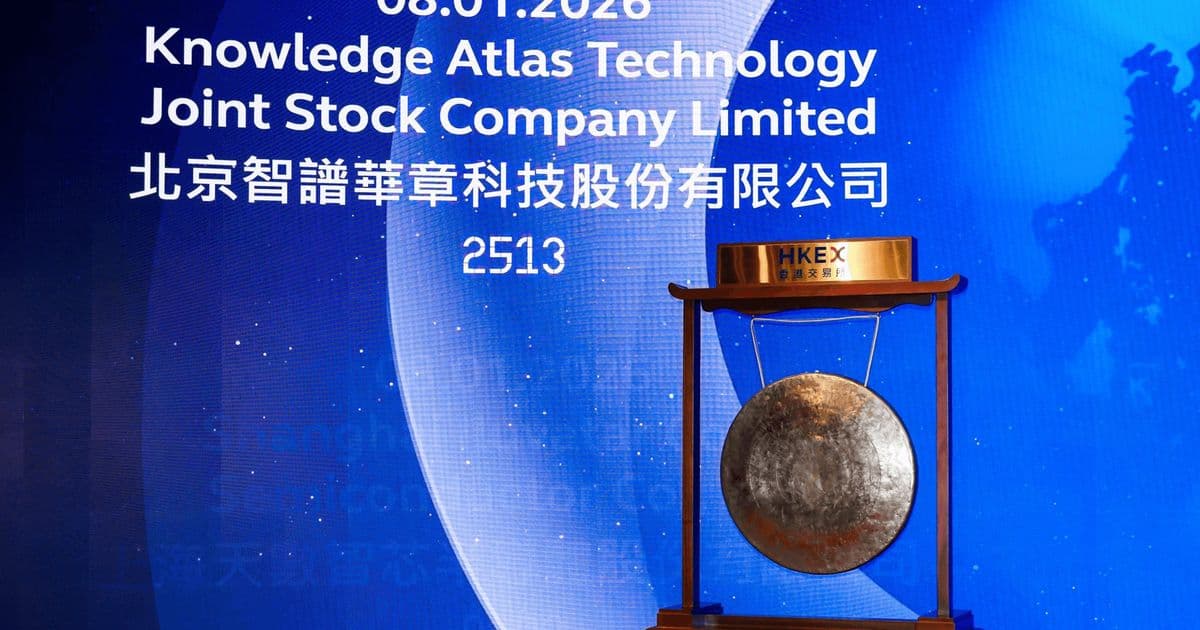
Chinese AI company Zhipu adds second sponsor for Shanghai STAR listing while GLM-5 model achieves top open-source rankings, marking shift from price wars to value-based pricing.
Chinese AI company Zhipu has taken two significant steps that signal both its financial ambitions and technical maturity, adding Guotai Haitong Securities as co-sponsor for its proposed Shanghai STAR Market listing while simultaneously launching GLM-5, an open-source model that now ranks among the world's most capable.
Dual Listing Strategy Gains Momentum
The company's decision to bring Guotai Haitong Securities on board as co-sponsor alongside China International Capital Corporation (CICC) represents a critical advancement in Zhipu's "H+A" dual-listing strategy. This approach aims to secure listings on both Hong Kong's main board and Shanghai's STAR Market, positioning Zhipu as a truly international player in the competitive AI landscape.
Today's trading reflected strong market confidence, with Zhipu's share price rising over 20%, pushing its market capitalization close to HK$220 billion. This valuation makes Zhipu the highest-valued large model company globally, with shares gaining 135% just this week alone. The market's enthusiasm suggests investors see Zhipu not just as another AI startup, but as a foundational technology platform with substantial growth potential.
GLM-5: Technical Achievement Meets Market Reality
On February 11, Zhipu open-sourced GLM-5, internally dubbed "Pony Alpha," positioning it as "the best open-source model for the Agentic Engineering era." The technical benchmarks tell a compelling story: on SWE-bench-Verified, GLM-5 scored 77.8, while on Terminal Bench 2.0, it achieved 56.2. Both scores represent the highest among open-source models, surpassing even Google's Gemini 3 Pro.
In the global Artificial Analysis leaderboard, GLM-5 currently ranks 4th overall and 1st among open-source models. This achievement is particularly noteworthy given the intense competition in the large language model space, where companies like OpenAI, Anthropic, and Google have dominated with proprietary models.
However, the most telling development may be Zhipu's simultaneous announcement of a structural price adjustment for its GLM Coding Plan. The company is implementing minimum 30% price increases, with some services seeing hikes of 60%. This move represents a significant departure from the price war mentality that has characterized much of the AI industry's recent history.
The End of AI Price Wars?
Zhipu's pricing strategy shift signals a maturing market. The company cites "surging demand, compute investment, and product upgrades" as justification for the increases. This rationale suggests that the economics of large language models are becoming more sustainable, moving away from the race-to-the-bottom pricing that has made profitability elusive for many AI companies.
This transition from price competition to value-based pricing could mark a turning point for the entire industry. As models become more capable and specialized, companies appear willing to charge premium prices for premium capabilities. For Zhipu, this strategy aligns with its positioning as a platform technology provider rather than a commodity AI service.
Domestic AI Ecosystem Integration
GLM-5's technical achievements extend beyond raw performance metrics. The model has completed deep inference adaptation with domestic AI chips including Ascend, Moore Threads, Cambricon, Kunlun, Muxi, Suiyuan, and Hygon. This broad hardware compatibility demonstrates Zhipu's commitment to China's domestic AI ecosystem and reduces dependence on foreign semiconductor technology.
This hardware integration is particularly strategic given ongoing geopolitical tensions and export controls affecting advanced AI chips. By optimizing for domestic alternatives, Zhipu ensures its technology remains accessible and deployable within China's regulatory and technological framework.
Financial Projections and Market Position
JPMorgan's recent analysis provides external validation of Zhipu's market position. The investment bank has named Zhipu a "technology-capability-driven platform with significant growth potential," projecting a 127% revenue compound annual growth rate from 2025 to 2030. More importantly, JPMorgan anticipates Zhipu will achieve profitability by 2029, a milestone that has proven elusive for many AI companies despite massive funding rounds.
These projections suggest that Zhipu's dual approach—technical excellence combined with strategic market positioning—may be paying off. The company appears to be building a sustainable business model rather than relying solely on investor enthusiasm for AI technology.
Implications for the Global AI Landscape
Zhipu's achievements carry broader implications for the global AI competition. As the first Chinese company to pursue a dual listing strategy in this space, Zhipu is effectively testing whether the capital markets will support AI companies at valuations comparable to their Western counterparts.
The company's success in both technical benchmarks and market valuation challenges the narrative that China lags significantly in AI development. While debates continue about the relative sophistication of models from different regions, Zhipu's performance demonstrates that Chinese companies can compete at the highest levels of the technology.
Moreover, Zhipu's pricing strategy shift may influence how other AI companies approach monetization. If the market accepts higher prices for better performance, it could accelerate the development of more specialized, capable models across the industry.
Looking Ahead
As Zhipu moves forward with its dual listing plans and continues to develop its model capabilities, several questions remain. Will the company maintain its technical leadership as competitors release new models? Can it successfully navigate the regulatory requirements for both Hong Kong and mainland Chinese listings? And most importantly, can it translate its current market valuation and technical achievements into sustainable, profitable growth?
The answers to these questions will not only determine Zhipu's future but may also shape the trajectory of the global AI industry. As the company transitions from price wars to value-based pricing, it may be charting a course that other AI companies will soon follow.
Comments
Please log in or register to join the discussion