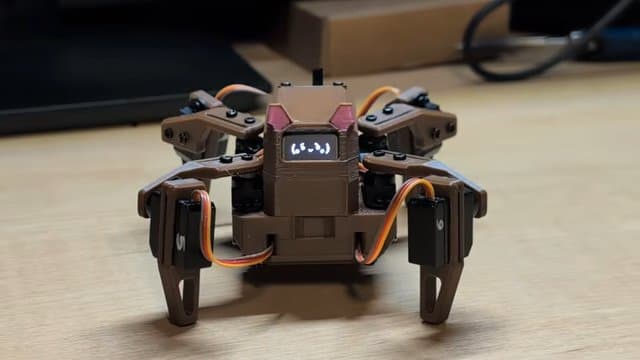
The Sesame Micro is an ultra-tiny, palm-sized quadruped robot with an adorable, expressive face. The creator used Autodesk Fusion 360 to precisely place eight Pico servos, driven by an Adafruit Metro Mini with an Xiao ESP32 relay. The build files are on GitHub, but the Micro isn't beginner-friendly; start with the original Sesame first.
The Sesame Micro is an ultra-tiny, palm-sized quadruped robot with an adorable, expressive face. The creator used Autodesk Fusion 360 to precisely place eight Pico servos, driven by an Adafruit Metro Mini with an Xiao ESP32 relay. The build files are on GitHub, but the Micro isn't beginner-friendly; start with the original Sesame first.
So, when I found out about the Sesame Micro, I was impressed that it was, reportedly, the smallest quadruped robot dog and could easily fit within the palm of my hand. But also, it's just extremely cute. Look at its little face; how could you say "no" to that?
Even after years of 3D printing, these still feel like magic, and they’re one of the best ways to show what a home printer can really do.
The Sesame Micro is a tiny version of an already-tiny robot
Making it was a real feat of engineering
As spotted by Hackster.io, this awesome project was the idea of Dorian Todd. Todd has already made his name in the robotics scene with the Sesame, which he claims you can make for around $60. Now, he's showing off the Sesame Micro, which is, well...a smaller Sesame. Given how the original Sesame wasn't exactly the biggest robot around, squashing it down even further to create the Sesame Micro took some real tinkering.
For one, Todd had to use Pico servos and carefully plan out their positioning in Autodesk Fusion 360, so they were equally spaced while also keeping the robot standing. Todd ended up using eight motors, which was too many for his planned Xiao ESP32 to control; instead, he deployed an Adafruit Metro Mini V2 to act as the primary driver for the servos, while using the Xiao ESP32 as the 'waiter' that sat between the remote control and the Adafruit, relaying the input.
Open-air filament storage is a quiet print killer. Here’s how bad storage leads to failed prints and wasted material.
The build files for the Sesame Micro are available on GitHub, but Todd recommends starting with the original Sesame first if you're new to robotics. The Micro requires precision 3D printing and careful assembly that makes it more suitable for experienced builders. The original Sesame provides a gentler introduction to quadruped robotics while still teaching the core principles of servo control and mechanical design.
What makes the Sesame Micro particularly impressive is how Todd solved the space constraints. The Pico servos are incredibly compact, but fitting eight of them along with the control electronics into such a small frame required careful planning. The Autodesk Fusion 360 model shows how each component had to be precisely positioned to maintain balance while allowing for the full range of motion needed for walking.
The control system is also clever - using the Adafruit Metro Mini V2 as the main servo controller while the Xiao ESP32 handles wireless communication keeps the design simple while still providing modern features like remote control. This two-board approach was necessary because the ESP32 alone couldn't handle driving eight servos while also managing Bluetooth or WiFi communication.
For those interested in building their own, the GitHub repository includes all the 3D printable files, electronic schematics, and code needed to create a Sesame Micro. However, be prepared for a challenging build - the tiny scale means there's little room for error in both the printing and assembly stages. The original Sesame remains a more forgiving project for those just starting their robotics journey.
The Sesame Micro represents an impressive achievement in miniaturization, proving that sophisticated robotics can be built at scales small enough to fit in your hand. It's a testament to how accessible advanced technology has become, with a dedicated hobbyist able to create something this impressive using readily available components and a desktop 3D printer.
Comments
Please log in or register to join the discussion