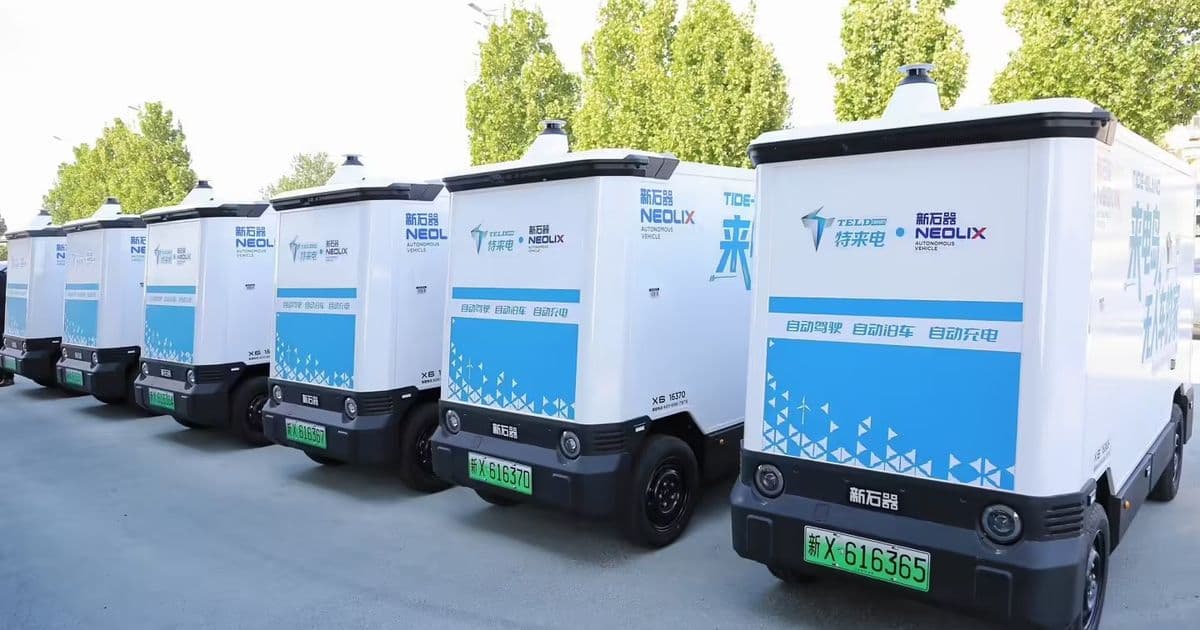
Neolix and charging‑network operator TELD announced a pilot hub in Qingdao that can park, charge, clean and self‑diagnose up to 100 delivery robots without human staff. The companies plan 300 hubs and 3 000 relay stations in China within three years, and a modest overseas rollout. While the concept promises lower operating cost, the engineering challenges of fully autonomous charging and maintenance remain substantial.
Neolix‑TELD ‘Power Island’: what the announcement actually delivers
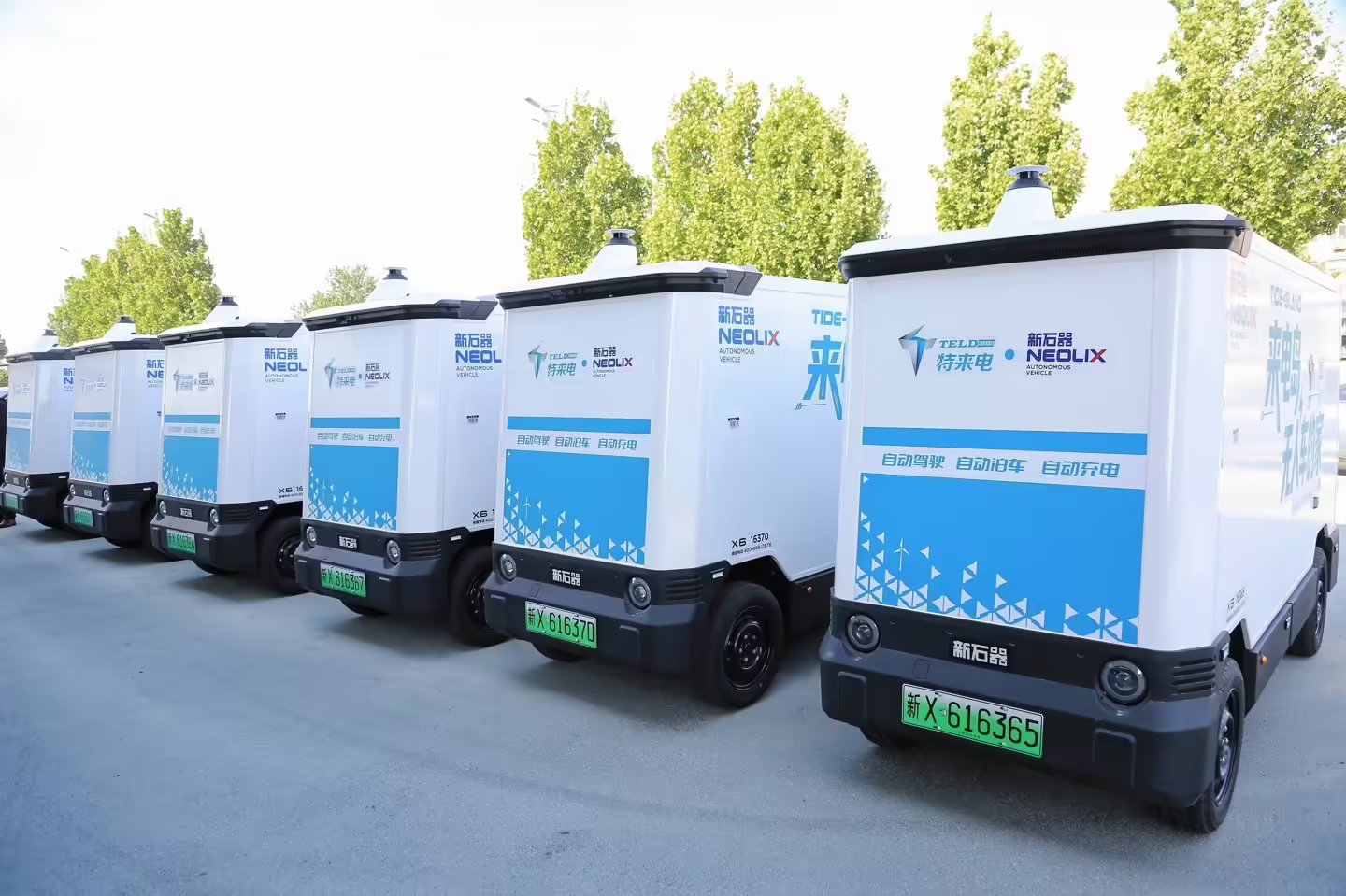
Neolix, the Chinese maker of autonomous delivery carts, and TELD, a large EV‑charging network, unveiled a facility they call Power Island (来电岛) at a press event in Qingdao on May 8. The headline claim is simple: a single site can accommodate 100 autonomous vehicles, charge each to 90 % in 60 minutes, and perform cleaning and self‑diagnostics without any human operator. The partnership is framed as a pivot for Neolix from vehicle builder to “mobility‑as‑a‑service” provider, and TELD positions the hub as the core infrastructure needed for large‑scale driverless logistics.
What is new compared to existing charging solutions?
Integrated workflow – Most current charging stations for delivery robots require a human to park the unit, plug it in, and later retrieve it. Power Island bundles three functions:
- Automated docking using vision‑based guidance and magnetic alignment, similar to the docking mechanisms used by warehouse AGVs.
- Fast DC charging delivering up to 150 kW per dock, enough to raise a 2 kWh battery from 10 % to 90 % in roughly an hour. The specification matches the CCS2 fast‑charge standard, which TELD already supports for passenger EVs.
- Robotic cleaning & self‑check – a small articulated arm equipped with a brush and a diagnostic camera runs a 5‑minute health scan after each charge cycle. The data stream is fed back to Neolix’s fleet‑management cloud for predictive maintenance.
Scale‑out plan – The joint venture, Qingdao TELD Neolix Autonomous Vehicle Operations Co., announced a roadmap of 300 main islands and 3 000 relay stations across 100 Chinese cities within three years. Each relay station would host 10–20 docks, acting as a “last‑mile” charging point for vehicles that cannot travel back to a central hub.
International pilot – A modest overseas rollout is slated for 30 islands in ten markets, targeting regions where Neolix already operates (UAE, Singapore, Thailand, Japan). The overseas version will use TELD’s existing charging backend, reducing the need for local hardware development.
Technical and operational limits
| Aspect | Claimed capability | Practical concerns |
|---|---|---|
| Charging speed | 90 % in 60 min (≈150 kW) | Battery chemistry for small delivery robots typically caps at 50‑70 kW to preserve cycle life. Pushing to 150 kW may shorten battery lifespan unless robust thermal management is added. |
| Docking accuracy | Fully autonomous, vision‑based | Urban environments introduce dust, rain, and glare that can degrade camera performance. Redundant lidar or RFID tags are often required for reliable docking. |
| Cleaning & diagnostics | 5‑min robotic arm routine | The arm adds mechanical complexity and wear points. Cleaning effectiveness on dirt‑heavy streets is unproven; most existing fleets rely on manual wash stations. |
| Scalability | 300 hubs + 3 000 relays in 3 yr | Deploying 300 central hubs means securing large parcels of land in dense cities, a non‑trivial urban‑planning hurdle. Relay stations need power‑grid upgrades to support fast‑charge loads. |
| Software stack | Integrated fleet‑management cloud | Interoperability with third‑party logistics platforms is not demonstrated. Open APIs would be needed for broader adoption beyond Neolix’s own fleet. |
In short, the hardware pieces exist, but the system‑level integration—especially the reliability of fully autonomous docking under real‑world conditions—has not been validated at scale.
Why the market cares (and why it should stay cautious)
- Cost pressure – Last‑mile delivery robots currently spend a large fraction of their operating budget on labor for charging and maintenance. Automating these steps could shave 15‑20 % off total cost of ownership if the hub runs with high uptime.
- Regulatory angle – Chinese city planners are beginning to allocate dedicated lanes for autonomous delivery. A centralized charging hub fits neatly into those plans, but each city will still need to approve the electrical load and safety certifications.
- Competitive response – Companies such as Starship Technologies and Nuro rely on semi‑automated charging stations that still need a human to plug in the robot. If Neolix can demonstrate a truly hands‑free loop, it may force rivals to accelerate similar developments.
However, the headline numbers (100 robots, 60‑minute charge) are comparable to what a well‑designed fast‑charging dock can already achieve with a human operator present. The real value lies in the automation of the entire workflow, and that part is where the risk of downtime, sensor failure, and unexpected edge cases is highest.
What to watch next
- Field trial data – TELD promised a live‑stream of the first 48‑hour test run. Independent telemetry showing docking success rate, average charge time, and maintenance‑cycle duration will be the first hard proof.
- Battery health reports – If the fast‑charge regime leads to accelerated degradation, the cost savings from automation could be offset by more frequent battery replacements.
- City‑level deployments – The involvement of 12 state‑owned urban investment platforms suggests political backing, but each municipality’s permitting timeline will reveal how quickly the network can actually expand.
- Open‑source components – Neolix has released a thin SDK for its docking controller on GitHub (link). Community contributions could surface hidden bugs or suggest more robust sensor fusion strategies.
Bottom line
Power Island is an interesting step toward removing the last human hand from autonomous delivery operations. The hardware—fast DC chargers, vision‑guided docks, and a cleaning arm—are all commercially available today. The novelty is in stitching them together into a self‑contained hub that can run a fleet of 100 robots continuously. Whether the system can maintain high reliability in the messy reality of city streets remains an open question. The upcoming pilot data will be the decisive factor for anyone watching the economics of driverless logistics.
Comments
Please log in or register to join the discussion