Eric Goldman explains why he's ending his two-decade relationship with Google AdSense, citing declining revenue, ad quality issues, and legal risk concerns.
After 20 years of running Google AdSense on his Technology & Marketing Law Blog, Eric Goldman has decided to pull the plug on the advertising program that once seemed like a promising experiment in understanding the online advertising ecosystem.
Goldman's journey with AdSense began in February 2005, shortly after launching his blog. Like many early adopters, he was drawn to the platform's potential to generate modest income while providing insider knowledge of the advertising industry he frequently wrote about. The early days were particularly lucrative - he recalls some initial clicks paying as much as $20 each, a stark contrast to the roughly $100 per year he was earning at the end.
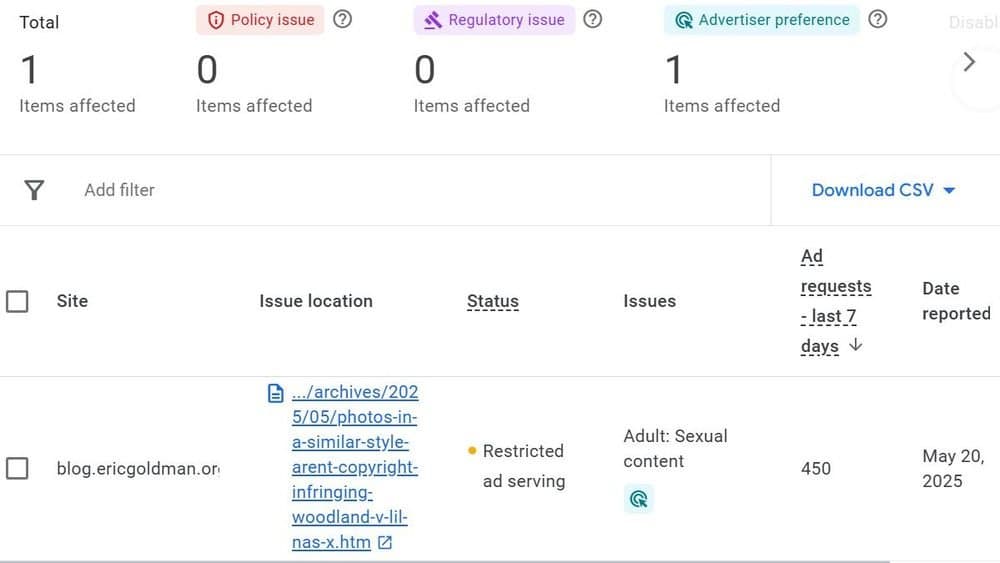
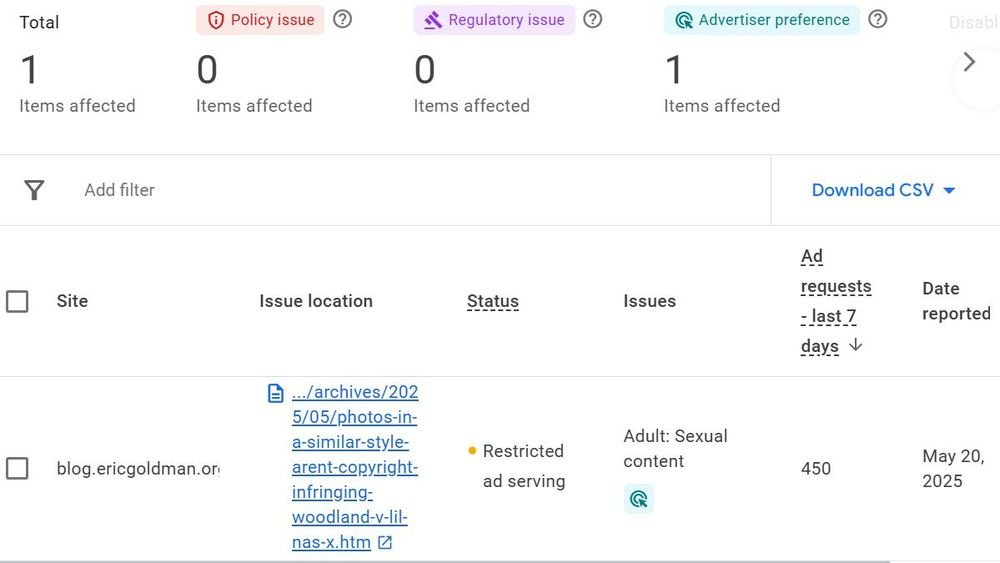
Over two decades, Goldman's motivations for maintaining AdSense gradually eroded. The financial incentive dwindled to negligible amounts, barely worth the effort of managing the account. More concerning were the operational headaches: his content frequently triggered AdSense's content rules due to what he describes as "Masnick's Impossibility Theorem" - a reference to the challenge of creating content that satisfies all platform guidelines while remaining authentic and substantive.
The quality of the advertising experience also deteriorated significantly. What began as a single modest square display ad in the upper right corner of his pages expanded without his full awareness into a more intrusive format featuring additional banners at both the top (on mobile) and bottom (on desktop) of pages. Goldman notes he rarely saw these changes personally due to his adblocker, but reader complaints about ad intrusiveness and quality became increasingly common.
Beyond the practical concerns, Goldman identifies a strategic legal consideration: removing ads helps more clearly classify his blog as "non-commercial" for various legal tests that impose greater liability on commercial actors. The $100 annual revenue wasn't compensating him for any additional legal risk or compliance burdens created by these doctrines.
Goldman acknowledges the bittersweet nature of ending a 20-year vendor relationship, even as he recognizes it's "well past time" for the change. He's deleted all ericgoldman.org domains from AdSense and invites readers to report any stray ads that might appear going forward.
The decision reflects broader tensions in the digital publishing ecosystem - the declining value of programmatic advertising for niche content, the challenges of maintaining platform relationships over decades, and the balancing act between monetization and user experience. For Goldman, the math was simple: the costs in time, reader satisfaction, and legal complexity outweighed the minimal financial return.
The move also highlights how the online advertising landscape has evolved since 2005. What was once an experimental and potentially lucrative opportunity for independent publishers has become increasingly automated, intrusive, and less rewarding for content creators who prioritize quality and authenticity over maximizing ad revenue.
Goldman's experience serves as a case study in the lifecycle of digital advertising relationships and raises questions about the sustainability of ad-supported models for specialized, long-form content in an era of declining ad rates and increasing user resistance to intrusive advertising formats.
Comments
Please log in or register to join the discussion