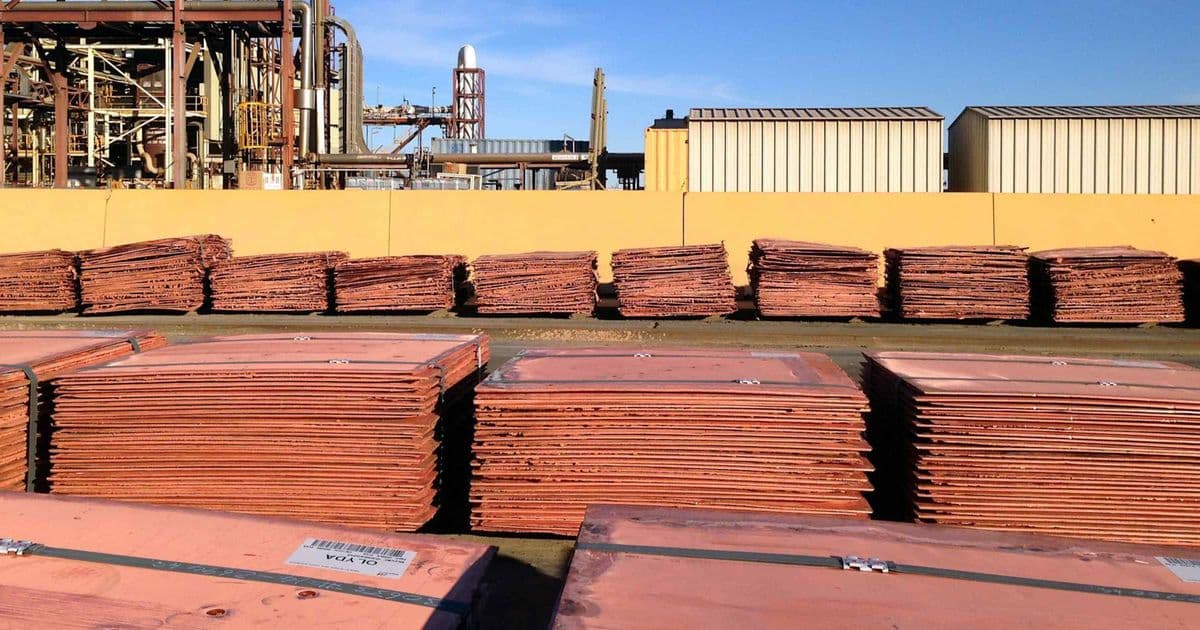
Copper prices have surged toward historic levels as traders bet on a looming sulfur shortage for smelting and a rapid expansion of AI‑related infrastructure, pushing the LME three‑month contract to $10,850 per tonne.
Speculators Drive Copper Near Record Highs Amid Sulfur Supply Concerns and AI‑Powered Demand
Business news
Tokyo – On May 22, 2026, the London Metal Exchange (LME) posted its three‑month copper contract at $10,850 per tonne, just 2 % shy of the all‑time peak recorded in February 2024. The rally follows a sharp inflow of speculative capital, which Reuters estimates at $3.2 billion in open interest since the start of the year. Two intertwined forces are fueling the surge:
- A looming sulfur shortage that threatens the supply of sulfuric acid, the essential reagent for copper leaching and electrolytic refining.
- Accelerated demand for AI‑related hardware, from data‑center GPUs to edge‑computing chips, which raises copper consumption in wiring, printed circuit boards, and cooling systems.
Market context
Sulfur supply risk
The Middle‑East conflict that erupted in early March has disrupted shipments of elemental sulfur from major producers in Saudi Arabia and Iran. Sulfur is a by‑product of natural‑gas processing and oil refining; with refinery output down 8 % in the region, the global sulfur surplus has contracted to approximately 4 million tonnes, down from 5.6 million tonnes a year earlier (USGS, 2025). Since copper smelting typically consumes 0.5 kg of sulfuric acid per kilogram of copper, a 20 % reduction in sulfur availability translates into a $150‑$200 per tonne cost premium for copper producers.
AI‑driven copper demand
The AI boom is reshaping copper fundamentals. IDC projects that global AI‑enabled data‑center capacity will grow from 12 GW in 2025 to 23 GW by 2028, a 92 % increase. Each megawatt of data‑center power requires roughly 2.5 kg of copper for power distribution and cooling loops, implying an additional ≈ 55 kt of copper demand annually just from new AI facilities. Moreover, AI‑optimized chip designs are moving toward higher pin counts and wider interconnects, further lifting copper usage in semiconductor packaging.
Price dynamics
Copper’s price trajectory this year can be plotted as three distinct phases:
| Period | LME Close (USD/tonne) | Key driver |
|---|---|---|
| Jan‑Mar 2026 | 9,300 – 9,700 | Post‑COVID inventory rebuild |
| Late Mar 2026 | 9,050 | Middle‑East escalation temporarily dampened risk appetite |
| Apr‑May 2026 | 10,200 – 10,850 | Sulfur shortage fears + AI demand surge |
The 10‑day rolling volatility has risen to 4.2 %, well above the 2.5 % average for the past five years, reflecting heightened uncertainty.
What it means
For copper miners
Major producers such as Codelco, Freeport‑McMoRan, and BHP are likely to see operating margins improve. Assuming a baseline production cost of $6,500 per tonne, the current price level adds $4,350 of gross profit per tonne, a 67 % margin uplift. Companies with on‑site sulfuric‑acid plants (e.g., Freeport’s Morenci operation) are better positioned to mitigate the supply shock, while those reliant on external acid purchases may face cost spikes of up to $250 per tonne.
For downstream manufacturers
Electronics assemblers and cable makers must brace for higher input costs. The International Copper Study Group (ICSG) forecasts a 0.8 % increase in copper‑intensive product prices for Q3‑2026, translating into roughly $15‑$20 higher retail prices for consumer electronics per unit. Companies with long‑term acid contracts or diversified supply chains (e.g., Mitsubishi Materials) will have a competitive edge.
For investors and speculators
The rapid price appreciation has attracted a wave of non‑commercial traders. Futures open interest has risen by 23 % since March, indicating that speculative bets now represent roughly 45 % of total market exposure. While the upside potential remains if sulfur constraints tighten further, a swift resolution of the Middle‑East supply bottleneck could trigger a correction of 5‑7 % in copper prices.
Policy implications
Japanese and South Korean governments, both heavily dependent on imported copper for their semiconductor sectors, are reviewing strategic stockpiles of sulfuric acid. Preliminary statements from Japan’s Ministry of Economy, Trade and Industry suggest a 10 % increase in strategic reserves by the end of 2026, aiming to insulate domestic smelters from external shocks.
Bottom line
Copper is at a crossroads where a traditional commodity risk—sulfur supply—intersects with a structural demand driver—AI hardware expansion. The current price level reflects both a short‑term squeeze and a longer‑term shift in consumption patterns. Market participants who can secure reliable acid supplies and lock in forward contracts will likely capture the bulk of the upside, while those overly exposed to speculative price swings should consider hedging strategies ahead of potential volatility spikes.
Comments
Please log in or register to join the discussion