
Telecom Business Support Systems are undergoing a fundamental shift as AI agents turn legacy platforms into intelligent systems that autonomously optimize commercial outcomes.
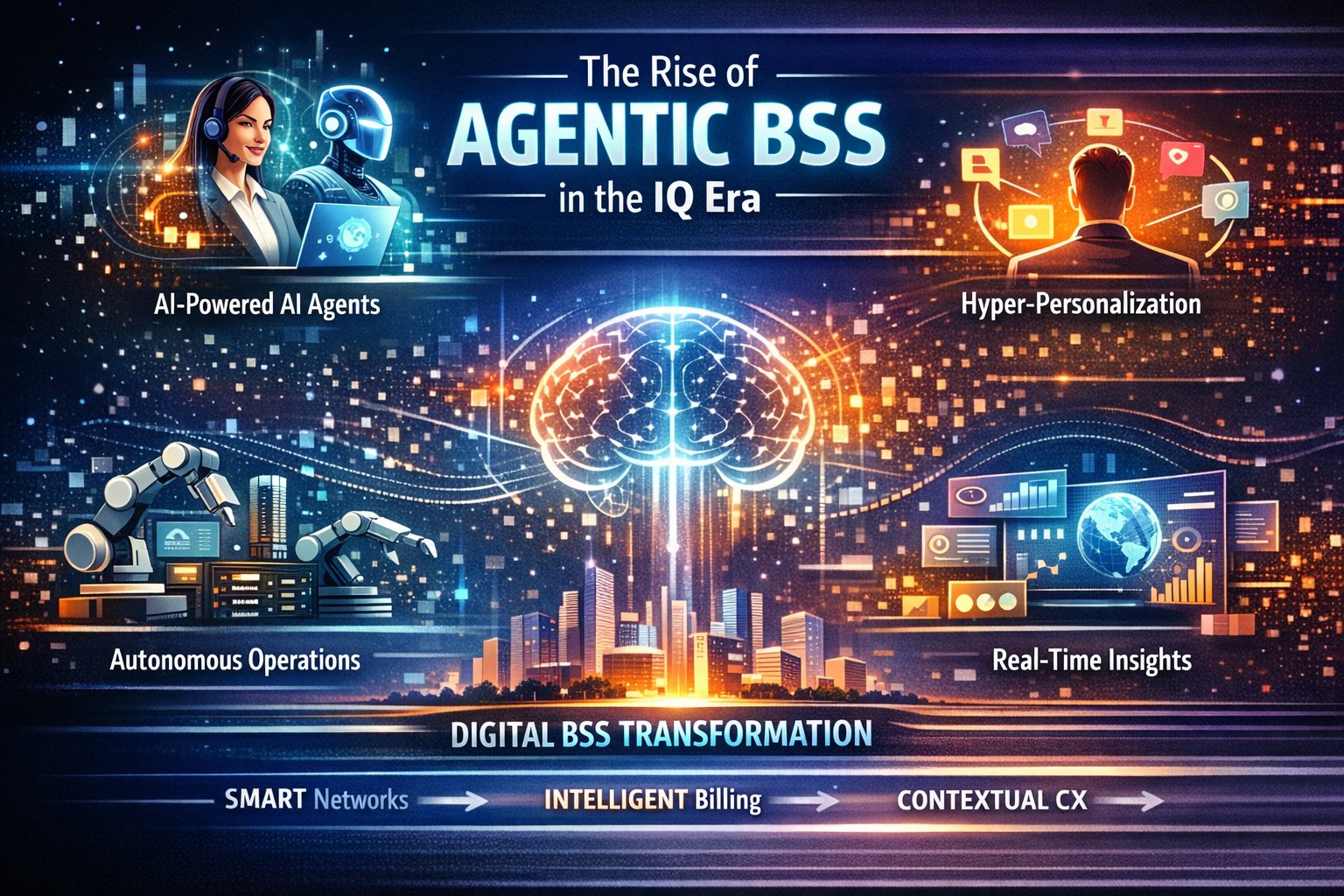
The telecom industry's Business Support Systems (BSS)—the commercial backbone governing service delivery, billing, and customer management—are undergoing their most significant transformation since the advent of digital billing. As networks evolve into programmable infrastructures and customer expectations demand real-time personalization, legacy BSS architectures built for linear workflows are hitting operational limits. This shift is propelled by agentic AI, which transforms BSS from passive systems of record into active systems of outcome.
Why Traditional BSS Reached Its Limits
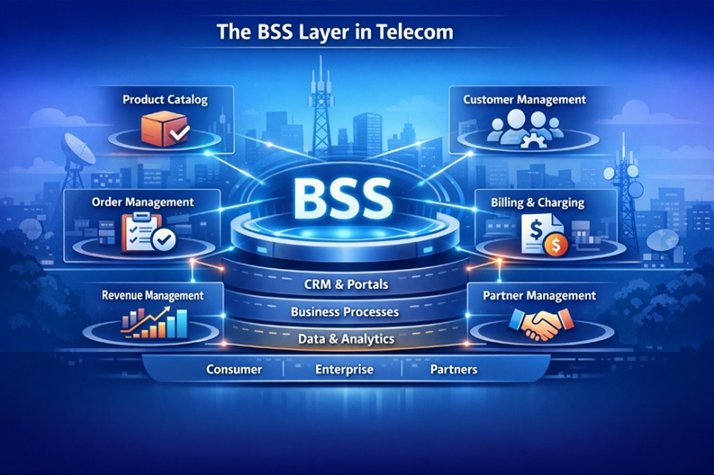
Telecom BSS handles mission-critical functions: product catalog management, order orchestration, charging, billing, partner settlement, and customer lifecycle operations. Its complexity stems from inherent industry challenges:
- Tightly coupled processes across sales, fulfillment, and assurance
- Massive transaction volumes requiring real-time processing
- Regulatory demands for financial precision
- Multi-vendor stacks accumulated over decades
These constraints create operational friction—slow product launches, high overhead costs, and fragmented customer experiences persist despite modernization efforts. Legacy systems lack the architecture for continuous optimization or autonomous decision-making.
Five Agentic BSS Use Cases Reshaping Telecom
Agentic BSS deploys goal-driven AI agents that operate across domains rather than within isolated applications:
Autonomous Quote-to-Order Orchestration: Agents interpret customer intent, validate eligibility, configure products, and resolve exceptions in real-time. For example, T-Mobile US uses AI agents as retail copilots, reducing transaction times by guiding associates through complex workflows.
Intelligent Revenue Assurance: Agents monitor usage patterns and billing anomalies, initiating corrective actions before revenue leakage occurs.
Adaptive Pricing Optimization: Agents analyze demand signals to dynamically adjust bundles and promotions based on market conditions.
Proactive Customer Lifecycle Management: Agents predict churn risks and trigger personalized retention actions across channels.
Partner Ecosystem Automation: Agents manage B2B2X partner onboarding, settlement, and disputes at machine speed.
Microsoft Copilot Studio: The Orchestration Layer
Microsoft Copilot Studio enables enterprises to build, govern, and scale agentic workflows:
- Design goal-oriented agents that reason across BSS domains
- Securely connect to enterprise systems via APIs and connectors
- Deploy agents across channels including Microsoft Teams
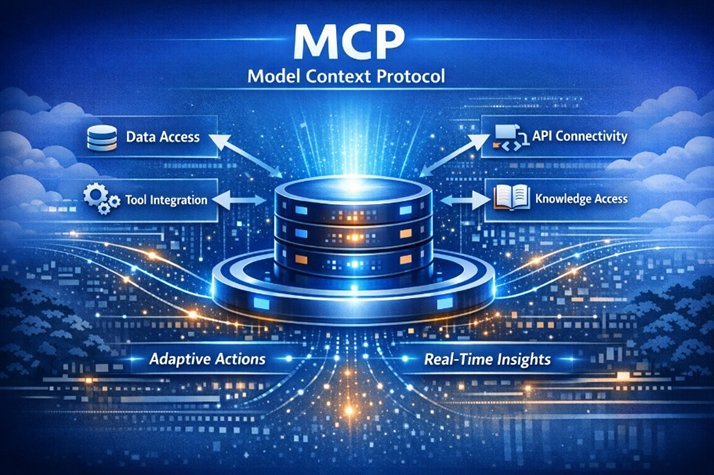
Critical to this architecture is the Model Context Protocol (MCP), which allows agents to dynamically discover and interact with external tools and APIs. MCP eliminates brittle point-to-point integrations, automatically adapting as backend systems evolve. As noted in the TM Forum's analysis, MCP is becoming "a foundational requirement for telecom AI-driven automation."
Standardization Through TM Forum Open APIs
Interoperability is achieved through TM Forum Open APIs, which provide standardized interfaces for customer, product, and billing domains. Microsoft has demonstrated how Copilot Studio accelerates Open API adoption:
- Agents invoke TM Forum APIs via MCP-enabled connectors
- Decoupling from vendor-specific implementations
- Reducing boilerplate code for faster deployment
Vendor Ecosystem Integration
Leading BSS platforms integrate with Copilot Studio via APIs or MCP servers, including:
- Netcracker Digital BSS
- Oracle Communications BSS
- Amdocs Optima
- Ericsson Charging
This allows CSPs to layer agentic capabilities atop existing investments without platform replacement.
Real-World Implementation: Exos Systems Partnership
In collaboration with Exos Systems, Microsoft built an agentic BSS platform demonstrating three core agents:
- Product Expert: Conversational product catalog access
- Billing Expert: Bill anomaly resolution for CSR
- Order Expert: Autonomous failed-order remediation
As Exos Systems CTO Saleh Bari notes: "With Copilot Studio, telcos turn industry standards into intelligent experiences in days rather than months." Detailed implementation insights are available in Exos Systems' technical blog.
Hands-On Deployment at Mobile World Congress
At MWC 2026, Microsoft hosted "Build Your Own Agent" workshops where participants created billing analysis agents in under 45 minutes using Copilot Studio. Attendees deployed agents that:
- Detected usage anomalies
- Predicted churn risks
- Generated role-specific reports
The workshop demonstrated low-code agent development grounded in real telecom data.
Strategic Implications
Agentic BSS doesn't replace existing platforms—it elevates them. By integrating Copilot Studio with TM Forum APIs and MCP, CSPs gain:
- 80%+ reduction in integration maintenance
- Real-time commercial decision-making
- Accelerated innovation cycles
As networks evolve toward 5G/6G and IoT scalability, this architectural shift transforms BSS from cost centers into value generators. The era of passive record-keeping has ended; intelligent outcome systems now drive telecom competitiveness.
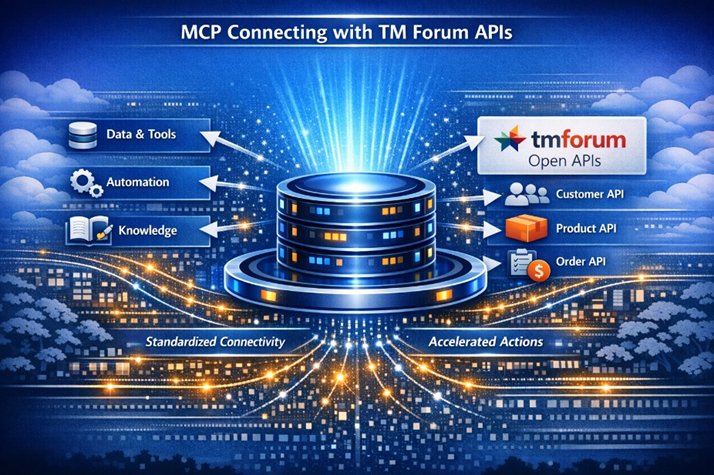
Image credits: Microsoft Tech Community
Comments
Please log in or register to join the discussion