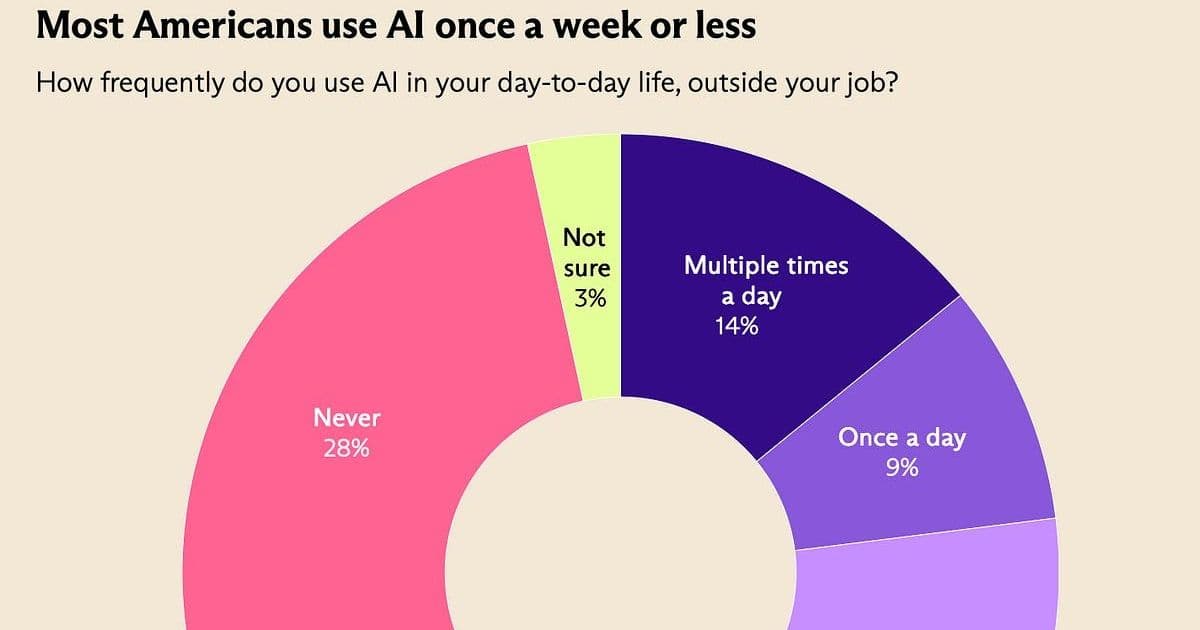
Multiple studies converge on the same finding: AI use in America splits roughly into thirds, contradicting the 'everyone is using AI for everything' narrative that dominates tech media.
 )
)
No, everyone is not using AI for everything. That premise, which has become a fixture of tech media coverage, doesn't hold up against the actual data.
The notion crystallized last year when The New York Times Magazine ran an A.I. issue with an introduction titled "Everyone Is Using A.I. for Everything. Is That Bad?" The piece, an edited transcript from the Hard Fork podcast, rests on two assumptions that are proving false: that people who try AI use it for everything, and that most people have tried it. Neither is true.
The reality is closer to "some people are using AI for some things," and a growing body of research supports this more measured picture.
The Numbers Tell a Different Story
Take Generation Z, the demographic with the highest AI awareness. Even as AI tools have supposedly improved significantly over the past year, Gen Z adoption has essentially plateaued, with a meaningful segment still using AI rarely or never. Gallup's year-over-year polling (2025/2026) shows:
- 79/81% use AI at least rarely
- 41/42% are anxious about AI
- 32/31% use AI only monthly or every few months
- 22/31% are angry about AI
- 21/19% never use AI
Microsoft's newly launched United States AI Diffusion site, built on anonymized, aggregated telemetry data, reinforces this picture. The associated blog reports that more than 30 percent of the US working-age population is using AI, up just 3 percentage points from the end of 2025. The underlying academic paper defines usage as engagement with major AI services including ChatGPT, Google Gemini, Anthropic Claude, and Microsoft Copilot with at least 90 minutes of usage time in a given month.
That means roughly 70% of working-age Americans are not using AI by that measure.
The Microsoft data aligns with a Datos study from last year based on real-world usage data. That research found only 21% of desktop devices visited AI tools 10 or more times per month, while 62% visited zero times. A Searchlight Institute study found 58% report using or trying AI, split evenly between fairly regular users (30% using it at least a few times monthly) and infrequent users (29% who have tried it but use it monthly or less). The Argument's recent survey found most Americans use AI once a week or less.
Taken together, these data points triangulate to a consistent finding: roughly one third of Americans actively use AI, one third occasionally use it, and one third never use it. This is far from "everyone is using AI for everything."
What's Actually Changing
Perhaps more striking than the adoption rates themselves is what hasn't changed. AI use hasn't shifted substantially in the past six months to a year. The primary shift has been in sentiment, and it's moving in a negative direction. Gallup's Gen Z polling shows anger about AI jumping roughly 40% relative year over year.
The Searchlight study identifies the top three concerns driving this hesitation: job displacement (42%), privacy violations (35%), and the spread of misinformation (33%). These aren't abstract worries. A solid majority of respondents think the government should prioritize creating safety and privacy rules for AI, even if that means the US develops AI more slowly than countries like China.
There's also deep skepticism about AI's actual value. When asked about the overall impact of various technologies on society, AI scored a net positive rating of just +8%, right next to social media at +7% and only better than crypto at -17%. Cell phones, the internet, and solar energy all scored in the mid-to-high +60s.
The Argument study drilled into specific societal benefits from AI and found broad skepticism, concluding that people aren't buying the bullish case that CEOs and boosters are selling. Given that many respondents have actually used AI, these aren't uninformed opinions about something they've never seen.
The Meat Consumption Analogy
There's an instructive comparison to be made with how Americans think about and consume meat. Protein is everywhere in health conversations, much like AI dominates tech discourse. Meat remains a primary source of protein, analogous to chat tools being the primary interface for generative AI. Yet American meat consumption preferences break down in ways that might surprise those assuming universal adoption:
- 95% eat meat
- 70% report reducing red meat consumption
- 30% eat meat only rarely or occasionally
- 12% don't eat red meat
- 4% are vegetarian
- 1% are vegan
Not everyone eats meat. A majority actively curbs their consumption of red meat. A significant percentage avoid it entirely. People limit their meat consumption for different reasons: health, cost, environment, ethics. These map directly to AI concerns: health (job displacement), cost (subscription fees), environment (energy consumption), ethics (privacy, bias).
The analogy illuminates market opportunities. Companies can appeal to people across the adoption continuum by addressing their specific concerns. DuckDuckGo, for instance, makes all AI features optional and offers duck.ai as a private chatbot alternative that addresses privacy concerns. In meat consumption terms, they're a restaurant offering everything from healthy meat dishes to vegetarian and vegan options.
What This Means for the AI Industry
The gap between the media narrative and reality matters. Companies, pundits, and policymakers who ignore how people actually feel and act about AI are making a mistake. The adoption pattern isn't binary. It's a continuum of opinions and usage, with substantial numbers of people in the middle who have tried AI and decided to limit their use.
This doesn't mean the one-third occasional usage pattern is permanent. The AI landscape is changing rapidly, and both product evolution and regulation could shift the picture. AI tools might become more genuinely useful to the average person. Regulations might address the concerns that are holding people back.
But right now, a meaningful percentage of the population has evaluated the current state of AI and made a deliberate choice to use it sparingly or not at all. That's not a temporary blip or a failure of education. It's a rational response to products that haven't yet delivered enough value to overcome legitimate concerns.
The tech industry would do well to take this seriously rather than assuming adoption is inevitable and universal. The meat industry didn't ignore the shift toward reduced consumption. The AI industry shouldn't ignore the substantial portion of the population that's opting out.
 )
)
Comments
Please log in or register to join the discussion