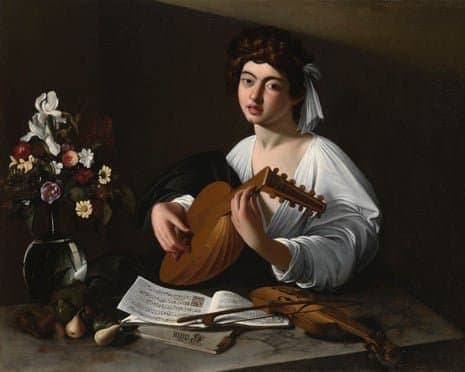
Artificial intelligence has identified a £71,000 painting previously dismissed by experts as a mere copy to be an authentic Caravaggio with 85.7% probability. The breakthrough analysis by Art Recognition overturns decades of art historical consensus, revealing how machine learning is revolutionizing authentication in high-stakes art markets.
For centuries, the art world relied on the discerning eyes of scholars and provenance papers to authenticate masterpieces. Now, artificial intelligence is entering the connoisseur’s gallery, delivering verdicts that challenge established expertise. In a stunning development, AI analysis has determined that The Lute Player from Badminton House – sold by Sotheby’s in 2001 for £71,000 as merely from the "circle of Caravaggio" – is highly likely (85.7% probability) to be an authentic work by the revolutionary 17th-century master Michelangelo Merisi da Caravaggio himself.
The Algorithmic Connoisseur The analysis was conducted by Swiss firm Art Recognition, which specializes in using AI for art authentication. Their system, developed in collaboration with researchers including those from Liverpool University, employs deep learning algorithms trained on high-resolution images of verified works by an artist. The AI scrutinizes minute details of brushwork, texture, pigment application, and compositional elements – aspects often imperceptible to the human eye – comparing them against the artist's known corpus.
"Everything over 80% is very high," stated Dr. Carina Popovici, head of Art Recognition, underscoring the significance of the 85.7% probability score for the Badminton House Lute Player. This result starkly contrasts with the AI's analysis of the long-favored Wildenstein collection version of the same subject, which returned a "negative result" for authenticity.
Overturning Decades of Scholarship The finding upends decades of art historical opinion:
- 1969: Sotheby's sold the Badminton painting as a copy "after Caravaggio" for £750.
- 1990-2013: The Metropolitan Museum of New York displayed the Wildenstein version as an original, with its then-head of European paintings, Keith Christiansen, explicitly dismissing the Badminton version as a copy. In a 2007 letter, Christiansen wrote, "No one – certainly no modern scholar – has ever or ever would entertain the idea that your painting could be painted by Caravaggio."
- 2001: Sotheby's upgraded its attribution slightly to "circle of Caravaggio" but still sold it for a fraction of the value commanded by verified Caravaggios (one discovered in 2019 was valued around £96m).
British art historian Clovis Whitfield, who purchased the Badminton painting in 2001 with collector Alfred Bader precisely because he believed it to be authentic, hailed the AI result. "The AI result knocks Mr Christiansen off his perch," Whitfield stated, criticizing some scholars as "a bit stuck in the traditional mud." He noted the painting's details matched a 1642 description in Giovanni Baglione's Caravaggio biography, including "minutely observed details such as the reflection on dew drops on the flowers."
Technical Evidence and Broader Implications Supporting evidence extends beyond the AI analysis. David Van Edwards, president of the Lute Society, identified technical inaccuracies in the lute depicted in the Wildenstein version, unlike the meticulously rendered instruments in the Badminton and Hermitage (Russia) versions. William Audland KC, analyzing the case forensically, concluded, "A holistic view of the relevant evidence points to the opposite conclusion [of traditional scholarship], one which has now been corroborated by AI analysis, which is objective, unlike the subjective opinions of scholars which can get in the way."
{{IMAGE:4}}
A New Era for Art Authentication This case signals a profound shift:
- Challenging Subjectivity: AI provides a data-driven, reproducible method to counter potential biases or entrenched views within traditional art scholarship.
- Democratizing Expertise: Access to sophisticated authentication tools could extend beyond major institutions.
- High-Stakes Impact: The financial implications are enormous, transforming a £71k "copy" into a potential nine-figure masterpiece overnight. Whitfield hopes it will find a home in a public collection.
- Unlocking Hidden Gems: This success suggests AI could help rediscover other misattributed works languishing in obscurity.
While Sotheby's co-chair George Gordon maintained that their 2001 assessment remains valid within the context of Caravaggio scholarship at the time, the AI's objective analysis injects a powerful new variable into the authentication equation. As the Badminton Lute Player awaits its final chapter – potentially featured in an upcoming podcast and documentary – its journey from dismissed copy to AI-authenticated masterpiece underscores how machine learning is irrevocably altering the landscape of art history, attribution, and the very definition of expertise. The algorithms aren't replacing connoisseurship; they are forcing it to evolve, armed with new, irrefutable data.
Comments
Please log in or register to join the discussion