An OpenAI model has achieved a remarkable breakthrough in mathematics, disproving an 80-year-old conjecture in discrete geometry. The solution demonstrates how AI can connect disparate mathematical fields and solve long-standing problems, marking a significant milestone in AI-assisted research.
The intersection of artificial intelligence and pure mathematics has yielded one of the most significant research breakthroughs in recent memory. An OpenAI model has autonomously disproved a central conjecture in discrete geometry that has puzzled mathematicians since Paul Erdős first posed it in 1946. This achievement represents not just a solution to a specific problem, but a demonstration of how AI systems can now engage in deep mathematical reasoning, connect seemingly unrelated fields, and contribute to frontier research in ways that extend beyond mere assistance to human mathematicians.
The problem in question, known as the planar unit distance problem, asks a deceptively simple question: if you place n points in the plane, what is the maximum number of pairs of points that can be exactly distance 1 apart? Despite its elementary formulation, this question has resisted definitive resolution for decades. As noted in the 2005 book "Research Problems in Discrete Geometry," it stands as "possibly the best known (and simplest to explain) problem in combinatorial geometry." Noga Alon, a leading combinatorialist at Princeton, describes it as "one of Erdős' favorite problems," and the mathematician himself offered a monetary prize for its resolution.
For nearly 80 years, the prevailing belief among mathematicians was that "square grid" constructions provided essentially optimal configurations for maximizing unit-distance pairs. The best known construction, derived from a rescaled square grid, achieved a growth rate of n^(1+C/log log n) for some constant C. This represents only slightly faster than linear growth, as the additional term in the exponent tends to zero as n increases. Erdős conjectured an upper bound of n^(1+o(1)), where the o(1) indicates a term that diminishes to zero as n grows.
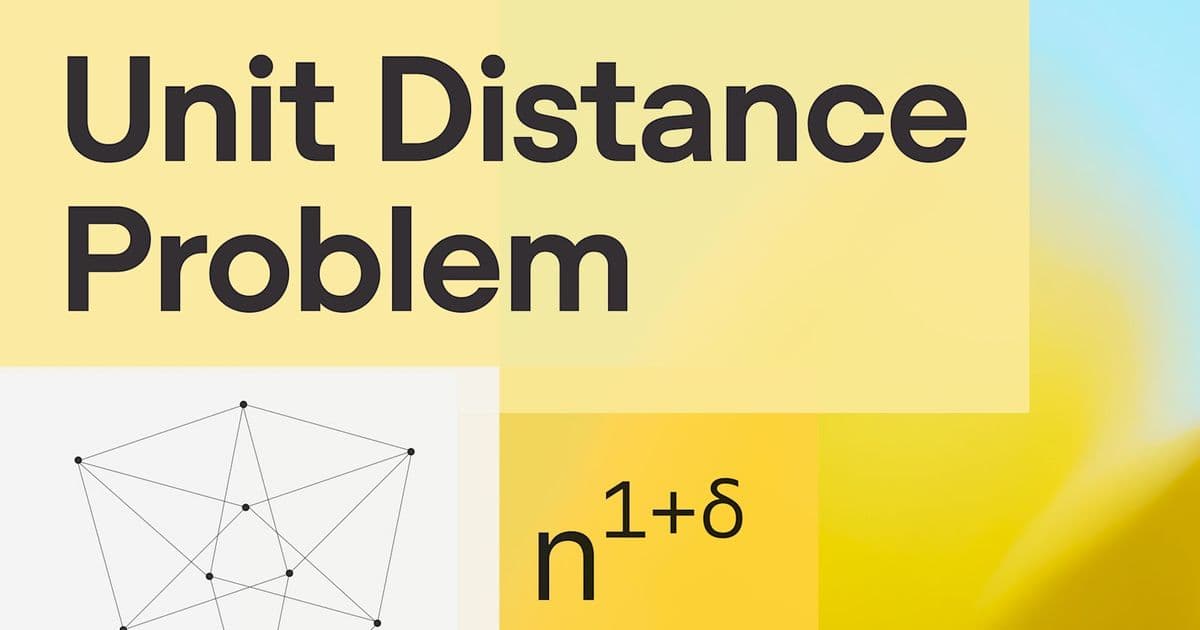
The OpenAI model's contribution was to disprove this long-standing conjecture by constructing, for infinitely many values of n, configurations achieving n^(1+δ) unit-distance pairs for some fixed δ > 0. While the original AI proof did not specify an explicit value for δ, a subsequent refinement by Princeton mathematics professor Will Sawin established that one can take δ = 0.014.

What makes this result particularly remarkable is not just the solution itself, but the method by which it was achieved. The proof emerged from a general-purpose reasoning model rather than from a system specifically trained for mathematics or targeted at the unit distance problem. This suggests a broader capability in AI systems to tackle diverse research challenges across different domains.
The mathematical innovation lies in the unexpected application of sophisticated concepts from algebraic number theory to a geometric question. Erdős's original lower bound could be understood through the Gaussian integers—numbers of the form a + bi, where a and b are integers and i is the square root of -1. The Gaussian integers extend the ordinary integers and possess properties like unique factorization into primes.
The new argument replaces the Gaussian integers with more complex generalizations from algebraic number fields that have richer symmetries, enabling the creation of many more unit-length differences. The proof employs advanced tools such as infinite class field towers and Golod-Shafarevich theory to demonstrate the existence of the number fields required for the argument. These concepts, while familiar to algebraic number theorists, had not previously been applied to geometric questions in the Euclidean plane.
The significance of this breakthrough extends beyond the specific mathematical result. It represents the first time that a prominent open problem central to a subfield of mathematics has been solved autonomously by AI. As Fields medalist Tim Gowers notes in the companion paper, this is "a milestone in AI mathematics." Leading number theorist Arul Shankar goes further, stating that the paper "demonstrates that current AI models go beyond just helpers to human mathematicians – they are capable of having original ingenious ideas, and then carrying them out to fruition."
The verification process adds another layer of significance. After the initial proof was produced, it was examined by a group of external mathematicians who not only confirmed its validity but also wrote a companion paper explaining the argument and providing broader context. This collaborative process highlights how AI can serve as a catalyst for mathematical discovery, with human mathematicians building upon and enriching AI-generated insights.
The unexpected connection between algebraic number theory and discrete geometry revealed by this solution is particularly noteworthy. As Thomas Bloom writes in the companion note, the result "shows that there is a lot more that number theoretic constructions have to say about these sorts of questions than we suspected; moreover, that the number theory required can be very deep." This suggests that the AI has not only solved a specific problem but has uncovered a bridge between mathematical domains that may lead to further discoveries.

The implications for mathematics research are profound. The AI's success suggests that these systems can identify and exploit connections between seemingly disparate areas of mathematics, potentially accelerating discovery across multiple fields. As Bloom observes, "The frontiers of knowledge are very spiky, and no doubt the coming months and years will see similar successes in many other areas of mathematics, where long-standing open problems are resolved by an AI revealing unexpected connections and pushing the existing technical machinery to its limit."
Beyond mathematics, this achievement offers insights into the broader trajectory of AI research. The ability to maintain complex reasoning, connect ideas across different domains, and produce work that withstands expert scrutiny are precisely the capabilities needed for advanced research in fields like biology, physics, materials science, engineering, and medicine. This represents a step toward more automated research systems that can help scientists and engineers explore a wider range of ideas and pursue more complex technical questions.
The result also speaks to evolving forms of human-AI collaboration. Rather than replacing human mathematicians, AI systems are emerging as partners that can expand the boundaries of what's possible. As the article notes, "Expertise becomes more valuable, not less. AI can help search, suggest, and verify. People choose the problems that matter, interpret the results, and decide what questions to pursue next."
In conclusion, the OpenAI model's resolution of the Erdős unit distance problem represents a significant milestone in both mathematics and artificial intelligence. It demonstrates that AI systems can engage in deep mathematical reasoning, connect disparate fields, and contribute to frontier research in meaningful ways. As we continue to develop these capabilities, we may witness an acceleration of discovery across multiple scientific domains, with AI serving as both a tool and a catalyst for human ingenuity. The cathedral of mathematics, as Bloom poetically describes it, likely holds many more unseen wonders waiting to be discovered through this emerging collaboration between human insight and artificial intelligence.
Comments
Please log in or register to join the discussion