As AI transitions from experimental technology to workplace necessity, organizations must develop comprehensive AI fluency strategies. This analysis examines Microsoft's approach to democratizing AI skills across departments and provides actionable frameworks for implementation.
The technological landscape has reached a pivotal moment where AI has moved from being a specialized tool to becoming the fundamental navigation system for modern work. Much like the shift from printed directions to GPS, organizations now face the imperative to adopt AI not as an optional enhancement but as core infrastructure for operational efficiency and competitive advantage.
The Evolution of AI in the Workplace
Two years ago, AI remained largely in the realm of specialized teams and experimental projects. Today, it has permeated every organizational function, becoming the default method for navigating complex workflows and orchestrating resources. This transformation mirrors the GPS revolution in personal navigation—where real-time guidance and dynamic rerouting replaced static, pre-planned routes.
Crucially, AI augmentation doesn't replace human judgment but eliminates friction points that previously consumed valuable time and cognitive resources. The fundamental question has shifted from "Will AI change work?" to "Are you fluent enough to lead with it?"
Defining AI Fluency in Organizational Context
AI fluency represents the collective ability of an organization to understand and effectively interact with generative AI technologies. This encompasses three critical dimensions:
- Recognition - Identifying appropriate applications where AI can add value and inspiration
- Integration - Incorporating AI into existing workflows and task processes
- Evaluation - Assessing outputs and maintaining appropriate human oversight
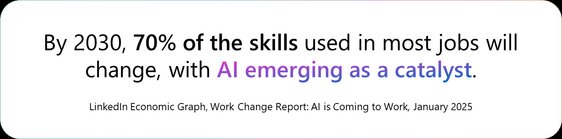
According to the January 2025 LinkedIn Economic Graph Work Change Report, "By 2030, 70% of the skills used in most jobs will change, with AI emerging as a catalyst." This projection underscores the urgency of developing organizational AI capabilities beyond technical teams.
Department-Specific AI Applications
The practical implementation of AI fluency varies significantly across organizational functions:
Marketing Teams
Marketing departments can leverage AI to overcome the blank-page syndrome by transforming campaign briefs from conceptual ideas into structured drafts. AI can generate initial creative concepts, audience targeting suggestions, and content calendars that maintain brand voice while accelerating production timelines.
Sales and Customer-Facing Roles
AI excels at enhancing customer interactions through:
- Automated meeting preparation with synthesized account histories
- Theme extraction from call transcripts to identify emerging customer concerns
- Drafting follow-up communications that maintain personalization while reducing response time
The value proposition extends beyond efficiency to improved customer relationships through more informed and timely engagement.
Financial Operations
Financial teams benefit from AI's ability to translate complex data into actionable narratives. Rather than presenting raw numbers, AI can help explain variances, anticipate questions from leadership, and highlight areas requiring verification before reporting.
Human Resources
HR departments can transform good intentions into clear, actionable language through:
- Job descriptions that accurately reflect role requirements and organizational culture
- Onboarding materials that provide structured guidance without overwhelming new hires
- Analysis of employee feedback themes to identify emerging organizational issues
Operations and Program Management
For professionals coordinating multiple stakeholders, AI can transform chaos into structured information through:
- Automated action tracking with deadline monitoring
- Risk identification and mitigation suggestions
- Status updates that maintain consistency across reporting periods
- Decision logs that preserve institutional knowledge
Legal and Compliance
With appropriate guardrails, AI can assist legal teams by:
- Triage and categorization of large document sets
- Identification of inconsistencies across contracts
- Summarization of regulatory changes
Critical to implementation is understanding that AI assists but doesn't replace legal judgment—particularly in areas requiring nuanced interpretation of regulations and case law.
Microsoft's AI Fluency Framework
Microsoft has developed a structured approach to organizational AI adoption centered on practical implementation rather than theoretical knowledge. Their framework emphasizes starting with familiar workflows before expanding into more complex applications.
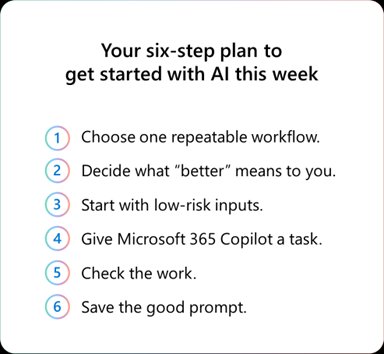
The six-step implementation plan provides organizations with a pragmatic approach to AI adoption:
- Identify a repeatable workflow - Begin with weekly tasks like meeting preparation or status updates
- Define improvement metrics - Determine what "better" means: faster output, greater clarity, reduced revisions
- Start with low-risk inputs - Use public information or internal notes while building confidence
- Assign clear context to AI tools - Provide specific goals, context, sources, and format requirements
- Implement verification protocols - Establish fact-checking processes for names, numbers, and sensitive information
- Create a prompt library - Save effective prompts for reuse and refinement
This approach recognizes that AI adoption succeeds through incremental improvements rather than revolutionary overhauls. The emphasis on verification and human oversight addresses the critical balance between leveraging AI capabilities and maintaining accountability.
AI Skills Navigator as a Learning Infrastructure
Microsoft's AI Skills Navigator represents a significant advancement in organizational learning infrastructure. This agentic learning space addresses the diverse learning needs across modern organizations through:
- Flexible learning formats - Short videos, AI-generated podcasts, quick summaries, and guided sessions
- Role-specific pathways - Curated learning experiences tailored to different functions
- Just-in-time learning - Bite-sized content that fits into existing workflows
- Continuous adaptation - Learning modules that evolve with both technology and organizational needs
The platform's effectiveness lies in its recognition that AI fluency develops through consistent, small-scale applications rather than intensive training programs. By making learning accessible and relevant to daily tasks, organizations can build sustainable AI capabilities without disrupting existing operations.

Implementation Considerations for Organizations
Developing organizational AI fluency requires careful consideration of several factors:
Change Management Strategies
Successful AI adoption depends on addressing both technological and cultural barriers. Organizations should:
- Identify and empower AI champions within departments
- Create safe spaces for experimentation and learning
- Recognize and reward AI-enhanced workflows
- Address concerns about job transformation through transparent communication
Governance and Risk Management
Organizations must establish clear policies regarding:
- Data privacy and security protocols
- AI output verification requirements
- Ethical guidelines for AI applications
- Compliance with industry-specific regulations
Measuring ROI on AI Fluency
Unlike traditional technology investments, AI fluency returns manifest across multiple dimensions:
- Productivity improvements in specific workflows
- Enhanced decision quality through data synthesis
- Employee satisfaction through reduced repetitive tasks
- Innovation capacity through accelerated ideation processes
Organizations should develop balanced scorecards that track both quantitative metrics (time saved, output volume) and qualitative indicators (decision quality, innovation frequency).
Future-Proofing the Workforce
The transition to AI-augmented operations represents a fundamental shift in how organizations create value. As AI becomes increasingly integrated into core business processes, organizations that prioritize AI fluency will gain significant competitive advantages through:
- Faster adaptation to market changes
- Improved decision-making capabilities
- Enhanced employee engagement through meaningful work
- Greater innovation capacity
The journey to AI fluency begins not with technological implementation but with mindset shift—from viewing AI as a replacement for human workers to seeing it as a collaborative tool that amplifies human capabilities.
For organizations seeking to begin this journey, the most effective approach mirrors the GPS revolution: start with small, practical applications that deliver immediate value while building the foundation for more sophisticated implementations. The organizations that thrive in the AI-augmented future will be those that recognize AI fluency not as an IT initiative but as a fundamental transformation of how work gets done.
Comments
Please log in or register to join the discussion